CHAPTER 11: WARDS
10.02 Interpretation
10.03 Application To Future Ordinances
10.04 Construction Of Code
10.05 Rules Of Interpretation; Definitions
10.06 Severability
10.07 Reference To Other Sections
10.08 Reference To Offices; Name Designations
10.09 Errors And Omissions
10.10 Reasonable Time
10.11 Repeal Or Modification Of Code Section
10.12 Limitation Periods
10.13 Ordinances Unaffected
10.14 Ordinances Which Amend Or Supplement Code
10.15 Section Histories; Statutory References
10.16 Preservation Of Penalties, Offenses, Rights And Liabilities
10.17 Publication
10.18 Posting
10.19 Effective Date
10.20 Ordinance Books
10.21 Destruction Of Records
10.99 General Penalty
All ordinances of a permanent and general nature of the city, as revised, codified, rearranged, renumbered, and consolidated into component codes, titles, chapters, and sections, shall be known and designated as the “Choteau City Code,” for which designation “code of ordinances,” “codified ordinances,” or “code” may be substituted. Code title, chapter, and section headings do not constitute any part of the law as contained in the code.
Unless otherwise provided herein, or by law or implication required, the same rules of construction, definition, and application shall govern the interpretation of this code as those governing the interpretation of state law.
All provisions of Title I compatible with future legislation shall apply to ordinances hereafter adopted amending or supplementing this code unless otherwise specifically provided.
- This code is a codification of previously existing laws, amendments thereto, and newly enacted laws. Any previously existing law or amendment thereto reenacted by this code shall continue in operation and effect, as if it had not been repealed by this code. All rules and regulations adopted under laws reenacted in this code shall remain in full force and effect unless repealed or amended subsequent to the enactment of this code.
- Any appropriation repealed and reenacted by this code is continued only for the period designated in the original enactment of that appropriation.
- The numerical order and position of sections in this code does not resolve a conflict between two or more sections.
- Any irreconcilable conflict between sections shall be resolved by reference to the dates that the sections were originally enacted. The section most recently enacted supersedes any conflicting section or division.
- All references within a section of this code to any section of previously existing laws refer to the numbers in the original enactment.
- The numerical designations and descriptive headings assigned to the various titles, chapters, subchapters, or sections of this code, as originally enacted or as added by amendment, are not law, and may be altered by the compilers of this or any subsequent codification, in any official publication, to more clearly indicate its content. These descriptive headings are for organizational purposes only and do not affect the meaning, application, or construction of the law they precede.
- Each note following a section of this code is for reference purposes only and is not a part of the section.
- All references to any section of this code refer to all subsequent amendments to that section, unless otherwise provided.
- Rules of interpretation. This code shall be construed by the following rules unless the construction is plainly repugnant to the legislative intent or context of the provision.
- Words and phrases shall be taken in their plain, ordinary, and usual sense. Technical words and phrases having a peculiar and appropriate meaning in law shall be understood according to their technical import.
- Words imputing joint authority to three or more persons shall be construed as imputing authority to a majority of the persons, unless otherwise declared in the section giving the authority.
- Where a section requires an act to be done which, by law, an agent or deputy may perform in addition to the principal, the performance of the act by an authorized deputy or agent is valid.
- Words denoting the masculine gender shall be deemed to include the feminine and neuter genders; words in the singular shall include the plural, and words in the plural shall include the singular; the use of a verb in the present tense shall include the future, if applicable.
- Definitions. For the purpose of this code of ordinances, the following definitions shall apply unless the context clearly indicates or requires a different meaning.
AGENT. A person acting on behalf of another.
CITY. The City of Choteau, Montana.
CITY CLERK. The City Clerk of the city.
CITY COUNCIL. The City Council.
CODE. Unless otherwise specifically stated shall mean this code.
COUNTY. Teton County, Montana.
EMPLOYEES. Whenever reference is made in this code to a city employee by title only, this shall be construed as though followed by the words “of the city.”
FEE. A sum of money charged by the city for the carrying on of a business, profession, or occupation.
HIGHWAY. Includes bridges, roads, and streets, unless otherwise expressly provided.
KNOWINGLY. Imports only a knowledge that the facts exist which brings the act or omission within the provisions of this code. It does not require any knowledge of the unlawfulness of such act or omission.
LICENSE. The permission granted for the carrying on of a business, profession, or occupation.
MISDEMEANOR. Any offense deemed a violation of the provisions of this code which is a lesser offense than a felony as defined by state law.
MONTH. One calendar month.
NEGLECT, NEGLIGENT, NEGLIGENCE, or NEGLIGENTLY. A want of such attention to the nature or probable consequences of the act or omission as a prudent person ordinarily bestows in acting in his or her own concern.
NUISANCE. Anything offensive or obnoxious to the health and welfare of the inhabitants of the city; or any act or thing repugnant to, or creating a hazard to, or having a detrimental effect on the property of, another person or to the community.
OCCUPANT. As applied to a building or land, includes any person who occupies the whole or any part of such building or land whether alone or with others.
OFFENSE. Any act forbidden by any provision of this code or the omission of any act required by the provisions of this code.
OFFICERS. Whenever reference is made in this code to a city officer by title only, shall be construed as though followed by the words of the city.
OPERATOR. The person who is in charge of any operation, business, or profession.
OWNER. As applied to a building or land, includes any part owner, joint owner, tenant in common, or joint tenant or lessee of the whole or of a part of such building or land.
PERSON. Includes the singular and the plural and shall also mean and include any person, firm, corporation, association, partnership, or any other form of association or organization.
PERSONAL PROPERTY. Includes every description of money, goods, chattels, effects, evidence of rights in action, and all written instruments by which any pecuniary obligation, right, or title to property is created, acknowledged, transferred, increased, defeated, discharged, or diminished and every right or interest therein.
PRECEDING and FOLLOWING. When referring to sections or divisions in this code, refer to the sections or divisions next following or next preceding that in which the words occur, unless some other section is designated.
RETAILER. Unless otherwise specifically defined, shall be understood to relate to the sale of goods, merchandise, articles, or things in small quantities direct to the consumer.
STATE. The State of Montana.
STREET. Includes alleys, lanes, courts, boulevard, public ways, public square, public places, and sidewalks.
TENANT. As applied to a building or land, includes any person who occupies the whole or any part of such building or land whether alone or with others.
WHOLESALER or WHOLESALE DEALER. As used in this code unless otherwise specifically defined, shall be understood to relate to the sale of goods, merchandise, articles, or things in quantity to persons who purchase for the purpose of resale.
WILLFULLY. When applied to the intent with which an act is done or omitted, implies simply a purpose or willingness to commit the act or make the omission referred to. It does not require any intent to violate law, or to injure another, or to acquire an advantage.
WRITTEN and IN WRITING. Include printing, lithographing, or other modes of representing words and letters. Where the written signature of a person is required, the terms mean the proper handwriting of the person, or the person’s mark.
YEAR. One calendar year, unless otherwise expressly provided.
(Old Code, § 1-3-1)
- If any section of this code now enacted or subsequently amended or its application to any person or circumstances is held invalid, the invalidity does not affect other sections that can be given effect without the invalid section or application.
- Except in the case of a section or amendment to this code containing a nonseverability provision, each division or part of every section is severable. If any portion or application of a section is held invalid, the invalidity does not affect the remainder of the section unless:
- The remainder is so essentially and inseparably connected with and so dependent upon the invalid provision or application that it cannot be presumed that the remainder would have been enacted without the invalid provision or application; or
- The remainder is incomplete and incapable of being executed in accordance with the legislative intent without the invalid provision or application.
- This section applies to every section of this code regardless of whether a section was enacted before or after the passage of this code.
- The repeal of a section or amendment stating that the provisions of a chapter, subchapter, or section are severable as provided in division (B) above does not affect the operation of division (B) with respect to that chapter, subchapter, or section.
Whenever in one section reference is made to another section hereof, the reference shall extend and apply to the section referred to as subsequently amended, revised, recodified, or renumbered unless the subject matter is changed or materially altered by the amendment or revision.
- Reference to offices. Reference to a public office or officer shall be deemed to apply to any office, officer, or employee of this municipality exercising the powers, duties, or functions contemplated in the provision, irrespective of any transfer of functions or change in the official title of the functionary.
- Name designations. Whenever any ordinance or resolution of the Council refers to any board, bureau, commission, division, department, officer, agency, authority, or instrumentality of any government, and that name designation is incorrectly stated; on the effective date of that ordinance or following the effective date, the rights, powers, duties, or liabilities placed with that entity are or were transferred to a different entity; then the named board, bureau, commission, department, division, officer, agency, authority, or instrumentality, whether correctly named in the ordinance at its effective date or not, means that correctly named entity, or the entity to which the duties, liabilities, powers, and rights were transferred.
If a manifest error is discovered, consisting of the misspelling of any words; the omission of any word or words necessary to express the intention of the provisions affected; the use of a word or words to which no meaning can be attached; or the use of a word or words when another word or words was clearly intended to express the intent, the spelling shall be corrected and the word or words supplied, omitted, or substituted as will conform with the manifest intention, and the provisions shall have the same effect as though the correct words were contained in the text as originally published. No alteration shall be made or permitted if any question exists regarding the nature or extent of the error.
- In all cases where an ordinance requires an act to be done in a reasonable time or requires reasonable notice to be given, REASONABLE TIME OR NOTICE shall be deemed to mean the time which is necessary for a prompt performance of the act or the giving of the notice.
- The time within which an act is to be done, as herein provided, shall be computed by excluding the first day and including the last. If the last day be a Saturday, Sunday, or a state holiday, it shall be excluded.
When a section of this code is repealed which repealed a former section or law adopted prior to the enactment of this code, the former section or law is not revived unless it so expressly provides. The repeal of any section shall not extinguish or release any penalty, forfeiture, or liability incurred under the section, unless the repealing section so expressly provides. The section shall be treated as still remaining in force for the purposes of sustaining any proper action or prosecution for the enforcement of the penalty, forfeiture, or liability.
The running of any period of limitations or any requirement of notice contained in any law, whether applicable to civil causes or proceedings, or to the prosecution of offenses, or for the recovery of penalties and forfeitures, contained in a law repealed and reenacted by this code, shall not be affected by the repeal and reenactment; but all suits, proceedings, and prosecutions for causes arising or acts committed prior to the effective date of this code may be commenced and prosecuted with the same effect as if this code had not been enacted.
All ordinances of a temporary or special nature and all other ordinances pertaining to subjects not embraced in this code shall remain in full force and effect unless herein repealed expressly or by necessary implication.
- If the legislative body shall desire to amend any existing chapter or section of this code, the chapter or section shall be specifically repealed and a new chapter or section, containing the desired amendment, substituted in its place.
- Any ordinance which is proposed to add to the existing code a new chapter or section shall indicate, with reference to the arrangement of this code, the proper number of the chapter or section. In addition to an indication thereof as may appear in the text of the proposed ordinance, a caption or title shall be shown in concise form above the ordinance.
- As histories for the code sections, the specific number and passage date of the original ordinance, and amending ordinances, if any, are listed following the text of the code section. Example: (Ord. 10, passed 5-13-1960; Ord. 15, passed 1-1-1970; Ord. 20, passed 1-1-1980; Ord. 25, passed 1-1-1985)
- If a statutory cite is included in the history, this indicates that the text of the section reads substantially the same as the statute. Example: (MCA § 36-5-2-2)
- If a statutory cite is set forth as a “statutory reference” following the text of the section, this indicates that the reader should refer to that statute for further information. Example: § 39.01 PUBLIC RECORDS AVAILABLE. This city shall make available to any person for inspection or copying all public records, unless otherwise exempted by state law. Statutory reference: Inspection of public records, see MCA § 11-1102
- If a section of this code is derived from the previous code of ordinances of the city published in 20xx and subsequently amended, the previous code section number shall be indicated in the history by “(Prior Code, § ____).”
All offenses committed under laws in force prior to the effective date of this code shall be prosecuted and remain punishable as provided by those laws. This code does not affect any rights or liabilities accrued, penalties incurred, or proceedings begun prior to the effective date of this code. The liabilities, proceedings, and rights are continued; punishments, penalties, or forfeitures shall be enforced and imposed as if this code had not been enacted. In particular, any agreement granting permission to utilize highway rights-of-way, contracts entered into or franchises granted, the acceptance, establishment, or vacation of any highway, and the election of corporate officers shall remain valid in all respects, as if this code had not been enacted.
All ordinances, bylaws, and resolutions of the city shall be published or posted as required by law.
(Prior Code, § 1-10-1) (Ord. 1, passed 5-5-1913)
All ordinances, bylaws, and resolutions shall be posted for a period of 30 days in three public places, in the city, one of which shall be the city hall, after which they shall be recorded in a book to be kept for that purpose by the City Clerk, who shall append to each ordinance, bylaw, and resolution, when so recorded and posted, over his or her signature, the following certificate: “Posted for 30 days, ____________, City Clerk”, and the record of said ordinance, bylaw, or resolution with said certificate shall be sufficient evidence in any court of the proper, legal publication of said ordinance, bylaw, or resolution.
(Prior Code, § 1-10-2) (Ord. 1, passed 5-5-1913)
All resolutions passed by the City Council shall be immediately effective unless a delayed effective date is specified. No ordinance passed by the City Council shall become effective until 30 days after its passage except general appropriation ordinances providing for the ordinary and current expenses of the city, excepting also, emergency measures and in the case of emergency measures, the emergency must be expressed in the preamble or in the body of an ordinance, as the ordinance must receive two-thirds vote of all the members elected. In emergency ordinances, the resolution shall include only such measures as are immediately necessary for the preservation of peace, health, and safety.
(Prior Code, § 1-10-3) (Ord. 234, passed 11-20-1984)
The book in which said ordinances, bylaws, and resolutions are recorded shall be called the “ordinance book”, shall be kept in the custody of the City Clerk, and shall be open to inspection by the public at all proper times.
(Prior Code, § 1-10-4) (Ord. 1, passed 5-5-1913)
It is hereby declared to be unlawful and a misdemeanor to in any manner to alter, mutilate, or destroy the copy of any ordinance, bylaw, or resolution which has been posted in accordance with the provisions hereof, and any person guilty of a violation of this section shall be deemed guilty of a misdemeanor.
(Prior Code, § 1-10-5) (Ord. 1, passed 5-5-1913) Penalty, see § 10.99
Statutory reference: Generally, see MCA §§ 2-66-1001 et seq. and 7-5-4201
- Generally. Any person convicted of violating any section of this code shall be fined in a sum not to exceed $500 for any one offense and such person may be confined in the municipal jail for a period of not more than six months. Either or both such fine and imprisonment may be imposed.
- License. When a person is convicted of a violation of any section of this code any license previously issued to him or her by the city may be revoked by the court or by the municipal governing body.
- Application. The penalty provided in this section shall be applicable to every section of this code the same as though it were a part of each and every separate section. Any person convicted of a violation of any section of this code, where any duty is prescribed or obligation imposed, or where any act which is of a continuing nature is forbidden or declared to be unlawful, shall be deemed guilty of a misdemeanor. A separate offense shall be deemed committed upon each day during or on which a violation occurs or continues.
(Prior Code, Ch. 1-4) (Ord. 171, passed 5-20-1968; Ord. 196, passed 5-19-1975)
Statutory reference: Generally, see MCA §§ 7-5-4207
11.02 First Ward
11.03 Second Ward
The city is hereby, for election and such other purposes as are or may hereafter be required by law, divided into two wards, to be known respectfully as the first ward and the second ward.
(Prior Code, § 1-5-1) (Ord. 22, passed 2-16-1914)
The first ward shall comprise all that territory within the corporate limits of the city lying to the north of the centerline of 1st Street northwest and 1st Street northeast.
(Prior Code, § 1-5-2) (Ord. 22, passed 2-16-1914)
The second ward shall comprise all that territory within the corporate limits of the city lying to the south of the centerline of 1st Street northwest and 1st Street northeast.
(Prior Code, § 1-5-3) (Ord. 22, passed 2-16-1914)
Statutory reference: Generally, see MCA § 7-5-4401(1)
CHAPTER 31: BOARDS AND COMMISSIONS
CHAPTER 32: CITY COURT
CHAPTER 33: FINANCE AND REVENUE
30.02 City Clerk
30.03 City Clerk-Treasurer
30.04 Fire Chief
The Mayor, by and with the consent of the Council, may appoint any or all of the officers described in MCA § 7-4102.
(Prior Code, § 1-6-1) (Ord. 25, passed 6-29-1944)
The duties of the City Clerk shall be such as are prescribed by MCA § 7-4-4501.
(Prior Code, § 1-6-2) (Ord. 25, passed 6-29-1944)
- The City Clerk-Treasurer shall collect all licenses that may become due, and at the end of each quarter of the fiscal year, and more often if required, prepare and file with the City Clerk-Treasurer a full and complete report for the quarter as to all licenses issued, giving the name of each person paying the license, and the amount paid therefor, and the business in which the same is paid, which report shall be submitted to the City Council at the next regular meeting after said report has been filed.
- When any warrant, drawn upon the City Clerk-Treasurer pursuant to any ordinance, resolution, or direction of the Council, is presented to the City Clerk-Treasurer for payment and is not paid for want of funds, such City Clerk-Treasurer must endorse thereon the words “not paid for want of funds”, annexing the date of presentation and his or her signature, and from that time until the warrant is called in for payment, such warrant shall bear interest at the rate of 6% per annum.
(Prior Code, § 1-6-5) (Ord. 4, passed 5-15-1913; Ord. 25, passed 6-29-1944)
The duties of the Fire Chief shall be such as are prescribed by the statutes of the state, the rules and regulations of the State Fire Marshal, and the various provisions of this code. The Fire Chief shall have supervision of the engine and firefighting apparatus of the city, and the city fire fighters shall be under his or her orders and control. His or her duties as inspector of buildings shall be such as are prescribed by the state laws and the provisions of this code.
(Prior Code, § 1-6-7) (Ord. 25, passed 6-29-1944)
There is hereby created and established a City Tree Board for the city which shall consist of seven members, citizens, and residents of the city, who shall be appointed by the Mayor with approval by the City Council. The members shall come from different interest groups including homeowners, tree professionals, and the city government. The members shall serve without compensation.
- Term of office. The term of the Board members shall be three years, except that they shall initially be staggered so that all terms do not expire at the same time. In the event that a vacancy occurs during the term of any member, his or her successor shall be appointed for the unexpired portion of the term.
- Operation. The City Tree Board shall choose its own officers and keep a journal of its proceedings. A majority of the members shall be a quorum for the transaction of business.
(Prior Code, § 8-7-3) (Ord. 298, passed 3-16-2004)
32.02 Duties Of City Judge
32.03 Arrests; Complaints
32.04 Bail Bond
32.05 Cash Bond
32.06 Collection Of Costs
32.07 Reports
32.08 Acquittal
The City Court shall commence at such hours as the City Judge shall designate.
(Prior Code, § 1-8-1) (Ord. 218, passed 2-19-1980)
The City Judge shall keep a regular docket of proceedings in the City Court, in which shall be entered in consecutive order a brief synopsis of the proceedings on each case, from the time of arrest up to and including final judgment rendered in the Court, and an entry of the appeal, if any appeal is taken.
(Prior Code, § 1-8-2) (Ord. 218, passed 2-19-1980)
If, in the opinion of the City Judge, a complaint is malicious or without probable cause, he or she may demand the payment in advance of the probable costs from the complainant, or security to pay the same within 30 days, before issuing the warrant, and such costs shall be refunded, or the security released upon the conviction of the defendant.
(Prior Code, § 1-8-3) (Ord. 218, passed 2-19-1980)
Cash bonds shall be turned over to the City Clerk-Treasurer within 24 hours and his or her receipt taken therefor, but the City Clerk-Treasurer shall not pay the same into any fund until the bond is declared forfeited, and may return the same to the depositor on the order of the City Judge when the condition of the bond has been met.
(Prior Code, § 1-8-4) (Ord. 218, passed 2-19-1980)
Any person found guilty of a violation of the provisions of this code which is punishable by a fine, the City Judge rendering judgment that the defendant pay such fine, may also direct that he or she be imprisoned in jail until such fine be satisfied as provided in § 10.99 of this code.
(Prior Code, § 1-8-5) (Ord. 218, passed 2-19-1980)
The City Judge shall collect the same costs in civil and criminal actions coming before him or her as are allowed by statute in similar cases or matters arising under the state laws, and all fines, fees, or charges so collected by him or her shall be paid over to the City Clerk-Treasurer for the benefit of the city. When a fine imposed by the City Judge for the violation of any provision of this code is paid in money, he or she shall note the payment and the amount thereof with the name of the person paying the same, if it is other than the defendant, on his or her docket as an entry in the case, and such entry shall be sufficient receipt therefor.
(Prior Code, § 1-8-6) (Ord. 218, passed 2-19-1980)
The City Judge shall make out and file with the City Clerk, at end of each quarter of the fiscal year, a report of the number of cases tried by him or her for offenses against the provisions of this code, the persons convicted and acquitted, the fines and costs imposed, and whether the same have been paid, and the number of days any person convicted has been sentenced to confinement in jail. The receipts of the City Clerk-Treasurer for money paid over to him or her by the City Judge during said quarter shall be attached to said report and made a part thereof.
(Prior Code, § 1-8-7) (Ord. 218, passed 2-19-1980)
When any defendant charged with the violation of any of the provisions of this code is acquitted, and if the City Judge shall certify in the minutes that the prosecution was malicious or without probable cause, he or she may order the complainant to pay the costs of the action, or to give satisfactory security by a written undertaking with one or more sureties to pay the same within 30 days after the trial. If the complainant does not pay the costs or give security therefor, the City Judge may enter judgment against him or her for the amount thereof, which may be enforced in all respects in the same manner as a judgment rendered in a civil action. An appeal may be taken as in other cases in civil action.
(Prior Code, § 1-8-8) (Ord. 218, passed 2-19-1980)
33.02 Special Improvement District Revolving Fund
33.03 Street Maintenance Fund And Street Maintenance District
The salaries and wages of the officers and employees of the city shall be fixed and determined by the City Council by proper resolution.
(Prior Code, § 1-11-1) (Ord. 267, passed 2-21-1995)
There is hereby created and established in the city a “Special Improvement District Revolving Fund” as authorized by MCA § 7-12-4221, as amended, to be maintained for any special improvement district or districts created during the year 1976 and thereafter, for any purpose, in order to secure prompt payment of any special improvement district bonds or warrants hereafter issued in payment of improvements made therein, and the interest thereon as it becomes due. For the purpose of providing funds for such revolving fund, the City Council may in its discretion, from time to time, transfer to the said revolving fund from the general fund of the city, such amount or amounts as may be deemed necessary, which amount or amounts so transferred shall be deemed and considered, and shall be, loans from such general fund to the revolving fund, and shall in addition to such transfer or transfers from the general fund, or in lieu thereof, levy and collect for such revolving fund such a tax, hereby declared to be for a public purpose, on all the taxable property in said city or town as shall be necessary to meet the financial requirements of such fund, such levy, together with such transfer, not to exceed in any one year 5% of the principal amount of the then outstanding special improvement district bonds and warrants. Whenever any special improvement district bond or warrant, or any interest thereon, shall become due and payable, and there shall then be either no money or not sufficient money in the appropriate district fund with which to pay the same, an amount sufficient to make up the deficiency may, by order of the City Council, be loaned by the revolving fund to such district fund to be used and applied as provided by MCA §§ 7-12-4222, 7-12-4223, 7-12-4224, 7-12-4225, 7-12-4227, and 7-12-4228, as amended.
(Prior Code, § 1-12-1) (Ord. 202, passed 7-19-1976)
The City Clerk-Treasurer shall set up a district revolving fund from which the expense and cost of the Street Maintenance District shall be paid.
(Prior Code, § 8-5-3) (Ord. 123, passed 3-1-1954)
Statutory reference: Generally, see RCM §§ 11-971 and 11-2258
CHAPTER 51: GARBAGE REGULATIONS
CHAPTER 52: WATER SYSTEM
CHAPTER 53: SEWER REGULATIONS
No person(s), firm, partnership, corporation, association, company, entity, or any combination thereof, shall install, or cause to be installed, within 1,000 feet of the city well, located at 705 Main Avenue North, Choteau, Montana, or 700 feet of the water source commonly known as the Richem well, located near the city, any underground storage facility of any kind or nature which shall contain petroleum products, dangerous substances, or toxic materials.
(Prior Code, § 7-5-1) (Ord. 240, passed 10-7-1986) Penalty, see § 10.99
51.02 Mandatory Use Of City Services
51.03 Container Requirements
51.04 Placement Of Containers
51.05 Prohibited Acts And Conditions
51.06 Removal Of Prohibited Conditions
51.07 Charges For Collection
51.99 Penalty
For the purpose of this chapter, the following definition shall apply unless the context clearly indicates or requires a different meaning.
SOLID WASTE. Includes each and every accumulation of animal matter, manure, fruits or vegetable matter, ashes, branches or parts of any trees, shrubs or vines, tin cans, bottles, grasses or weeds, rags, paper, dead animals or parts thereof, garbage, trash or filth, and all other offensive matter.
(Prior Code, § 7-1-1) (Ord. 299, passed 5-18-2004)
Except as provided in MCA § 7-2-4736, all residents, businesses, and other persons located within the city limits shall be required to use the city’s solid waste hauling services with respect to all solid waste that the city hauls, unless the city approves, in writing, the use of a licensed private hauler. No resident, business, or other person shall engage a licensed hauler, without first receiving written approval from the city, to haul solid waste of the type that the city hauls.
(Prior Code, § 7-1-2) (Ord. 299, passed 5-18-2004) Penalty, see § 51.99
- City-approved containers required. Solid waste, as identified in this chapter, shall only be placed outside of a home, garage, or other animal-proof enclosure if contained in a city-approved solid waste container.
- Containers kept clean. Residents and businesses shall be responsible for ensuring that all city-approved solid waste containers are kept clean and sanitary.
- Repairing and replacing. Residents and businesses of the city shall be responsible for repairing or replacing any city-approved solid waste containers that are abused, damaged, or lost.
(Prior Code, § 7-1-3) (Ord. 299, passed 5-18-2004)
- Time of collection. Solid waste containers must only be placed at the designated pick-up location by 7:00 a.m. on the morning that such solid waste will be picked up by the city or other permitted hauler.
- Preparation for collection.
- All solid waste produced in any house, flat, apartment, restaurant or other store, building, or establishment, shall be drained of all surplus liquids, except grease, and thereupon shall be securely wrapped in paper or plastic before depositing in solid waste receptacles.
- Paper and combustible rubbish of every kind whatsoever shall be securely wrapped, packed, or contained in a manner that will prevent blowing by the wind and shall be deposited in a proper receptacle.
- All solid waste must be placed in city-approved containers to be removed by the city solid waste collectors. Any waste that cannot be placed in the container must be moved to the Northern Montana Joint Refuse Disposal District roll-off site by the owner or occupant of the premises, or collected by city solid waste collectors upon prepayment of charges as set by resolution.
- Trimmings resulting from trimming or removing hedges and trees shall be cut up into short lengths not to exceed four feet, and placed in solid waste receptacles or else moved to the Northern Montana Joint Refuse Disposal District roll-off site by the owner or occupant of the premises, or collected by city solid waste collectors upon prepayment of charges as set by resolution. Tree trunks of more than six inches in diameter at the large end shall be removed to the Northern Montana Joint Refuse Disposal District roll-off site by the owner or occupant of the premises and shall not be removed by the city solid waste collectors, or collected by city solid waste collectors upon prepayment of charges as set by resolution.
- All solid waste must be placed in the containers so as to allow the lids to be shut. The lids must be kept closed on the containers at all times.
- Dirt, rocks, and building debris.
- Dirt and rocks accumulated as a result of improving or grading lawns and gardens will not be removed from the premises, nor from the streets and alleys, by the city solid waste collectors, but shall be removed to the Northern Montana Joint Refuse Disposal District roll-off site by the owner or occupant of the premises where such material originated.
- Dirt and rocks accumulated as a result of excavation of building sites shall not be deposited in streets or alleys, but shall be removed from the premises where such material originates by the owner, occupant, or contractor, or whoever was responsible for doing the work.
- Other building rubbish shall be removed to the Northern Montana Joint Refuse Disposal District roll-off site from the premises where such rubbish originates, by the occupant, owner, contractor, or whoever was responsible for doing the work, at least once weekly or as specified by the Public Works Department.
(Prior Code, § 7-1-4) (Ord. 299, passed 5-18-2004)
- Deposits on public ways. It is unlawful for any person to throw, scatter, or otherwise place or leave, or cause to be thrown or scattered or otherwise placed or left, upon or along any street, avenue, alley, or other public place, or upon any vacant or unoccupied lot or lots within the city, any wastepaper, rubbish, refuse, debris, or solid waste of any kind.
- Burning. It shall be unlawful to burn papers, paper goods, carbon, rubbish, solid waste, organic debris, or any other type of combustible matters outdoors within the city.
- Use of specific containers.
- It is unlawful for any person to place, discard, or deposit solid waste into solid waste containers provided or placed within the city’s parks unless such solid waste is actually generated and accumulated in the park by park visitors. The use of such solid waste containers and/or receptacles provided in the city’s parks is restricted to solid waste generated in the park by park visitors, and no other solid waste shall be brought into the city’s parks for disposal.
- All persons shall place, dispose, discard, or deposit their solid waste in the solid waste containers provided for their particular residence or place of business and shall not use such solid waste containers and/or receptacles provided for other persons or for public use at city parks or street receptacles.
- It is unlawful for any person who resides outside of the city limits to place, dispose, discard, or deposit their solid waste into solid waste containers provided or placed within the city’s parks or provided for the use by city residents and businesses.
- Special care items. It shall be unlawful to dispose of any products that contain corrosive, toxic, ignitable, or reactive ingredients which may require special care in the methods of disposal.
(Prior Code, § 7-1-5) (Ord. 299, passed 5-18-2004) Penalty, see § 51.99
- Responsibility of owner. It shall be sufficient proof for the purpose of securing a conviction under the terms of this chapter that any such solid waste or other offensive matter is shown to have been found improperly packed or at any unauthorized place as specified hereinabove, or to have been found in, upon, or adjacent to the grounds or premises used or occupied by such person charged with violation of the terms of this chapter whether such premises are owned, rented, leased, or otherwise held or occupied in any manner, and any such owners, occupants, tenants, or lessees aware of, or who should have been aware of, the presence of the solid waste which has been improperly disposed of are declared to be personally responsible under this chapter for any such refuse, solid waste, or offensive matter so thrown, located, placed, or found.
- Removal authority. The Mayor, the Public Works Director, or the Fire Chief shall have the power to, and are authorized to, order by printing, posting, or by written personal notice, to order the agent, tenant, or owner to remove from his or her premises, or the streets and alleys adjacent thereto, any rubbish or filth which in the judgment of any of these officers, is a menace to public health, nuisance, or hazardous in case of fire.
- Removal by city. In case the rubbish is not removed within the time specified in the notice and order, any of the officers shall have the power to cause the rubbish to be removed at the cost of the city.
- Lien on premises. The cost for the removal of such rubbish, when duly approved by the City Council, shall be a lien against the property from which such matter was deposited, and the City Clerk is authorized to certify the cost to the County Clerk for collection along with those taxes and other legal charges against the property.
(Prior Code, § 7-1-6) (Ord. 299, passed 5-18-2004)
- Following a public hearing and public notice, the City Council shall adopt a resolution regulating, establishing, or changing rates for solid waste collection at such times as it determines necessary to defray the costs of solid waste collection.
- The city may make monthly billings for the costs of collection of solid waste from the streets, alleys, commercial, and private premises of the city. Charges shall be charged to the renter or owner of the property from which such solid waste is collected.
- Payments of charges shall be made within 30 days after the billing date and unpaid charges shall be delinquent after that date. Delinquent charges may be assessed against the property.
(Prior Code, § 7-1-7) (Ord. 299, passed 5-18-2004)
A person convicted of violating any of the provisions of this chapter shall be guilty of a misdemeanor and, upon conviction thereof, be subject to a fine as provided in the general penalty in § 10.99 of this code.
(Prior Code, § 7-1-8) (Ord. 299, passed 5-18-2004)
52 Regulations
52 Water Rates And Charges
52 Old School House Springs And City Water Supply
52.02 Rules And Regulations
52.03 Application For Water
52.04 Charges For Connections
52.05 Variation In Water Pressure
The Public Works Director shall have the following duties regarding the Water Department:
- Executive officer. Be the general executive officer of the water system and shall have the immediate control and management of all things pertaining to the water system, and shall perform all acts which may be necessary for the prudent, efficient, and economical management and protection of the water system, subject to the approval and control of the City Council;
- Administration. Have charge of all employees and all property belonging to, and pertaining to the water system, and shall give written orders for all supplies and materials, and preserve a copy of such orders in the office;
- Contracts and repairs. Have charge of all contracts and shall see that they are faithfully executed, and shall have charge of all erection, alteration, and repair of all buildings, engines, pumps, fixtures, wells, reservoirs, and grounds. The Superintendent shall determine the location and size of all water mains, service connections, valves, hydrants, and specials, subject to approval by the Department of Environmental Quality;
- Records. Keep correct record of all mains, hydrants, valves, and specials, and submit all bills, payrolls, and accounts to the city for their audit and approval;
- Books and papers. Have the care and safekeeping, in a place provided by the city, of all books and papers regarding the water system;
- Permits. Issue all permits for tapping mains and shall keep record of all taps, service pipes, their size, location, material, and all data pertaining to same;
- Pump record. Cause to be kept a daily record of all the work of each pump, the pressure maintained, the number of gallons pumped, and such other data as may be necessary;
- Gates and hydrants. See that all gates and hydrants are restored to their proper condition after use by the Fire Department and shall see that all breaks or defects, should any be discovered, are repaired as necessary and as resources permit;
- Taps and service pipes. Shall require that service pipes and connections be properly laid and curb stops placed in their proper location, and record kept of same;
- Meters. Keep a true record of each meter in use and test any meters which are suspected of inaccuracy and cause the same to be remedied; and
- Delegation of duties. The Superintendent may delegate any of the above responsibilities to other city employees.
(Prior Code, § 2-1-1) (Ord. 294, passed 4-16-2002)
The rules and regulations hereby established for the management, control, and protection of the water system shall be considered to be part of each contract with each customer of city water who will be deemed to have consented to be bound to these rules and regulations. Failure to know the rules will not excuse anyone from the penalty for infringement of such rules.
(Prior Code, § 2-1-2) (Ord. 294, passed 4-16-2002)
Applications for city water to be used for any purpose must be made at the city office upon the printed form furnished for that purpose. The application must be signed by the owner or duly authorized agent of the owner of the property to be served. No taps shall be made to the main until the applicant has signed the contract mentioned herein, and a permit has been issued authorizing the laying and connecting of such pipes as will conform with the application.
(Prior Code, § 2-1-3) (Ord. 294, passed 4-16-2002) Penalty, see § 52.99
At the time of making application and signing the contract set forth herein, the applicant shall pay for the cost of the tap and the material furnished by the city for making said connection.
(Prior Code, § 2-1-4) (Ord. 294, passed 4-16-2002)
The city will not be held responsible for damages resulting from variation in water pressure or soil collapse from any cause whatsoever.
(Prior Code, § 2-1-26) (Ord. 294, passed 4-16-2002)
52.16 Responsibility For Service Pipes And Fixtures
52.17 Seasonal Rules
52.18 Using Water During Fire Prohibited
52.19 Tapping Water Mains; Authorized Persons
52.20 One Connection For Two Or More Buildings Prohibited; Exceptions
52.21 Shutting Off Water At Mains
52.22 Unlawful Acts
52.23 Water Meters And Permits
52.24 Water Meters; Property Of City
52.25 Water Meters To Have Cut-Offs; Bypass
52.26 Licensed Person Only To Install
52.27 Bond For Water Connection Work
52.28 Curb Stops
52.29 New Construction And Total Reconstruction; Connection To City Water
52.30 Private Water Supply; Permit Required
52.31 Private Water Supply; No Connection To City Water System
Should an owner of property desire to discontinue the use of water at the owner’s property, written notice thereof shall be filed with the city. When the water is ordered shut off from any premises, all charges for water supplied to such premises shall be immediately due and payable to the city. The water will be turned off without charge, but the owner shall continue to be obligated to pay the monthly base rate. The owner of property requiring reconnection after voluntary discontinuance of service shall pay a reconnection fee.
(Prior Code, § 2-1-5) (Ord. 294, passed 4-16-2002)
The city is responsible for the water main and main corporation valve. The property owner is responsible for the service pipe from the city water main to the premises together with the curb stops and box. The service pipe and curb stop will be installed according to city specifications and by authorized persons only, at the expense of the property owner. No claim shall be made against the city on account of failure of any service pipe or fixtures or for accidental failure in the supply of water.
(Prior Code, § 2-1-6) (Ord. 294, passed 4-16-2002)
The City Council shall make such rules as it deems necessary for controlling the seasonal use of water. All water users shall be notified of these rules by publication in the newspaper or by mail. Users violating the rules adopted by the City Council shall be given a warning by the city.
(Prior Code, § 2-1-7) (Ord. 294, passed 4-16-2002) Penalty, see § 52.99
During a fire, it is unlawful for any person to use hoses, yard fountains, and all other outlets where a constant flow of water is maintained except for the extinguishment of the fire.
(Prior Code, § 2-1-8) (Ord. 294, passed 4-16-2002) Penalty, see § 52.99
No person other than an authorized employee of the city shall make any tap or connection with any main or with any distributing pipe of the water system, and water may be turned on at the curb cock only by an authorized employee of the city. It is a misdemeanor for any unauthorized person to turn water on or tap into or connect with the water system.
(Prior Code, § 2-1-9) (Ord. 294, passed 4-16-2002) Penalty, see § 52.99
It is unlawful for any owner, agent, or tenant to supply or permit to be supplied, any water to two or more buildings through one and the same connection except on a special contract with the city. Supplying or permitting water to be supplied to two or more buildings without a special contract is a violation of the owner’s contract and owners shall be liable for the cost of all water used. The city reserves the right to shut off the supply of water for willful abuses.
(Prior Code, § 2-1-10) (Ord. 294, passed 4-16-2002) Penalty, see § 52.99
The city reserves the right at any time without notice to shut the water off at its mains for the purpose of making repairs or extensions, or for any other purpose, and no claim shall be made against the city for any damage that may result from shutting off the water.
(Prior Code, § 2-1-11) (Ord. 294, passed 4-16-2002)
- It is unlawful for any person with intent to injure or defraud, to:
- Break or deface the seal on any water meter;
- Obstruct, alter, injure, or prevent the action of any water meter;
- Make any connection by means of a pipe, or otherwise, with any main or pipe used for delivery of water to a consumer thereof, in such a manner as to take water from said main or pipe without its passage through the meter;
- Make any connection or connection with such main or pipe, or turn off or on, or in any manner interfere with any valve, stopcock, or other appliance connected therewith; or
- Prevent by the erection of any device or construction, or by any other means, free access to any water meter or to interfere with, obstruct, or prevent, by any means, the reading or inspection of such water meter by any agent of the city.
- Any violation of this section will be deemed a misdemeanor.
(Prior Code, § 2-1-12) (Ord. 294, passed 4-16-2002) Penalty, see § 52.99
All property with water service lines tapped into or connected to the city water system shall be serviced by a city-approved water meter. No person, firm, or corporation shall connect any water service pipe or pipes into the city water mains without having first obtained a permit, in accordance with the fee schedule therefor from the City Council and on file in the city office.
(Prior Code, § 2-1-13) (Ord. 294, passed 4-16-2002)
Water meters are owned by the city and are furnished to customers. Meter cost shall be originally paid by the city and repairs or replacements paid by the city except for meters damaged by the willful acts or negligence of the customer or user. Meter installation cost on new construction will be the responsibility of the consumer, and proper receptacles are to be provided for the meters and the service pipes are to be suitably arranged.
(Prior Code, § 2-1-14) (Ord. 294, passed 4-16-2002)
All meters installed for measuring city water shall be provided with a cut-off on each side of said meter, so that any meter may be removed for the purpose of testing or repairing, and a bypass may be placed in the service pipe for the purpose of supplying the customer with water during the testing of said meter.
(Prior Code, § 2-1-15) (Ord. 294, passed 4-16-2002)
No water meter or water service shall be installed except by a plumber, duly licensed under the laws of the state, or by the city, and no person other than one acting under the authority and direction of the city shall open, repair, or interfere with any water meter in service.
(Prior Code, § 2-1-16) (Ord. 294, passed 4-16-2002) Penalty, see § 52.99
Any private contractor or plumber authorized and licensed by the city for making water connections to the city main shall file with the city a bond or proof of insurance in at least the sum of $100,000 protecting the city against all loss or damage, which may occur on account of such license through the willful or negligent acts or omissions, to act in the execution or protection of his or her work, or by reason of any inadequate or defective work done by such person or his or her employees.
(Prior Code, § 2-1-17) (Ord. 294, passed 4-16-2002)
The opening of curb stops by any means other than with a proper wrench by an authorized person is strictly forbidden and persons violating this section shall be liable for all damages occasioned thereby.
(Prior Code, § 2-1-18) (Ord. 294, passed 4-16-2002)
All new commercial or non-commercial construction and total reconstruction of a demolished residence or building within the city limits must connect to the city water system provided, however, that the lot or premises is adjacent to a city water line existing at the time of the construction or reconstruction.
(Prior Code, § 2-1-19) (Ord. 294, passed 4-16-2002)
Every person who owns or occupies premises within the city limits connected to city water service who intends to construct or install a private, domestic water supply, must obtain a permit from the city. A private, domestic water supply is any assemblage of pipes, hoses, conduits, pumps, tanks, or other apparatus whereby water is obtained from a well, spring, pond, stream, or lake to be used for domestic water use.
(Prior Code, § 2-1-20) (Ord. 294, passed 4-16-2002)
It is prohibited to have any physical connection between a private water supply and the city water system.
(Prior Code, § 2-1-21) (Ord. 294, passed 4-16-2002) Penalty, see § 52.99
52.46 Water Rates; Payable
52.47 Water Service; Delinquent Accounts; Violation
52.48 Deposit For New Accounts
- The charges for water furnished by the city to a customer whose property is not metered shall be based on the rates in effect on the date of adoption hereof or as adopted by resolution of the City Council, which schedule may be revised from time to time by resolution and in accordance with MCA §§ 69-7-101 et seq.
- The charges for water furnished by the city to a customer whose property has been metered shall be based on a schedule of charges for water furnished by the city as adopted by resolution of the City Council, which schedule may be revised from time to time by resolution of the City Council and in accordance with MCA §§ 69-7-101 et seq.
(Prior Code, § 2-1-22) (Ord. 294, passed 4-16-2002)
- On a monthly basis, the city shall prepare a statement of charges assessed against each user for the previous month. The city shall mail said statement of charges to the user at the address provided to the city by the user.
- Payment for the charges named therein shall be due in the office of the City Clerk no later than 30 days from the issuance date of the statement.
(Prior Code, § 2-1-23) (Ord. 294, passed 4-16-2002)
- For violation of any of the rules set out in this chapter or for non-payment, the city has the right to turn off water to the premises.
- Charges shall be delinquent if not paid on or before the due date, and a delinquency which continues 30 days or more shall result in termination of water service unless arrangements acceptable to the city have been made. The city shall have an action at law for the collection of delinquent charges, interest at the legal rate from the date of delinquency, costs, and attorney fees.
- Once terminated, the water service shall not be restored until the customer’s account is paid in full, including both current and delinquent charges, or until arrangements acceptable to the city have been made. The city shall have the sole discretion to decide what arrangements, if any, are acceptable.
- Whenever the water supply shall be shut off in the service pipe for non-payment, before service is reinstated, the customer shall pay a fee as determined by resolution of the City Council and payable at the time that service is turned on again, and in the event that the authorized city representative has to dig down to, or cause to be dug down to the service pipe or water main, in order to shut off and/or turn on the water service, the customer shall pay all expense thereof, in addition to the fees mentioned in this section before the water shall be turned on.
(Prior Code, § 2-1-24) (Ord. 294, passed 4-16-2002)
At the time of making application for a new account for city water service, the customer shall pay a deposit in an amount determined by resolution of the City Council.
(Prior Code, § 2-1-25) (Ord. 294, passed 4-16-2002)
52.61 Duty Of Public Works Director
52.62 Interference Unlawful
52.63 Destruction Of Pipes
52.99 Penalty
The term “OLD SCHOOL HOUSE SPRINGS", as used in this subchapter, shall mean that certain natural spring rising in or near the northwest corner NE 1/4 SW 1/4, section 24, township 24 north range 5 west MPM.
(Prior Code, § 8-12-1) (Ord. 71, passed 4-4-1932)
It is hereby made the duty of the Public Works Director, or such other person as the City Council may from time to time designate, under the direction of the City Council, to supervise the flowage and disposition of the flowage of the waters of “Old School House Springs” and all other springs and wells, owned or within the control of the city, as a source of water supply.
(Prior Code, § 8-12-2) (Ord. 71, passed 4-4-1932)
Any interference with the flowage of said spring or other source by placing of any dam, obstruction, refuse, rubbish, or contaminative material therein or in the water or channel therefrom, in such manner as to impair the purity of said water or deprive the city of the full use and benefit thereof to the full extent of its rights therein, is hereby prohibited and any person violating any provision of this section shall be guilty of a misdemeanor.
(Prior Code, § 8-12-3) (Ord. 71, passed 4-4-1932) Penalty, see § 52.99
Any person who shall, excepting as may from time to time, authorized by the City Council, obstruct, tamper with, break, or injure any dam, dike, pipe valve, flume, ditch, or other fixture or appurtenance, used or constructed by the city in and about the diversion of any of the water of said spring, or other source, shall be guilty of a misdemeanor.
(Prior Code, § 8-12-4) (Ord. 71, passed 4-4-1932)
Statutory reference: Generally, see MCA §§ 7-13-4402, 7-13-4311, 7-13-4312, 7-13-4313, and 7-13-4314
- Any person violating any provision of this chapter for which no specific penalty is prescribed shall be subject to § 10.99 of this code of ordinances.
- A person who violates § 52.17 after receiving a warning is guilty of a misdemeanor and, upon conviction thereof, shall be punished by a fine of not less than $25 nor more than $100.
(Prior Code, § 2-1-7) (Ord. 294, passed 4-16-2002)
53 Sewer Service Charges
53.02 Use Of Public Sewers Required
53.03 Private Wastewater Disposal
53.04 Sanitary Sewers, Building Sewer, And Connections
53.05 Use Of The Public Sewers
53.06 Protection From Damage
53.07 Powers And Authority Of Inspectors
53.08 Hearing Board
For the purpose of this subchapter, the following definitions shall apply unless the context clearly indicates or requires a different meaning.
BIOCHEMICAL OXYGEN DEMAND (BOD). The quantity of oxygen utilized in the biochemical oxidation of organic matter under standard laboratory procedure in five days at 20ºC, expressed in milligrams per liter.
BUILDING DRAIN. The part of the lowest horizontal piping of a drainage system which receives the discharge from soil, waste, and other drainage pipes inside the walls of the building and conveys it to the building sewer, beginning five feet outside the inner face of the building wall.
BUILDING SEWER. The extension from the building drain to the public sewer or other place of disposal. Also called HOUSE CONNECTION.
COMBINED SEWER. A sewer intended to receive both wastewater and storm or surface water.
EASEMENT. An acquired legal right for the specific use of land owned by others.
FLOATABLE OIL. Oil, fat, or grease in a physical state such that it will separate by gravity from wastewater by treatment in an approved pretreatment facility. A wastewater shall be considered free of floatable fat, if it is properly pretreated, and the wastewater does not interfere with the collection system.
GARBAGE. The animal and vegetable waste resulting from the handling, preparation, cooking, and serving of foods.
HEARING BOARD. That Board appointed according to the provisions of § 53.08 of this subchapter.
INDUSTRIAL WASTES. The wastewater from industrial processes, trade, or business as distinct from domestic or sanitary wastes.
NATURAL OUTLET. Any outlet, including storm sewers and combined sewer, overflows, into a watercourse, pond, ditch, lake, or other body of surface or ground water.
pH. The logarithm of the reciprocal of the hydrogen-ion concentration. The concentration is the weight of hydrogen-ions, in grams per liter of solution. Neutral water, for example, has a pH value of seven and a hydrogen-ion concentration of 10-7.
PROPERLY SHREDDED GARBAGE. The wastes from the preparation, cooking, and dispensing of food that have been shredded to such a degree that all particles will be carried freely under the flow conditions normally prevailing in public sewers, with no particle greater than one-half inch in any dimension.
PUBLIC SEWER. A common sewer controlled by a governmental agency or public utility.
SANITARY SEWER. A sewer that carries liquid and water-carried wastes from residences, commercial buildings, industrial plants, and institutions, together with minor quantities of ground, storm, and surface waters that are not admitted intentionally.
SEWAGE. The spent water of a community. The preferred term is WASTEWATER (see also WASTEWATER).
SEWER. A pipe or conduit that carries wastewater or drainage water.
SLUG. Any discharge of water or wastewater, which in concentration of any given constituent or in quantity of flow, exceeds for any period of duration longer than 15 minutes more than five times the average 24-hour concentration, or flows during normal operation and shall adversely affect the collection system and/or performance of the wastewater treatment works.
STORM DRAIN (STORM SEWER). A drain or sewer for conveying water, ground water, subsurface water, or unpolluted water from any source.
SUPERINTENDENT. The Superintendent of wastewater facilities of the city, or his or her authorized deputy, agent, or representative.
SUSPENDED SOLIDS (SS). Total suspended matter that either floats on the surface of, or is in suspension in water, wastewater, or other liquids, and that is removable by laboratory filtering as prescribed in Standard Methods for the Examination of Water and Wastewater and referred to as nonfilterable residue.
UNPOLLUTED WATER. Water of quality equal to or better than the effluent criteria in effect, or water that would not cause violation of receiving water quality standards and would not be benefited by discharge to the sanitary sewers and wastewater treatment facilities provided.
WASTEWATER. The spent water of a community. From the standpoint of source, it may be a combination of the liquid and water carried wastes from residences, commercial buildings, industrial plants, and institutions, together with any ground water, surface water, and storm water that may be present.
WASTEWATER FACILITIES. The structures, equipment, and processes required to collect, carry away, and treat domestic and industrial wastes and dispose of the effluent.
WASTEWATER TREATMENT WORKS. An arrangement of devices and structures for treating wastewater, industrial wastes, and sludge. Sometimes used as synonymous with WASTE TREATMENT PLANT or WASTEWATER TREATMENT PLANT, or WATER POLLUTION CONTROL PLANT.
WATERCOURSE. A natural or artificial channel for the passage of water either continuously or intermittently.
(Prior Code, § 7-2-1) (Ord. 227, passed 5-18-1982)
- It shall be unlawful for any person to place, deposit, or permit to be deposited in any unsanitary manner on public or private property within the city, or in any area under the jurisdiction of said city, any human or animal excrement, garbage, or other objectionable waste.
- It shall be unlawful to discharge to any natural outlet within the city, or in any area under the jurisdiction of said city, any sewage or other polluted waters, except where suitable treatment has been provided in accordance with subsequent provisions of this subchapter.
- Except as hereinafter provided, it shall be unlawful to construct or maintain any privy, privy vault, septic tank, cesspool, or other facility intended or used for the disposal of wastewater.
- The owner(s) of all houses, buildings, or properties used for human occupancy, employment, recreation, or other purposes, situated within the city and abutting on any street, alley, or right-of-way in which there is now located or may in the future be located, a public sanitary or combined sewer of the city is hereby required at the owner’s expense to install suitable toilet facilities therein, and to connect such facilities directly with the proper public sewer in accordance with the provisions of this subchapter within 90 days after the date of official notice to do so, provided that said public sewer is within 400 feet of the property line.
(Prior Code, § 7-2-2) (Ord. 227, passed 5-18-1982) Penalty, see § 52.99
- Where a public sanitary or combined sewer is not available under the provisions of § 53.02(D) of this subchapter, the building sewer shall be connected to a private wastewater disposal system complying with the provisions of this section.
- Before commencement of construction of a private wastewater disposal system, the owner(s) shall first obtain a written permit signed by the Superintendent. The application for such permit shall be made on a form furnished by the Superintendent, which the applicant shall supplement by any plans, specifications, and other information as are deemed necessary by the Superintendent. A permit and inspection fee of $25 shall be paid to the city at the time the application is filed.
- A permit for a private wastewater disposal system shall not become effective until the installation is completed to the satisfaction of the Superintendent. The Superintendent shall be allowed to inspect the work at any stage of construction and, in any event, the applicant for the permit shall notify the Superintendent when the work is ready for final inspection, and before any underground portions are covered. The inspection shall be made within 48 hours of the receipt of notice by the Superintendent, exclusive of weekends or legal holidays.
- The type, capacities, location, and layout of a private wastewater disposal system shall comply with all recommendations of the Department of Health of the state. No permit shall be issued for any private wastewater disposal system employing subsurface soil absorption facilities where the area of the lot is less than 20,000 square feet. No septic tank or cesspool shall be permitted to discharge to any natural outlet.
- At such time as a public sewer becomes available to the property served by a private wastewater disposal system, as provided in division (D) above, a direct connection shall be made to the public sewer within 60 days in compliance with this subchapter, and any septic tanks, cesspools, and similar private wastewater disposal facilities shall be cleaned of sludge and filled with suitable material.
- The owner(s) shall operate and maintain the private wastewater disposal facilities in a sanitary manner at all times, at no expense to the city.
- No statement contained in this section shall be construed to interfere with any additional requirements that may be imposed by the Health Officer.
(Prior Code, § 7-2-3) (Ord. 227, passed 5-18-1982)
- No unauthorized person(s) shall uncover, make any connections with, or openings into, use, alter, or disturb any public sewer or appurtenance thereof without first obtaining a written permit from the Superintendent.
- There shall be two classes of building sewer permits:
- For residential and commercial service; and
- For service to establishments producing industrial wastes.
- In either case, the owner(s) or his or her agent shall make application on a special form furnished by the Superintendent. The permit application shall be supplemented by any plans, specifications, or other information considered pertinent in the judgment of the Superintendent. A permit and inspection fee of $10 for a residential or commercial building sewer permit, and $100 for an industrial building sewer permit shall be paid to the city at the time the application is filed.
- There shall be two classes of building sewer permits:
- All costs and expenses incidental to the installation and connection of the building sewer shall be borne by the owner(s). The owner(s) shall indemnify the city from any loss or damage that may directly or indirectly be occasioned by the installation of the building sewer.
- A separate and independent building sewer shall be provided for every building, except where one building stands at the rear of another on an interior lot, and no private sewer is available or can be constructed to the rear building through an adjoining alley, court, yard, or driveway, the building sewer from the front building may be extended to the rear building, and the whole considered as one building sewer, but the city does not and will not assume any obligation or responsibility for damage caused by or resulting from any such single connection aforementioned.
- Old building sewers may be used in connection with new buildings only when they are found, on examination and tests by the Superintendent, to meet all requirements of this subchapter.
- The size, slope, alignment, materials of construction of all sanitary sewers, including building sewers, and the methods to be used in excavating, placing of the pipe, jointing, testing, and backfilling the trench, shall all conform to the requirements of the Building and Plumbing Codes or other applicable rules and regulations of the city and the state. In the absence of suitable code provisions or in amplification thereof, the materials and procedures set forth in appropriate specifications of the ASTM and WPCF “Manual of Practice No. 9” shall apply.
- Whenever possible, the building sewer shall be brought to the building at an elevation below the basement floor. In all buildings in which any building drain is too low to permit gravity flow to the public sewer, sanitary sewage carried by such building drain shall be lifted by an approved means and discharged to the building sewer.
- No person(s) shall make connection of roof downspouts, foundation drains, areaway drains, or other sources of surface runoff or ground water to a building sewer or building drain, which in turn is connected directly or indirectly to a public sanitary sewer, unless such connection is approved by the Superintendent and the State Department of Health for purposes of disposal of polluted surface drainage.
- The connection of the building sewer into the public sewer shall conform to the requirements of the Building and Plumbing Codes or other applicable rules and regulations of the city and the state, or the procedures set forth in appropriate specifications of the ASTM and the WPCF “Manual of Practice No. 9”. All such connections shall be made gastight and watertight and verified by proper testing. Any deviation from the prescribed procedures and materials must be approved by the Superintendent before installation.
- The applicant for the building sewer permit shall notify the Superintendent when the building sewer is ready for inspection and connection to the public sewer. The connection and testing shall be made under the supervision of the Superintendent or his or her representative.
- All excavations for building sewer installation shall be adequately guarded with barricades and lights so as to protect the public from hazard. Streets, sidewalks, parkways, and other public property disturbed in the course of the work shall be restored in a manner satisfactory to the city.
(Prior Code, § 7-2-4) (Ord. 227, passed 5-18-1982) Penalty, see § 53.99
- No person(s) shall discharge or cause to be discharged any unpolluted waters, such as storm water, surface water, ground water, roof runoff, subsurface drainage, or cooling water to any sewer, except storm water runoff from limited areas, which storm water may be polluted at times, may be discharged to the sanitary sewer by permission of the Superintendent and the State Department of Health.
- Storm water other than that exempted under division (A) above and all other unpolluted drainage shall be discharged to such sewers as are specifically designated as combined sewers or storm sewers, or to natural outlet approved by the Superintendent and the State Department of Health. Unpolluted industrial cooling water or process waters may be discharged, on approval of the Superintendent, to a storm sewer, combined sewer, or natural outlet.
- No person(s) shall discharge or cause to be discharged any of the following described water or wastes to any public sewers:
- Any gasoline, benzene, naphtha, fuel oil, or other flammable or explosive liquid, solid, or gas;
- Any waters containing toxic or poisonous solids, liquids, or gases in sufficient quantity, either singly or by interaction with other wastes, to contaminate the sludge of any municipal system, to injure or interfere with any sewage treatment process, constitute a hazard to humans or animals, create a public nuisance, or create any hazard in or have an adverse effect on the waters receiving any discharge from the treatment works; and
- Each user which discharges any toxic pollutants which cause an increase in the cost of managing the effluent or the sludge of the city treatment works shall pay for such increased costs; or
- Solid or viscous substances in quantities or of such size capable of causing obstructions to the flow in sewers, or other interference with the proper operation of the wastewater facilities such as, but not limited to, ashes, cinders, sand, mud, straw, shavings, metal, glass, rags, feathers, tar, plastics, wood, unground garbage, whole blood, paunch manure, hair and fleshings, entrails and paper dishes, cups, milk containers, and the like, either whole or ground by garbage grinders.
- The following described substances, materials, waters, or wastes shall be limited in discharges to municipal systems to concentrations or quantities which will not harm either the sewers, the sludge of any municipal system, the wastewater treatment process or equipment, will not have an adverse effect on the receiving stream, or will not otherwise endanger lives, limb, public property, or constitute a nuisance. The Superintendent may set limitations lower than the limitations established in the regulations below if, in his of her opinion, such more severe limitations are necessary to meet the above objectives. In forming his or her opinion as to the acceptability, the Superintendent will give consideration to such factors as the quantity of subject waste in relation to flows and velocities in the sewers, materials of construction of the sewers, the wastewater treatment process employed, capacity of the wastewater treatment plant, and other pertinent factors. The limitations or restrictions on materials or characteristics of waste or wastewaters discharged to the sanitary sewer, which shall not be violated without the approval of the Superintendent, are as follows:
- Wastewater having a temperature higher than 150°F (65°C);
- Wastewater containing more than 25 milligrams per liter of petroleum oil, nonbiodegradable cutting oils, or product of mineral oil origin;
- Wastewater from industrial plants containing floatable oils, fat, or grease;
- Any garbage that has not been properly shredded (see § 53.01 of this subchapter for definition of PROPERLY SHREDDED GARBAGE). Garbage grinders may be connected to sanitary sewers from homes, hotels, institutions, restaurants, hospitals, catering establishments, or similar places where garbage originates from the preparation of food in kitchens, for the purpose of consumption on the premises or when served by caterers;
- Any waters or wastes containing iron, chromium, copper, zinc, and similar objectionable or toxic substances to such degree that any such material received in the composite wastewater at the wastewater treatment works exceeds the limits established by the Superintendent for such materials;
- Any waters or wastes containing odor-producing substances exceeding limits which may be established by the Superintendent;
- Any radioactive wastes or isotopes of such half-life or concentration as may exceed limits established by the Superintendent in compliance with applicable state or federal regulations;
- Quantities of flow, concentrations, or both which constitute a “slug” as defined in § 53.01 of this subchapter;
- Waters or wastes containing substances which are not amenable to treatment or reduction by the wastewater treatment processes employed or are amenable to treatment only to such degree that the wastewater treatment plant effluent cannot meet the requirements of other agencies having jurisdiction over discharge to the receiving waters; and
- Any water or wastes which, by interaction with other water or wastes in the public sewer system, release obnoxious gases, form suspended solids which interfere with the collection system, or create a condition deleterious to structures and treatment processes.
- If any waters or wastes are discharged or are proposed to be discharged to the public sewers, which waters contain the substances or possess the characteristics enumerated in division (D) above, and which in the judgment of the Superintendent, may have a deleterious effect upon the wastewater facilities, processes, equipment, or receiving waters, or which otherwise create a hazard to life or constitute a public nuisance, the Superintendent may:
- Reject the wastes;
- Require pretreatment to an acceptable condition for discharge to the public sewers;
- Require control over the quantities and rates of discharge; and/or
- Require payment to cover the added cost of handling and treating the wastes not covered by existing taxes or sewer charges under the provisions of division (K) below.
- If the Superintendent permits the pretreatment or equalization of waste flows, the design and installation of the plants and equipment shall be subject to the review and approval of the Superintendent and the State Department of Health.
- If any waters or wastes are discharged or are proposed to be discharged to the public sewers, which waters contain the substances or possess the characteristics enumerated in division (D) above, and which in the judgment of the Superintendent, may have a deleterious effect upon the wastewater facilities, processes, equipment, or receiving waters, or which otherwise create a hazard to life or constitute a public nuisance, the Superintendent may:
- Grease, oil, and sand interceptors shall be provided when, in the opinion of the Superintendent, they are necessary for the proper handling of liquid wastes containing floatable grease in excess amounts as specified in division (D)(3) above, or any flammable wastes, sand or other harmful ingredients, except that such interceptors shall not be required for private living quarters or dwelling units. All interceptors shall be of a type and capacity approved by the Superintendent and the State Plumbing Code, and shall be located as to be readily accessible for cleaning and inspection. In the maintaining of these interceptors, the owner(s) shall be responsible for the proper removal and disposal by appropriate means of the captivated material, and shall maintain records of the dates and means of disposal which are subject to review by the Superintendent. Any removal and hauling of the collected materials not performed by the owner(s) personnel must be performed by currently licensed waste disposal firms.
- Where pretreatment or flow equalization facilities are provided or required for any waters or wastes, they shall be maintained continuously in satisfactory and effective operation by the owner(s) at his or her expense.
- When required by the Superintendent, the owner(s) of any property serviced by a building sewer carrying industrial wastes shall install a suitable structure together with such necessary meters and other appurtenances in the building sewer to facilitate observation, sampling, and measurement of the wastes. Such structures, when required, shall be accessibly and safely located, and shall be constructed in accordance with plans approved by the Superintendent. The structure shall be installed by the owner at his or her expense, and shall be maintained by him or her, so as to be safe and accessible at all times.
- The Superintendent may require a user of sewer services to provide information needed to determine compliance with this subchapter. These requirements may include:
- Wastewater’s discharge peak rate and volume over a specified time period;
- Chemical analysis of wastewaters;
- Information on raw materials, processes, and products affecting wastewater volume and quality;
- Quantity and disposition of specific liquid, sludge, oil, solvent, or other materials important to sewer use control;
- A plot plan of sewers of the user’s property showing sewer and pretreatment facility location;
- Details of wastewater pretreatment facilities; and
- Details of systems to prevent and control the losses of materials through spills to the municipal sewer.
- All measurements, tests, and analyses of the characteristics of waters and wastes to which reference is made in this subchapter shall be determined in accordance with the latest edition of Standard Methods for the Examination of Water and Wastewater, published by the American Public Health Association. Sampling methods, location, times, durations, and frequencies are to be determined on an individual basis subject to approval by the Superintendent.
- No statement contained in this section shall be construed as preventing any special agreement or arrangement between the city and any industrial concern whereby an industrial waste of unusual strength may be accepted by the city for treatment.
(Prior Code, § 7-2-5) (Ord. 227, passed 5-18-1982) Penalty, see § 53.99
No person(s) shall maliciously, willfully, or negligently break, damage, destroy, uncover, deface, or tamper with any structure, appurtenance, or equipment which is a part of the wastewater facilities. Any person(s) violating this provision shall be subject to immediate arrest under the charge of disorderly conduct.
(Prior Code, § 7-2-6) (Ord. 227, passed 5-18-1982) Penalty, see § 53.99
- The Superintendent and other duly authorized employees of the city bearing proper credentials and identification shall be permitted to enter all properties for the purposes of inspection, observation, measurement, sampling, and testing pertinent to discharge to the community system in accordance with the provisions of this subchapter.
- The Superintendent or other duly authorized employees are authorized to obtain information concerning industrial processes which have a direct bearing on the kind and source of discharge to the wastewater collection system. The industry may withhold information considered confidential. However, the industry must establish that the revelation to the public of the information in question might result in an advantage to competitors.
- While performing the necessary work on private properties referred to in division (A) above, the Superintendent, or duly authorized employees of the city, shall observe all safety rules applicable to the premises established by the company, and the company shall be held harmless for injury or death to the city employees, and the city shall indemnify the company against loss or damage to its property by city employees and against liability claims and demands for personal injury or property damage asserted against the company growing out of the gauging and sampling operation, except as such may be caused by negligence or failure of the company to maintain safe conditions as required in § 53.05(H) of this subchapter.
- The Superintendent and other duly authorized employees of the city bearing proper credentials and identification shall be permitted to enter all private properties through which the city holds a duly negotiated easement for the purposes of, but not limited to, inspection, observation, measurement, sampling, repair, and maintenance of any portion of the wastewater facilities lying within said easement. All entry and subsequent work, if any on said easement, shall be done in full accordance with the terms of the duly negotiated easement pertaining to the private property involved.
(Prior Code, § 7-2-7) (Ord. 227, passed 5-18-1982)
- A Hearing Board shall be appointed as needed for arbitration of differences between the Superintendent and sewer users on matters concerning interpretation and execution of the provisions of this subchapter by the Superintendent. The cost of the arbitration will be divided equally between the city and the sewer user.
- The Board shall consist of the City Council and chaired by the Mayor, and the user requesting arbitration, and legal representation for both the city and the user, if desired.
(Prior Code, § 7-2-8) (Ord. 227, passed 5-18-1982)
53.21 Determining The Total Annual Cost Of Operation And Maintenance
53.22 Determining Each User's Wastewater Contribution Percentage
53.23 Determining A Surcharge System For Users With Excess BOD And TSS
53.24 Determining Each User's Wastewater Service Charge
53.25 Payment Of The User's Wastewater Service Charge And Penalties
53.26 Review Of Each User's Wastewater Service Charge
53.27 Notification
53.28 Wastes Prohibited From Being Discharged To The Wastewater Treatment System
53.29 Prohibition Of Clear Water Connections
53.30 Proper Design And Construction Of New Sewers And Connections
53.99 Penalty
The purpose of this subchapter shall be to generate sufficient revenue to pay all costs for the operation and maintenance of the complete wastewater system. The costs shall be distributed to all users of the system in proportion to each user’s contribution to the total loading of the treatment works. Factors such as strength (BOD and TSS), volume, and delivery flow rate characteristics shall be considered and included as the basis for the user’s contribution to ensure a proportional distribution of operation and maintenance costs to each user (or user class).
(Prior Code, § 7-4-1) (Ord. 228, passed 5-18-1982)
The city or Public Works Director shall determine the total annual costs of operation and maintenance of the wastewater system which are necessary to maintain the capacity and performance, during the service life of the treatment works, for which such works were designed and constructed. The total annual cost of operation and maintenance shall include, but need not be limited to, labor, repairs, equipment replacement, maintenance, necessary modifications, power, sampling, laboratory tests, and a reasonable contingency fund.
(Prior Code, § 7-4-2) (Ord. 228, passed 5-18-1982)
- The city, or Public Works Director, shall determine for each user or user class the average daily volume of wastewater discharged to the wastewater system, which shall then be divided by the average daily volume of all wastewater discharged to the wastewater system to determine such user’s volume contribution percentage. The amount used as the total average daily volume of wastewater shall exclude infiltration and inflow. The city, or Public Works Director, shall determine for each user or user class, the average daily poundage of five-day, 20° C. biochemical oxygen demand (BOD) discharged to the wastewater system, which shall then be divided by the average daily poundage of all five-day BOD discharged to the wastewater system to determine such user’s BOD contribution percentage.
- The city, or Public Works Director, shall determine for each user or user class, the average daily total suspended solids (TSS) poundage discharged to the wastewater system, which shall then be divided by the average daily poundage of all TSS discharged to the wastewater system, to determine such user’s TSS contribution percentage. The volume contribution percentage, BOD contribution percentage, and TSS contribution percentage for each user or user class shall be multiplied by the annual operation and maintenance costs for wastewater treatment of the total volume flow, total five-day, 20°C. BOD, and total TSS, respectively.
(Prior Code, § 7-4-3) (Ord. 228, passed 5-18-1982)
- In general. The city, or Public Works Director, will assess a surcharge rate for all non- residential users discharging wastes with BOD and TSS strengths greater than the average residential user. Such users will be assessed a surcharge sufficient to cover the cost of treating their above normal strength wastes. Normal strength wastes are considered to be 110 ppm BOD and 140 ppm TSS. The surcharge rate structure for such above normal strength waste discharges is as described in division (B) below.
- Surcharge rate schedule for above normal strength wastes. The city, or Public Works Director, has determined that the average total suspended solids (TSS) and five-day biochemical oxygen demand (BOD) daily loadings for the average residential user are 110 ppm BOD and 140 ppm TSS. The city, or Public Works Director, has assessed a surcharge rate for all non-residential users discharging wastes with BOD and TSS strengths greater than the average residential user. The surcharge will be sufficient to cover the costs of treating such users’ above normal strength wastes. Such users will pay an additional service charge of $0.35 per 1,000 gallons for each 25 ppm over 110 ppm of BOD and $0.25 per 1,000 gallons for each 25 ppm over 140 ppm TSS.
(Prior Code, § 7-4-4) (Ord. 228, passed 5-18-1982)
Each non-residential user’s wastewater treatment costs contributions as determined in §§ 53.22 and 53.23 of this subchapter shall be added together to determine such user’s annual wastewater service charge. Residential users may be considered to be one class of user and an equitable service charge may be determined for each user based on an estimate of the total wastewater contribution of this class of user. The governing body may classify industrial, commercial, and other non-residential establishments as a residential user, provided that the wastes from these establishments are equivalent to the wastes from the average residential user with respect to volume, total suspended solids, and BOD. Each user’s wastewater treatment cost contribution will be assessed in accordance with the rate schedule in this section.
- Residential users are considered to be one class of user and are assessed a charge of $0.96 per month. Non-residential users with flows no greater than the average residential user’s flow of 16,500 gallons per month and with BOD and TSS no greater than the average residential user’s strength of 110 ppm BOD and 140 ppm TSS will pay the same charge of $0.96 per month as the average residential user.
- Non-residential users with volumes greater than the average residential user will pay an additional charge of $0.06 per 1,000 gallons per month for all flows greater than the average residential user’s flow of 16,500 gallons per month.
- Any non-residential user with BOD and TSS greater than the average residential user’s strength of 110 ppm BOD and 140 ppm TSS will pay a surcharge in accordance with the rates shown in the surcharge rate schedule.
(Prior Code, § 7-4-5) (Ord. 228, passed 5-18-1982)
The city shall submit an annual statement to the user for the user’s annual wastewater service charge or one-twelfth of the user’s annual wastewater service charge may be included with the monthly water and/or wastewater utility billing. The city shall add a penalty of 10% per month if the payment is not received by the city within 30 days. Should any user fail to pay the user wastewater service charge and penalty within three months of the due date, the city may stop the wastewater service to the property.
(Prior Code, § 7-4-7) (Ord. 228, passed 5-18-1982)
The city shall review the total annual cost of operation and maintenance, as well as each user’s wastewater contribution percentage not less often than every two years, and will revise the system as necessary to assure equity of the service charge system established herein, and to assure that sufficient funds are obtained to adequately operate and maintain the wastewater treatment works. The city shall apply excess revenues collected from a class of users to the costs of operation and maintenance attributable to that class for the next year, and adjust the rate accordingly. If a significant user, such as an industry, has completed in-plant modifications which would change that user’s wastewater contribution percentage, the user can present, at a regularly scheduled meeting of the governing body, such factual information, and the city shall then determine if the user’s wastewater contribution percentage is to be changed. The city shall notify the user of its findings as soon as possible.
(Prior Code, § 7-4-8) (Ord. 228, passed 5-18-1982)
Each user will be notified, at least annually, in conjunction with a regular bill, of the rate and that portion of the user charges which are attributable to the wastewater treatment services.
(Prior Code, § 7-4-9) (Ord. 228, passed 5-18-1982)
- The discharge of any waters containing toxic or poisonous solids, liquids, or gases in sufficient quantity, either singly or by interaction with other wastes, to contaminate the sludge of any municipal systems, or to injure or interfere with any sewage treatment process, constitute a hazard to humans or animals, create a public nuisance, or create any hazard in or have an adverse effect on the waters receiving any discharge from the treatment works is hereby prohibited.
- Each user which discharges any toxic pollutants which cause an increase in the cost of managing the effluent or the sludge of the city treatment works shall pay for such increased costs.
- Section 53.05 of this chapter contains additional requirements covering the use of the city’s public sewers.
(Prior Code, § 7-4-10) (Ord. 228, passed 5-18-1982) Penalty, see § 53.99
No person shall make connection of roof downspouts, exterior foundation drains, areaway drains, or other sources of surface runoff or ground water to a building sewer or building drain which in turn is connected directly or indirectly to a public sanitary sewer.
(Prior Code, § 7-4-11) (Ord. 228, passed 5-18-1982) Penalty, see § 53.99
- The size, slope, alignment, materials of construction of all sanitary sewers and sewer connections, and the methods to be used in excavating, placing of the pipe, jointing, testing, and backfilling the trench, shall all conform to the requirements of the Building and Plumbing Codes or other applicable rules and regulations of the city and the state. In the absence of code provisions or in amplification thereof, the materials and procedures set forth in appropriate specifications of the ASTM and WPCF “Manual of Practice No. 9” number 9 shall apply.
- Section 53.04 of this subchapter contains additional requirements covering the proper design and construction of the city’s sanitary sewers, building sewers, and connections.
(Prior Code, § 7-4-12) (Ord. 228, passed 5-18-1982)
- Any person violating any provision of this chapter for which no specific penalty is prescribed shall be subject to § 10.99 of this code of ordinances.
- Any person found to be violating any provision of §§ 53.01 through 53.08, except § 53.06, shall be served by the city with a written notice stating the nature of the violation, and providing a reasonable time limit for the satisfactory correction thereof. The offender shall, within the period of time stated in such notice, permanently cease all violations.
- Any person who shall continue any violation beyond the time limit provided for in division (B)(1) above, shall be guilty of a misdemeanor, and on conviction thereof, shall be fined in the amount not exceeding $250 for each violation. Each day in which any such violation shall continue shall be deemed a separate offense.
- Any person violating any of the provisions of §§ 53.01 through 53.08 shall be liable to the city for any expense, loss, or damage occasioned the city by reason of such violation.
(Prior Code, § 7-2-9) (Ord. 227, passed 5-18-1982)
CHAPTER 71: TRAFFIC REGULATIONS
CHAPTER 72: STOPPING, STANDING, AND PARKING
CHAPTER 73: BICYCLES AND OFF-ROAD VEHICLES
CHAPTER 74: TRAFFIC SCHEDULES
70 Administration
70 Enforcement
70 Procedure On Arrest
70.02 Police May Take Possession Of Vehicles
70.03 State License
For the purpose of this title, the following definitions shall apply unless the context clearly indicates or requires a different meaning.
ALLEY. Any public space or public thoroughfare 20 feet or less in width.
AUTHORIZED EMERGENCY VEHICLE. Vehicles of the Fire Department (fire patrol), police vehicles, and such ambulances and emergency vehicles of municipal departments or public service corporations as are designated or authorized by the City Council.
BICYCLE. Every device propelled by human power upon which any person may ride, having two tandem wheels either of which is over 20 inches in diameter.
BUSINESS DISTRICT. The territory contiguous to and including a street or highway when within any 600 feet along such street or highway there are buildings in use for business or industrial purposes, including, but not limited to, hotels, banks or office buildings, railroad stations, and public buildings which occupy at least 300 feet collectively on both sides of the street or highway, provided however, that the Public Works Director, with the consent of the City Council, may change the boundaries or territory within said business district.
COMMERCIAL VEHICLE. Every vehicle designed, maintained, or used primarily for the transportation of property.
CONTROLLED ACCESS HIGHWAY. Every highway, street, or railroad in respect to which owners or occupants of abutting property or lands, and other persons have no legal right of access to or from the same, except at such points only and in such manner as may be determined by this title or by the City Council.
CROSSWALK. The part of a roadway at an intersection included within the connections of the lateral lines of the sidewalks on opposite sides of the highway measured from the curbs, or in the absence of curbs from the edges of the traversable roadway. Any portion of a roadway at an intersection or elsewhere distinctly indicated for pedestrian crossing by lines or other markings on the surface.
CURB LOADING ZONE. A space adjacent to a curb reserved for the exclusive use of vehicles during the loading or unloading of passengers or materials.
DRIVER. Every person who drives or is in actual physical control of a vehicle.
FREIGHT CURB LOADING ZONE. A space adjacent to a curb for the exclusive use of vehicles during the loading or unloading of freight.
INTERSECTION.
- The area embraced within the prolongation or connection of the lateral curb lines, or, if none, then the lateral boundary lines of the roadways of two highways which join one another at or approximately at right angles, or the area within which vehicles traveling upon different highways joining at any other angle may come in conflict.
- Where a highway includes two roadways 30 feet or more apart, then every crossing of each roadway of such divided highway by an intersecting highway shall be regarded as a separate INTERSECTION. In the event such intersecting highway also includes two roadways 30 feet or more apart, then every crossing of two roadways of such highways shall be regarded as a separate INTERSECTION.
LANED ROADWAY. A roadway which is divided into two or more clearly marked lanes for vehicular traffic.
MOTOR VEHICLE. Every vehicle which is self-propelled not operating upon rails.
MOTORCYCLE. Every motor vehicle having a saddle for the use of the rider and designed to travel on not more than three wheels in contact with the ground, but excluding a tractor.
OFFICIAL TIME STANDARD. Whenever certain hours are named herein, they shall mean standard time or daylight saving time, as may be in current use in the city.
OFFICIAL TRAFFIC-CONTROL DEVICES. All signs, signals, markings, and devices not inconsistent with this title placed or erected by authority of the City Council for the purpose of regulating, warning, or guiding traffic and parking.
PARK. When prohibited, means the standing of a vehicle, whether occupied or not, otherwise than temporarily for the purpose of and while actually engaged in loading or unloading.
PASSENGER CURB LOADING ZONE. A place adjacent to a curb reserved for the exclusive use of vehicles during the loading or unloading of passengers.
PEDESTRIAN. Any person afoot.
PERSON. Every natural person, firm, copartnership, association, or corporation.
POLICE OFFICER. Every officer of the Police Department or any officer authorized to direct or regulate traffic or to make arrests for violations of this title.
PRIVATE ROAD OR DRIVEWAY. Every way or place in private ownership and used for vehicular travel by the owner and those having express or implied permission from the owner, but not by other persons.
RAILROAD. A carrier of persons or property upon cars operated upon stationary rails.
RAILROAD TRAIN. A steam engine, electric, or other motor, with or without cars coupled thereto, operated upon rails.
RESIDENCE DISTRICT. The territory contiguous to and including a street or highway not comprising a business district when the property on such street or highway for a distance of 300 feet or more is in the main improved with residences, or residences and buildings in use for business.
RIGHT-OF-WAY. The privilege of the immediate use of the roadway.
ROADWAY. The portion of a street or highway improved, designed, or ordinarily used for vehicular travel, exclusive of the berm or shoulder. In the event a highway includes two or more separate roadways, ROADWAY, as used herein, shall refer to any such ROADWAY separately but not to all such roadways collectively.
SAFETY ZONE. The area or space officially set apart within a roadway for the exclusive use of pedestrians, and which is protected or is so marked or indicated by adequate signs as to be plainly visible at all times while set apart as a safety zone.
SIDEWALK. The portion of a street between curb lines, or the lateral lines of a roadway, and the adjacent property lines intended for the use of pedestrians.
STOP. When required, means complete cessation of movement.
STOP, STOPPING, or STANDING. When prohibited, any stop or standing of a vehicle, whether occupied or not, except when necessary to avoid conflict with other traffic, or in compliance with the directions of a police officer or traffic-control sign or signal.
STREET or HIGHWAY. The entire width between the boundary lines of every way publicly maintained, when any part thereof is open to the use of the public for purposes of vehicular travel.
THROUGH HIGHWAY. Every street or highway, or portion thereof, at the entrances to which vehicular traffic from intersecting streets or highways is required by law to stop before entering or crossing the same, and when stop signs are erected as provided in this title.
TRAFFIC. Pedestrians, ridden or herded animals, vehicles, and other conveyances, either singly or together, while using any street for the purpose of travel.
TRAFFIC-CONTROL SIGNAL. Any device, whether manually, electrically, or mechanically operated, by which traffic is alternately directed to stop and to proceed.
TRAFFIC DIVISION. The traffic division of the Police Department of the city, or in the event a traffic division is not established, then said term, whenever used herein, shall be deemed to refer to the Police Department of the city.
TRUCK. Every motor vehicle designed, used, or maintained primarily for the transportation of property, and rated one ton or more capacity.
VEHICLE. Every device in, upon, or by which any person or property is or may be transported or drawn upon a highway, except devices moved by human power or used exclusively upon stationary rails or tracks.
(Prior Code, Ch. 10-1)
Any member of the Police Department is hereby authorized to take possession of any motor vehicle owned by any person who has violated, as to said vehicle, any of the provisions of MCA §§ 32-2142, 32-2143, or 32-2143.3, as amended, and such police officer has authority to remove such vehicle from the street, alleys, or other public places where the violation occurs, and to store and keep possession thereof until the owner of such vehicle appears and claims the same. The costs of towing or removing such vehicle, and the cost of storing the same shall be chargeable against the owner of said vehicle before the same shall be released. The vehicle may be stored in a public garage or on city property; if stored in a public garage, the storage charges shall be the amount charged for such storage.
(Prior Code, § 10-11-1) (Ord. 209, passed 6-6-1978)
The owner of a motor vehicle shall register such vehicle with the Registrar of Motor Vehicles of the state and shall further comply with all provisions of the Motor Vehicle Registration Act. The owner shall display in a conspicuous place on such registered vehicle the proper license plates which must be legible at all times for a distance of 100 feet. Any state resident who shall drive any motor vehicle upon the streets of the city shall have, in his or her possession, a driver’s license issued to him or her by the state. Nonresidents shall comply in this respect with the Montana Nonresident Act.
(Prior Code, § 10-15-1)
70.16 Records Of Traffic Violations
70.17 Police Department To Investigate Accidents
70.18 Driver's Files To Be Maintained
70.19 Annual Traffic Safety Report
70.20 Necessary, Emergency, And Experimental Regulations
It shall be the duty of the Police Department of the city to enforce the provisions of this title, and all of the state vehicle laws applicable to street traffic in the city, to make arrests for traffic violations, to investigate accidents, and to cooperate with other officers of the city in the administration of the traffic laws, and in developing ways and means to improve traffic conditions, and to carry out those duties specially imposed upon said Department by this title and the traffic ordinances of the city.
(Prior Code, § 10-2-1)
- The Police Department shall keep a record of all violations of the traffic provisions of this code or of the state vehicle laws of which any person has been charged, together with a record of the final disposition of all such alleged offenses. Such record shall be so maintained as to show all types of violations, and the total of each said record shall accumulate during at least a five-year period, and from that time on the record, shall be maintained complete for at least the most recent five-year period.
- All forms for records of violations and notices of violations shall be serially numbered. For each month and year, a written record shall be kept available to the public showing the disposal of all such forms.
- All such records and reports shall be public records.
(Prior Code, § 10-2-2)
It shall be the duty of the Public Works Director and members of the Police Department to investigate traffic accidents, to arrest, and to assist in the prosecution of those persons charged with violations of laws causing or contributing to such accidents.
(Prior Code, § 10-2-3)
- The Police Department shall maintain a suitable record of all traffic accidents, warnings, arrests, convictions, and complaints reported for each driver which shall be filed alphabetically under the name of the driver concerned.
- Said Department shall study the cases of all drivers charged with frequent or serious violations of the traffic laws or involved in frequent traffic accidents or any serious accident, and shall attempt to discover the reasons therefor, and shall take whatever steps are lawful and reasonable to prevent the same or to have the licenses of such persons suspended or revoked.
(Prior Code, § 10-2-4)
The Public Works Director shall annually prepare a traffic report which shall be filed with the City Council. Such report shall contain information on traffic matters in the city as follows:
- The number of traffic accidents, the number of persons killed, the number of persons injured, and other pertinent traffic accident data;
- The number of traffic accidents investigated and other pertinent data on the safety activities of the police; and
- The plans and recommendations of the Police Department for future traffic safety provisions.
(Prior Code, § 10-2-5)
- The Public Works Director, with the approval of the City Council, is hereby empowered to make and enforce regulations necessary to make effective the provisions of the Traffic Code of the city.
- The Public Works Director may test traffic-control devices under actual conditions of traffic.
(Prior Code, § 10-2-6)
70.36 Required Obedience To Traffic Code
70.37 Obedience To Police And Fire Department Officials
70.38 Persons Propelling Certain Vehicles
70.39 Restricted Uses
70.40 Public Employees To Obey Traffic Regulations
70.41 Authorized Emergency Vehicles
70.42 Approaching Authorized Emergency Vehicles
70.43 Immediate Notice Of Accident
70.44 Written Reports Of Accidents
70.45 Driver Unable To Report
70.46 Written Accident Reports Confidential
- It shall be the duty of the officers of the Police Department, or such officers as are assigned by the Public Works Director, to enforce all street traffic laws of the city, and all of the state vehicle laws applicable to street traffic in the city.
- Officers of the Police Department or such officers as are assigned by the Public Works Director are hereby authorized to direct all traffic by voice, hand, or signal in conformance with traffic laws, provided, that, in the event of a fire or other emergency, or to expedite traffic or to safeguard pedestrians, officers of the Police Department may direct traffic as conditions may require notwithstanding the provisions of the Traffic Code.
- Officers of the Fire Department, when at the scene of a fire, may direct or assist the police in directing traffic thereat or in the immediate vicinity.
(Prior Code, § 10-3-1)
It is a misdemeanor for any person to do any act forbidden or fail to perform any act required in this title.
(Prior Code, § 10-3-2) Penalty, see § 70.99
No person shall willfully fail or refuse to comply with any lawful order or direction of a police officer or Fire Department official.
(Prior Code, § 10-3-3) Penalty, see § 70.99
Every person propelling any push cart or riding an animal upon a roadway, and every person driving any animal drawn vehicle, shall be subject to the provisions of this code, applicable to the driver of any vehicle, except those provisions of this code which by their very nature can have no application.
(Prior Code, § 10-3-4)
No person upon roller skates, or riding in or by means of any coaster, toy vehicle, or similar device, shall go upon any roadway except while crossing a street on a crosswalk, and when so crossing such person, shall be granted all the rights and shall be subject to all of the duties applicable to pedestrians. This section shall not apply upon any street while set aside as a play street as authorized by the provisions of this code.
(Prior Code, § 10-3-5) Penalty, see § 70.99
The provisions of this code shall apply to the driver of any vehicle owned by or used in the service of the United States government, the state, county, or city, and it shall be unlawful for any said driver to violate any of the provisions of this code, except as otherwise permitted in this code by state statute.
(Prior Code, § 10-3-6) Penalty, see § 70.99
- The driver of an authorized emergency vehicle, when responding to an emergency call or when in the pursuit of an actual or suspected violator of the law, or when responding to but not upon returning from a fire alarm, may exercise the privileges set forth in this section, but subject to the conditions herein stated.
- The driver of an authorized emergency vehicle may:
- Park or stand, irrespective of the provisions of this code;
- Proceed past a red or stop signal or stop sign, but only after slowing down as may be necessary for safe operation;
- Exceed the prima facie speed limits so long as he or she does not endanger life or property; or
- Disregard regulations governing direction of movement or turning in specified directions.
- The exemptions herein granted to an authorized emergency vehicle shall apply only when the driver of any said vehicle while in motion sounds audible signal by bell, siren, or exhaust whistle as may be reasonably necessary, and when the vehicle is equipped with at least one lighted lamp displaying a red light visible under normal atmospheric conditions from a distance of 500 feet to the front of such vehicle, except that an authorized emergency vehicle operated as a police vehicle need not be equipped with or display a red light visible from in front of the vehicle.
- The foregoing provisions shall not relieve the driver of an authorized emergency vehicle from the duty to drive with due regard for the safety of all persons, nor shall such provisions protect the driver from the consequences of his or her reckless disregard for the safety of others.
(Prior Code, § 10-3-7)
- Upon the immediate approach of an authorized emergency vehicle equipped with at least one lighted lamp exhibiting red light visible under normal atmospheric conditions from a distance of 500 feet to the front of such vehicle, other than a police vehicle when operated as an authorized emergency vehicle, and when the driver is giving audible signal by siren, exhaust whistle, or bell.
- The driver of every other vehicle shall yield the right-of-way and shall immediately drive to a position parallel to, and as close as possible to, the right-hand edge or curb of the roadway clear of any intersection, and shall stop and remain in such position until the authorized emergency vehicle has passed, except when otherwise directed by a police officer.
- This section shall not operate to relieve the driver of an authorized emergency vehicle from the duty to drive with due regard for the safety of all persons using the highway.
(Prior Code, § 10-3-8)
The driver of a vehicle involved in an accident resulting in injury to or death of any person or property damage to an apparent extent of $25 or more, shall immediately by the quickest means of communication, give notice of such accident to the Police Department if such accident occurs within the city.
(Prior Code, § 10-3-9) Penalty, see § 70.99
The driver of a vehicle which is in any manner involved in an accident resulting in injury to or death of a person or total property damage to an apparent extent of $25 or more shall, within five days after such accident, forward a written report of such accident to the Police Department, or a copy of any report he or she is required to forward to the state.
(Prior Code, § 10-3-10)
- Whenever the driver of a vehicle is physically incapable of giving immediate notice of an accident as required in § 70.43 of this subchapter, and there was another occupant in the vehicle at the time of the accident capable of doing so, such occupant shall give, or cause to be given, the notice not given by the driver.
- Whenever the driver is physically incapable of making a written report of an accident as required in § 70.44 of this subchapter, and such driver is not the owner of the vehicle, then the owner of the vehicle involved in such accident shall, within five days after learning of the accident, make such report not made by the driver.
(Prior Code, § 10-3-11)
All written accident reports made by drivers, owners, or occupants of vehicles involved in accidents as required in §§ 70.43 and 70.44 of this subchapter shall be without prejudice to the individual so reporting, and shall be for the confidential use of the Police Department or other governmental agencies having use for the records for accident prevention purposes, except that the Police Department may disclose the identity of a person involved in an accident when such identity is not otherwise known, or when such person denies his or her presence at such accident. No such report shall be used as evidence in any trial, civil or criminal, arising out of an accident, except that the Department shall furnish upon demand of any person who has, or claims to have made, such a report or upon demand of any court, a certificate showing that a specified accident report has or has not been made to the Police Department solely to prove a compliance or a failure to comply with the requirements that such a report be made to the Department.
(Prior Code, § 10-3-12)
70.61 Procedure Of Police Officers
70.62 Disposition Of Records
70.63 Illegal Cancellation Of Citations
70.64 Audit Of Records
70.65 Copy Of Citation May Be Deemed Lawful Complaint
70.66 Failure To Obey Citation
70.67 Citation On Illegally Parked Vehicle
70.68 Failure To Comply With Traffic Citation
70.69 Presumption In Reference To Illegal Parking
70.70 Warrant To Be Issued
70.71 Records; Reports
70.72 Disposition Of Traffic Fines And Forfeitures
70.73 Authority To Impound Vehicles
70.99 Penalty
- The City Clerk shall provide books to include traffic citation forms for notifying alleged violators to appear and answer to charges of violating traffic laws and regulations in the police court of the city. Said books shall include serially numbered sets of citations in quadruplicate in the form prescribed and approved by the City Council.
- The City Clerk shall issue such books to the Public Works Director or his or her duly authorized agent and shall maintain a record of every book so issued.
- The Public Works Director shall be responsible for the issuance of such books to individual members of the Department. The Public Works Director shall require a written receipt for every book so issued, and shall maintain a record of every such book and each set of citations contained therein.
(Prior Code, § 10-19-2)
Except when authorized or directed under state law to immediately take a person before a magistrate for the violation of any traffic laws, a police officer who halts a person for such violation other than for the purpose of giving him or her a warning or warning notice, and does not take such person into custody under arrest, shall take the name, address, and operator’s license number of said person, the registered number of the motor vehicle involved, and such other pertinent information as may be necessary, and shall issue to him or her in writing on a form provided by the City Council a traffic citation containing a notice to answer to the charge against him or her in the police court of the city at a time within five days after such alleged violation, to be specified in the citation, shall release such person from custody.
(Prior Code, § 10-19-3)
- Every police officer upon issuing a traffic citation to an alleged violator of any provision of the motor vehicle laws of the state or any provision of the Traffic Code of the city shall deposit the original and a duplicate copy of the citation with his or her immediate superior officer, who shall cause the original to be delivered to the police court of the city, and said duplicate copy to the central records section of the Police Department. The second duplicate copy of the citation shall be retained in the traffic citation book and shall be delivered by such superior officer to the City Clerk together with such book when all traffic citations therein have been used.
- Upon the filing of such original citation in the police court of the city as aforesaid, said citation may be disposed of only by trial in said court or by other official action by a judge of said court, including forfeiture of bail or by payment of a fine to the court.
- The Public Works Director shall require the return to him or her of each traffic citation and all copies thereof, except that copy required to be retained in the book as provided herein, which has been spoiled or upon which any entry has been made and has not been issued to an alleged violator.
- The Police Judge shall maintain or cause to be maintained in connection with every traffic citation issued by a member of the Police Department, a record of the disposition of the charge by the police court of the city.
- The Public Works Director shall maintain or cause to be maintained, a record of all warrants issued by the police court of the city or by any other court on said traffic violation charges, and which are delivered to the Police Department for service, and of the final disposition of all such warrants.
- It shall be unlawful and official misconduct for any member of the Police Department or other officer or public employee to dispose of, alter, or deface a traffic citation or any copy thereof, or the record of the issuance or disposition of any traffic citation, complaint, or warrant, in a manner other than as required in this section.
(Prior Code, § 10-19-4) Penalty, see § 70.99
It shall be unlawful for any person to cancel or solicit the cancellation of any traffic citation in any manner other than as provided in this subchapter.
(Prior Code, § 10-19-5) Penalty, see § 70.99
Every record of traffic citations, complaints thereon, and warrants issued therefor required in this subchapter shall be public records. The court shall report monthly to the City Council.
(Prior Code, § 10-19-6)
In the event the form of citation provided under § 70.60 of this subchapter includes information and is sworn to as required under the general laws of the state in respect to a complaint charging commission of the offense alleged in said citation to have been committed, then such citation when filed with a court having jurisdiction shall be deemed to be a lawful complaint for the purpose of prosecution under this title.
(Prior Code, § 10-19-7)
It shall be unlawful for any person to violate his or her written promise to appear given to an officer upon the issuance of a traffic citation, regardless of the disposition of the charge for which such citation was originally issued.
(Prior Code, § 10-19-8) Penalty, see § 70.99
Whenever any motor vehicle without a driver is found parked or stopped in violation of any of the restrictions imposed by the provisions of this code, or by state law, the officer finding such vehicle shall take its registration number and may take any other information displayed on the vehicle, which may identify its user, and shall conspicuously affix to such vehicle a traffic citation, on a form provided by the City Council, for the driver to answer to the charge against him or her within 48 hours during the hours and at a place specified in the citation.
(Prior Code, § 10-19-9)
If a violator of the restrictions on stopping, standing, or parking under the traffic laws or regulations does not appear in response to a traffic citation affixed to such motor vehicle within a period of five days, the police court shall send to the owner of the motor vehicle to whom the traffic citation was affixed, a letter informing him or her of the violation, and warning him or her that in the event such letter is disregarded for a period of five days, a warrant of arrest will be issued.
(Prior Code, § 10-19-10)
- In any prosecution charging a violation of any law or regulation governing the standing or parking of a vehicle, proof that the particular vehicle described in the complaint was parked in violation of any such law or regulation, together with the proof that the defendant named in the complaint was at the time of such parking, the registered owner of such vehicle, shall constitute, in evidence a prima facie presumption, that the registered owner of such vehicle was the person who parked or placed such vehicle at the point where, and for the time during which, such violation occurred.
- The foregoing stated presumption shall apply only when the procedure as prescribed in §§ 70.66 and 70.67 of this subchapter has been followed.
(Prior Code, § 10-19-11)
In the event any person fails to comply with a traffic citation given to such person or attached to a vehicle, or fails to make appearance pursuant to a summons directing an appearance to the police court, or if any person fails or refuses to deposit bail as required and within the time permitted by law, the police court shall secure and issue a warrant for his or her arrest.
(Prior Code, § 10-19-12)
- Every magistrate or judge of a court shall keep or cause to be kept a record of every traffic complaint, traffic citation, or other legal form of traffic charge deposited with or presented to said court or the Traffic Violations Bureau, and shall keep a record of every official action by said court or its traffic violations bureau in reference thereto, including, but not limited to, a record of every conviction, forfeiture of bail, judgment of acquittal, and the amount of fine or forfeiture resulting from every said traffic complaint or citation deposited with or presented to said court or the Traffic Violations Bureau.
- Within ten days after the conviction or forfeiture of bail of a person upon a charge of violating any provisions of this code or other law regulating the operation of vehicles on highways, every said magistrate of the court or clerk of the court of record in which such conviction was had or bail was forfeited, shall prepare and immediately forward to said State Department of Motor Vehicles an abstract of the record of said court covering the case in which said person was so convicted or forfeited bail, which abstract must be certified by the person so required to prepare the same to be true and correct. Report need not be made of any conviction involving the illegal parking or standing of a vehicle.
- Said abstract must be made upon a form furnished by said State Department of Motor Vehicles and shall include the name and address of the party charged, the number, if any, of his or her operator’s or chauffeur’s license, the registration number of the vehicle involved, the nature of the offense, the date of hearing, the plea, the judgment, or whether bail was forfeited, and the amount of the fine or forfeiture as the case may be.
- The failure, refusal, or neglect of any such judicial officer to comply with any of the requirements of this section shall constitute misconduct in office and shall be grounds for removal therefrom.
(Prior Code, § 10-19-13)
All fines or forfeitures collected upon conviction or upon the forfeiture of bail of any person charged with a violation of any of the provisions of this title shall be paid into the Office of the Treasurer to be credited by that officer to either the Police License Fund or the General Fund of the city, as may be directed.
(Prior Code, § 10-19-14)
- Members of the Police Department are hereby authorized to remove a vehicle from a street or highway to the nearest garage, or other place of safety, or to a garage designated or maintained by the Police Department, or otherwise maintained by the city under the circumstances hereinafter enumerated:
- When any vehicle is left unattended upon any bridge, viaduct, or causeway, or in any tube or tunnel where such vehicle constitutes an obstruction to traffic;
- When a vehicle upon a highway is so disabled as to constitute an obstruction to traffic, and the person or persons in charge of the vehicle are by reason of physical injury incapacitated to such an extent as to be unable to provide for its custody or removal; or
- When any vehicle is left unattended upon a street and is so parked illegally as to constitute a definite hazard or obstruction to the normal movement of traffic or the movement of traffic during extraordinary occasions.
- Whenever an officer removes a vehicle from a street as authorized in this section, and the officer knows or is able to ascertain from the registration records in the vehicle the name and address of the owner thereof, such officer shall immediately give or cause to be given, notice in writing to such owner of the fact of such removal and the reasons therefor, and of the place to which such vehicle has been removed. In the event any such vehicle is stored in a public garage, a copy of such notice shall be given to the proprietor of such garage.
- Whenever an officer removes a vehicle from a street under this section and does not know and is not able to ascertain the name of the owner, or for any other reason, is unable to give the notice to the owner as hereinbefore provided, and in the event the vehicle is not returned to the owner within a period of three days, then and in that event, the officer shall immediately send or cause to be sent, a written report of such removal by mail to the State Registrar of Motor Vehicles, and shall file a copy of such notice with the proprietor of any public garage in which the vehicle may be stored. Such notice shall include a complete description of the vehicle, the date, time, and place from which removed, the reasons for such removal, and name of the garage or place where the vehicle is stored.
(Prior Code, § 10-19-15)
In all cases where the penalty for the violation of the provisions of this Traffic Code is not prescribed or is otherwise provided by law, every person violating any provisions of this Traffic Code shall be deemed guilty of a misdemeanor and upon conviction thereof, shall be punished as provided in § 10.99 of this code of ordinances.
(Prior Code, § 10-19-1) (Ord. 172, passed 5-20-1968)
71 Traffic-Control Devices
71 Play Streets
71 Speed Regulations
71 Turning Movements
71 Special Stops Required
71 Driving Rules
71 Pedestrians' Rights And Duties
71 Vehicle Right-Of-Way Regulations
71 Equipment Standard
Whenever any provision of this code designates any one-way street or alley, the Sheriff shall place and maintain signs giving notice thereof, and no such regulation shall be effective unless such signs are in place. Signs indicating the direction of lawful traffic movement shall be placed at every intersection where movement of traffic in the opposite direction is prohibited.
(Prior Code, § 10-8-1)
71.16 Specifications
71.17 Obedience To Traffic-Control Devices
71.18 Enforcement Purposes
71.19 Traffic-Control Signal Legend
71.20 Pedestrian Control Signals
71.21 Flashing Signals
71.22 Flashing Red Signal
71.23 Flashing Yellow Signal
71.24 Unauthorized Signs, Signals, Or Markings
71.25 Interference Prohibited
71.26 Duty Of Public Works Director
The Sheriff, with the approval of the City Council, shall place and maintain traffic-control signs, signals, and devices, when and as required under the Traffic Code of the city, to make effective the provisions of said code, and may place and maintain such additional traffic-control devices as he or she may deem necessary to regulate traffic under the traffic code or under state law, or to guide or warn traffic.
(Prior Code, § 10-4-1)
All traffic-control signs, signals, and devices, insofar as possible, shall conform to the standards set forth by the National Association of Traffic Engineers. All signs and signals required hereunder for a particular purpose shall, so far as practicable, be uniform as to type and location throughout the city. All traffic-control devices so erected and not inconsistent with the provisions of state law or this code shall be official traffic-control devices.
(Prior Code, § 10-4-2)
The driver of any vehicle shall obey the instructions of any official traffic-control device applicable thereto placed in accordance with this chapter, unless otherwise directed by a police officer subject to the exceptions granted the driver of an authorized emergency vehicle in this title.
(Prior Code, § 10-4-3)
No provision of this code for which signs are required shall be enforced against an alleged violator, if at the time and place of the alleged violation, an official sign is not in proper position and sufficiently legible to be seen by an ordinarily observant person. Whenever a particular section does not state that signs are required, such section shall be effective even though no signs are erected or in place.
(Prior Code, § 10-4-4)
- Whenever traffic is controlled by traffic-control signals exhibiting the words “go”, “caution”, or “stop” or exhibiting different colored lights successively one at a time, or with arrows, the following colors only shall be used, and said terms and lights shall indicate and apply to drivers of vehicles and pedestrians as follows.
- Green alone or “go”.
- Vehicular traffic facing the signal, except when prohibited by this subchapter, may proceed straight through or turn right or left unless a sign at such place prohibits either such turn. But vehicular traffic, including vehicles turning right or left, shall yield the right-of-way to other vehicles and to pedestrians lawfully within the intersection or an adjacent crosswalk at the time such signal is exhibited.
- Pedestrians facing the signal may proceed across the roadway within any marked or unmarked crosswalk.
- Yellow alone or “caution” when shown following the green or “go” signal.
- Vehicular traffic facing the signal is thereby warned that the red or “stop” signal will be exhibited immediately thereafter, and such vehicular traffic shall not enter or be crossing the intersection when the red or “stop” signal is exhibited.
- No pedestrian facing such signal shall enter the roadway until the green or “go” is shown alone.
- Red alone or “stop”.
- Vehicular traffic facing the signal shall stop before entering the crosswalk on the near side of the intersection or, if none, then before entering the intersection and shall remain standing until green or “go” is shown alone.
- No pedestrian facing such signal shall enter the roadway until the green or “go” is shown alone.
- Green alone or “go”.
- In the event an official traffic-control signal is erected and maintained at a place other than an intersection, the provisions of this section shall be applicable except as to those provisions which by their nature can have no application. Any stop required shall be made at a sign or marking on the pavement indicating where the stop shall be made, but in the absence of any such sign or marking, the stop shall be made at the signal.
(Prior Code, § 10-4-5) Penalty, see § 70.99
Whenever special pedestrian control signals exhibiting the words “walk”, “wait”, or “don’t walk” are in place, such signals shall indicate as follows.
- Walk. Pedestrians facing such signal may proceed across the roadway in the direction of the signal and shall be given the right-of-way by the drivers of all vehicles.
- Wait or don’t walk. No pedestrian shall start to cross the roadway in the direction of such signal, but any pedestrian who has partially completed his or her crossing on the walk signal shall proceed to a sidewalk or safety zone while the wait signal is showing.
(Prior Code, § 10-4-6)
Whenever an illuminated flashing red or yellow signal is used in a traffic sign or signal, it shall require obedience by vehicular traffic.
(Prior Code, § 10-4-7)
When a red lens is illuminated with rapid intermittent flashes, drivers of vehicles shall stop before entering the nearest crosswalk at an intersection or at a limit line when marked, or, if none, then before entering the intersection, and the right to proceed shall be subject to the rules applicable after making a stop at a stop sign.
(Prior Code, § 10-4-8)
When a yellow lens is illuminated with rapid intermittent flashes, drivers of vehicles may proceed through the intersection or past such signal only with caution.
(Prior Code, § 10-4-9)
- No person shall place, maintain, or display upon or in view of any highway, any unauthorized sign, signal, marking, or device which purports to be or is an imitation of or resembles an official traffic-control device or railroad sign or signal, or which attempts to direct the movement of traffic, or which hides from view or interferes with the effectiveness of any official traffic-control device or any railroad sign or signal.
- No person shall place or maintain, nor shall any public authority permit upon any highway any traffic sign or signal bearing thereon any commercial advertising.
- This section shall not be deemed to prohibit the erection upon private property adjacent to highways of signs giving useful directional information and of a type that cannot be mistaken for official signs.
- Every such prohibited sign, signal, or marking is hereby declared to be a public nuisance and the Sheriff of the city is hereby empowered to remove the same or cause it to be removed without notice.
(Prior Code, § 10-4-10) Penalty, see § 70.99
No person shall without lawful authority attempt to or in fact alter, deface, injure, knock down, or remove any official traffic-control device or any railroad sign or signal or any inscription, shield, or insignia thereon, or any other part thereof.
(Prior Code, § 10-4-11) Penalty, see § 70.99
The Public Works Director, with the approval of the City Council, is hereby authorized:
- To designate and maintain, by appropriate devices, marks, or lines upon the surface of the roadway, crosswalks at intersections, where in his or her opinion, there is particular danger to pedestrians crossing the roadway, and at such other places as he or she may deem necessary;
- To mark lanes for traffic on-street pavements at such places as he or she may deem advisable;
- To mark off individual parking spaces to be designated by lines painted or durably marked on the curbing or surface of the street, at each space so marked off, it shall be unlawful to park any vehicles in such a way that said vehicle shall not be entirely within the limits of the space so designated; and
- To establish safety zones of such kind and character, and at such places as he or she may deem necessary for the protection of pedestrians.
(Prior Code, § 10-4-12)
71.41 Play Streets Designated
The Sheriff, with the approval of the City Council, shall have the authority to declare any street or part thereof a play street, and to place appropriate signs or devices in the roadway indicating and helping to protect the same.
(Prior Code, § 10-5-1)
Whenever authorized signs are erected indicating any street, or part thereof as a play street, no person shall drive a vehicle upon any such street or portion thereof except drivers of vehicles having business or whose residences are within such closed area, and then any said driver shall exercise the greatest care in driving upon any such street or portion thereof.
(Prior Code, § 10-5-2)
71.56 Speed Limits; Highways
- Reasonable speed. Subject to the speed limits set forth in Ch. 74, Sch. I of this title, a person shall operate a motor vehicle in a careful and prudent manner and at a reduced rate of speed no greater than is reasonable and prudent under the conditions existing at the point of operation, taking into account the amount and character of traffic, visibility, weather, and roadway conditions.
- Violations. In every charge of violation of this section and Ch. 74, Sch. I of this title, the complaint, also the summons or notice to appear, shall specify the speed at which the defendant is alleged to have driven, also the speed which this section and any accompanying schedules declare shall be prima facie lawful or unlawful at the time and place of such violation.
(Prior Code, § 10-6-1) (Ord. 309, passed 6-4-2014) Penalty, see § 70.99
- The state traffic laws regulating the speed of vehicles shall be applicable upon all streets within the city designated as state, interstate, or United States highways, except as this chapter hereby declares and determines upon the basis of engineering and traffic investigation, that certain speed regulations shall be applicable upon said specified highways, in which event it shall be unlawful for any person to drive a vehicle of any character at a speed in excess of any speed so declared in this chapter when signs are in place, giving notice thereof.
- It is hereby determined upon the basis of an engineering and traffic investigation that the speed permitted by state law upon said state, interstate, or United States highways, within the city is in some areas less than is necessary for safe operation of vehicles thereon by reason of the designation and sign posting of said streets as through highways, and it is hereby declared that the speed limit on said highways shall be as designated and posted.
(Prior Code, § 10-6-2) (Ord. 254, passed 3-20-1990)
71.71 Signals Before Certain Movements
71.72 Placement And Obedience To Turning Markers
71.73 Restricted Turn Signs
71.74 Obedience To No Turn Signs
71.75 Limitations On Turning Around
The driver of a vehicle intending to turn at an intersection shall do as follows.
- Right turns. Both the approach for a right turn and a right turn shall be made as close as practicable to the right-hand curb or edge of the roadway.
- Left turns on two-way roadways. At any intersection where traffic is permitted to move in both directions on each roadway entering the intersection, an approach for a left turn shall be made in that portion of the right one-half of the roadway nearest the centerline thereof and by passing to the right of such centerline where it enters the intersection and after entering the intersection, the left turn shall be made so as to leave the intersection to the right of the centerline of the roadway being entered. Whenever practicable, the left turn shall be made at that portion of the intersection to the left of the center of the intersection.
- Left turns on other than two-way roadways. At any intersection where traffic is restricted to one direction on one or more roadways, the driver of a vehicle intending to turn left at any such intersection shall approach the intersection in the extreme left-hand lane lawfully available to traffic moving in the direction of travel of such vehicle, and after entering the intersection, the left turn shall be made so as to leave the intersection, as nearly as practicable, in the left-hand lane lawfully available to traffic moving in such direction upon the roadway being entered.
(Prior Code, § 10-7-1)
- The driver of any vehicle upon a highway before slowing down, stopping, or turning from a direct line shall first see that such movement can be made in safety, and, if any pedestrians may be affected by such movement, shall signal by sounding the horn, and whenever the operation of any vehicle may be affected by such movement, shall give the signal required in this section plainly visible to the driver of such vehicle of the intention to make such movement.
- The signal herein required shall be given by means of the hand and arm, and in the manner herein specified, or by an approved mechanical or electrical signal device, except that when conveyance is so constructed or loaded as to prevent the hand and arm signal from being visible both to the front and rear, the signal shall be of a device of a type which has been approved by the Sheriff.
- Whenever the signal is given by means of the hand or arm, the driver shall indicate his or her intention to slow down or stop by extending hand and arm downward, to turn left by extending the hand and arm horizontally, and to turn right by extending hand and arm upward beyond the left side of the vehicle.
(Prior Code, § 10-7-2)
- The Sheriff is authorized to place markers, buttons, or signs within or adjacent to intersections indicating the course to be traversed by vehicles turning at such intersections, and such course to be traveled as so indicated may conform to or be other than as prescribed by the provisions of this code or state law.
- When authorized markers, buttons, or other indications are placed within an intersection indicating the course to be traveled by vehicles turning thereat, no driver shall disobey the directions of such indications.
(Prior Code, § 10-7-3)
The Sheriff, with the consent of the City Council is hereby authorized to determine those intersections at which drivers of vehicles shall not make a right, left, or U-turn, and shall place proper signs at such intersections. The making of such turns may be prohibited between certain hours of any day and permitted at other hours, in which event the same shall be plainly indicated on the signs or they may be removed when such turns are permitted.
(Prior Code, § 10-7-4)
Whenever authorized signs are erected indicating that no right, left or U-turn is permitted, no driver of a vehicle shall disobey the directions of any such sign.
(Prior Code, § 10-7-5) Penalty, see § 70.99
The driver of any vehicle shall not turn such vehicle so as to proceed in the opposite direction upon any street in a business district, and shall not upon any other street so turn a vehicle unless such movement can be made in safety and without interfering with other traffic.
(Prior Code, § 10-7-6) Penalty, see § 70.99
71.86 Stop Signs
71.87 Intersections Where Stop Required
71.88 Vehicles To Stop At Stop Signs
71.89 Emerging From Alley, Driveway, Or Building
71.90 Stop When Traffic Obstructed
71.91 Stopping Within Intersection Or On Crosswalk
71.92 Obedience To Railroad Signals
When the intersection is designated by the City Council, as a “yield” intersection, the driver of a vehicle approaching the “yield” sign shall slow to a speed of not more than 15 mph and yield right-of-way to all vehicles approaching from the right or left on the intersecting roads or streets, which are so close as to constitute an immediate hazard. If a driver is involved in a collision at an intersection or interferes with the movement of other vehicles after driving past a “yield” sign, such collision or interference shall be deemed evidence of the driver’s failure to yield right-of-way.
(Prior Code, § 10-9-2)
Whenever any of the provisions of this code designate and describe a through street, it shall be the duty of the Sheriff to place and maintain a stop sign on each and every street intersecting such through street or intersecting that portion thereof described and designated as such by any provision of this code, unless traffic at any such intersection is controlled at all times by traffic-control signals, provided, however, that at the intersection of two such through streets, or at the intersection of a through street and a heavy traffic street not so designated, stop signs shall be erected at the approaches of either of said streets as may be determined by the Sheriff upon the basis of an engineering and traffic study.
(Prior Code, § 10-9-3)
The Sheriff, with the consent of the City Council, is hereby authorized to determine and designate intersections where particular hazards exist upon, other than through streets, and to determine whether vehicles shall stop at one or more entrances to any such stop intersection, and shall erect a stop sign at every such place where a stop is required.
(Prior Code, § 10-9-4)
When stop signs are erected as herein authorized at or near the entrance to any intersection, every driver of a vehicle approaching a stop sign shall stop before entering the crosswalk on the near side of the intersection, or in the event there is no crosswalk, shall stop at a clearly marked stop line, but if none, then at the point nearest the intersecting roadway where the driver has a view of approaching traffic on the intersecting roadway before entering the intersection, except when directed to proceed by a police officer or traffic-control signal.
(Prior Code, § 10-9-5)
The driver of a vehicle within a business or residence district emerging from an alley, driveway, or building shall stop such vehicle immediately prior to driving onto a sidewalk or onto the sidewalk area extending across any alleyway, yielding the right-of-way to any pedestrian as may be necessary to avoid collision, and upon entering the roadway, shall yield the right-of-way to all vehicles approaching on said roadway.
(Prior Code, § 10-9-6)
No driver shall enter an intersection or a marked crosswalk unless there is sufficient space on the other side of the intersection or crosswalk to accommodate the vehicle he or she is operating without obstructing the passage of other vehicles or pedestrians, notwithstanding any traffic-control signal indication to proceed.
(Prior Code, § 10-9-7) Penalty, see § 70.99
It shall be unlawful for any vehicle to stop within an intersection or on a crosswalk for the purpose of picking up or discharging passengers, guests, or other persons.
(Prior Code, § 10-9-8) Penalty, see § 70.99
- Whenever any person driving a vehicle approaches a railroad grade crossing under any of the circumstances stated in this section, the driver of such vehicle shall stop within 50 feet, but not less than 15 feet from the nearest rail of such railroad, and shall not proceed until he or she can do so safely. The foregoing requirements shall apply when:
- A clearly visible electric or mechanical signal device gives warning of the immediate approach of a railroad train;
- A crossing gate is lowered or when a human flagperson gives or continues to give a signal of the approach of passage of a railroad train;
- A railroad train approaching within approximately 1,500 feet of the highway crossing emits a signal audible from such distance and such railroad train, by reason of its speed or nearness to such crossing, is an immediate hazard; or
- An approaching railroad train is plainly visible and is in hazardous proximity to such crossing.
- No person shall drive any vehicle through, around, or under any crossing gate or barrier at a railroad grade crossing while such gate or barrier is closed or is being opened or closed.
(Prior Code, § 10-9-9) Penalty, see § 70.99
71.106 Crossing Fire Hose
71.107 Driving Through Processions
71.108 Drivers In A Procession
71.109 Funeral Processions To Be Identified
71.110 Vehicles Not To Be Driven On Sidewalks
71.111 Limitations On Backing
71.112 Riding On Motorcycles
71.113 Clinging To Vehicles
71.114 Boarding And Alighting From Vehicles
71.115 Unlawful Riding
71.116 Railroad Trains Not To Block Streets
71.117 Flagperson At Crossing
71.118 Obstruction To View
71.119 Driving By Certain Persons Unlawful
71.120 Motorcycle Regulations
The driver of any vehicle other than one on official business shall not follow any fire apparatus traveling in response to a fire alarm closer than 500 feet, or drive into or park such vehicle within the block where such fire apparatus has stopped in answer to a fire alarm.
(Prior Code, § 10-10-1) Penalty, see § 70.99
No vehicle shall be driven over any unprotected hose of the Fire Department when laid down on any street or private driveway, to be used at any fire or alarm of fire, without the consent of the Fire Department official in command.
(Prior Code, § 10-10-2) Penalty, see § 70.99
- No driver of a vehicle shall drive between the vehicles comprising a funeral or other authorized procession while they are in motion and when such vehicles are conspicuously designated (as required by the provisions of this chapter).
- This section shall not apply at intersections where traffic is controlled by traffic-control signals or police officers.
(Prior Code, § 10-10-3) Penalty, see § 70.99
Each driver in a funeral or other procession shall drive as near to the right-hand edge of the roadway as practical and shall follow the vehicle ahead as close as is practical and safe.
(Prior Code, § 10-10-4) Penalty, see § 70.99
A funeral composed of a procession of vehicles shall be identified as such by a lighting of the headlights of all vehicles in said procession, or by such other method as may be determined and designated by the Sheriff.
(Prior Code, § 10-10-5) Penalty, see § 70.99
The driver of a vehicle shall not drive within any sidewalk area except at a permanent driveway, or upon a temporary driveway when a permit therefor has been secured from the Sheriff.
(Prior Code, § 10-10-6) Penalty, see § 70.99
The driver of a vehicle shall not back the same unless such movement can be made with reasonable safety and without interference with other traffic.
(Prior Code, § 10-10-7) Penalty, see § 70.99
A person operating a motorcycle shall ride only upon the permanent and regular seat attached thereto, and such operator shall not carry any other person nor shall any other person ride on a motorcycle unless such motorcycle is designed to carry more than one person, in which event a passenger may ride upon the permanent and regular seat if designed for two persons, or upon another seat firmly attached to the rear side of the operator.
(Prior Code, § 10-10-8) Penalty, see § 70.99
No person riding upon any bicycle, coaster, roller skates, sled, or toy vehicle shall attach the same or himself or herself to any vehicle upon a roadway.
(Prior Code, § 10-10-9) Penalty, see § 70.99
No person shall board or alight from any vehicle while such vehicle is in motion.
(Prior Code, § 10-10-10) Penalty, see § 70.99
No person shall ride on any vehicle or portion thereof not designed or intended for the use of passengers. This provision shall not apply to an employee engaged in the necessary discharge of a duty, or to persons riding within truck bodies in space intended for merchandise.
(Prior Code, § 10-10-11) Penalty, see § 70.99
It shall be unlawful for the directing officer, the engineer, conductor, or other person in charge of any railroad train to direct the operation of or to operate the same in such a manner as to prevent the use of any street in the city over which said railroad crosses for a period of time longer than five minutes, except that this provision shall not apply to trains in motion other than those engaged in switching.
(Prior Code, § 10-10-12) Penalty, see § 70.99
- Every person, association, or corporation owning, running, or operating a “railroad train” or trains as defined § 70.01 of this title, across any street or highway in the city shall station a flagperson or watchperson at any such street or highway crossing, as may be designated by the City Council, after being notified as hereinafter provided, who shall give a signal of warning to all persons, drivers, pedestrians, or bicycle riders, or any of them, approaching the railroad crossing before and during the passage of any railroad train, and such flagperson or watchperson shall be on duty for such time during the day or night, or both, as the City Council shall direct. Such flagperson or watchperson shall be so stationed within five days after such person, association, or corporation shall be notified in writing so to do by the Sheriff of the city. Service of such written notice of any requirement of the City Council under the provisions of this code upon an agent of such person, association, or corporation with the city shall be sufficient notice thereof.
- Any person, association, or corporation failing to observe and comply with the provisions of this section shall, upon conviction thereof, be deemed guilty of a misdemeanor.
(Prior Code, § 10-10-13) Penalty, see § 70.99
- It shall be unlawful for the driver of any vehicle to drive the same when such vehicle is so loaded, or when there are in the front seat of such vehicle, such number of persons as to obstruct the view of the driver to the front or sides, or to interfere with the driver’s control over the driving mechanism of the vehicle.
- It shall be unlawful for any passenger in a vehicle to ride in such a position as to interfere with the driver’s view ahead or to the sides, or to interfere with the driver’s control over the driving mechanism of the vehicle.
(Prior Code, § 10-10-14) Penalty, see § 70.99
It shall be unlawful for any person under the age of 15 years, unless such person has been issued and is in possession of a driving authorization permit from the Montana Highway Patrol (or the Sheriff), to drive any motor vehicle on the streets of the city. It shall be the duty of members of the Police Department to arrest any person violating this provision, to take possession of the vehicle so driven, and to hold the same until any penalty imposed for such violation has been paid or satisfied. The owner of a vehicle shall be held responsible for the operation of such vehicle by any person under the minimum age limit hereinbefore set forth, provided, however, that this section shall not apply to a student or other person taking a regular driving course of learning to drive when accompanied by his or her parent or teacher holding a driver’s permit.
(Prior Code, § 10-10-15) Penalty, see § 70.99
- A person operating a motorcycle on public streets or highways shall ride only upon the permanent and regular seat attached thereto, and such operator shall not carry any other person, nor shall any other person ride on a motorcycle unless such motorcycle is designed to carry more than one person, in which event a passenger may ride upon the permanent and regular seat if designed for two persons, or upon another seat firmly attached to the rear or side of the operator.
- No passenger shall be carried in a position that will interfere with the operation of the motorcycle or the view of the operator.
- No person operating a motorcycle shall carry any packages, bundles, or articles which would interfere with the operation of said vehicle in a safe and prudent manner.
- “Sidesaddle” riding on a motorcycle is prohibited.
- Motorcycles are to be operated with lights on at all times when operated on any public highway or street.
- Every person riding a motorcycle upon any public street, whether as operator or passenger, shall wear a helmet, which is rated Z90.1-1966-USASI safety standards, or better.
- Not more than two motorcycles shall be operated side by side in a single traffic lane.
- All motor vehicles, including motorcycles, are entitled to the full use of a traffic lane, and no vehicle shall be driven or operated in such a manner so as to deprive any other vehicle of the full use of a traffic lane, except that motorcycles may, with the consent of both drivers, be operated not more than two abreast in a single traffic lane.
- Every person riding a motorcycle upon a roadway shall be granted all of the rights and shall be subject to all of the duties applicable to the driver of a motor vehicle, except as to those provisions which, by their nature, can have no application.
- Any person violating any of the provisions of this section shall be guilty of a misdemeanor and be subject to the penalty provided therefor in § 10.99 of this code of ordinances.
(Prior Code, § 10-10-16) (Ord. 179, passed 12-7-1970) Penalty, see § 70.99
71.131 Right-Of-Way In Crosswalk
71.132 Pedestrians To Use Right Half Of Crosswalk
71.133 Crossing At Right Angles
71.134 When Pedestrian Shall Yield
71.135 Pedestrians Walking Along Roadway
71.136 Pedestrians Soliciting Rides Or Business
71.137 Drivers To Exercise Due Care
Pedestrians shall be subject to traffic-control signals as heretofore declared in §§ 71.19 and 71.20 of this chapter, but at all other places, pedestrians shall be granted those rights and be subject to the restrictions stated in this chapter.
(Prior Code, § 10-12-1)
- When traffic-control signals are not in place or not in operation, the driver of a vehicle shall yield the right-of-way slowing down or stopping, if need be, to so yield to a pedestrian crossing, the roadway or street within a crosswalk when the pedestrian is upon the one-half of the roadway upon which the vehicle is traveling or when the pedestrian is approaching so closely from the opposite one-half of the roadway as to be in danger, but no pedestrian shall suddenly leave a curb or other place of safety, and walk or run into the path of a vehicle, which is so close that it is impossible for the driver to yield.
- Whenever any vehicle is stopped at a marked crosswalk or at any unmarked crosswalk at an intersection to permit a pedestrian to cross the roadway, the driver of any other vehicle approaching from the rear shall not overtake and pass such stopped vehicle.
- No person, except a blind person, shall carry a white cane in the city. When a person carrying a white cane enters any intersection in the city, the driver of any motor vehicle shall bring such motor vehicle to a stop.
- It is unlawful for any person to drive a motor vehicle through a column of school children crossing a street or highway, or past a member of the school safety patrol while the member of the school safety patrol is directing the movement of children across a street or highway, and while the school safety patrol member is holding his or her official signal in the stop position.
(Prior Code, § 10-12-2) Penalty, see § 70.99
Pedestrians shall move, whenever practicable, upon the right one-half of crosswalks.
(Prior Code, § 10-12-3)
No pedestrian shall cross a roadway at any place other than right angles to the curb or by the shortest route to the opposite curb except in a crosswalk.
(Prior Code, § 10-12-4) Penalty, see § 70.99
Every pedestrian crossing a roadway at any point other than within a marked crosswalk or within an unmarked crosswalk at an intersection shall yield the right-of-way to all vehicles upon the roadway.
(Prior Code, § 10-12-5)
- Where sidewalks are provided, it shall be unlawful for any pedestrian to walk along and upon adjacent road.
- Where sidewalks are not provided, any pedestrian walking along and upon a highway shall, when practicable, walk only on the left side of the roadway or its shoulder facing traffic, which may approach from the opposite direction.
(Prior Code, § 10-12-6) Penalty, see § 70.99
- No person shall stand in a roadway for the purpose of soliciting a ride, employment, or business from the occupant of any vehicle.
- No person shall stand on or in proximity to a street or highway for the purpose of soliciting the watching or guarding of any vehicle while parked or about to be parked on a street or highway.
(Prior Code, § 10-12-7) Penalty, see § 70.99
Notwithstanding the foregoing provisions of this chapter, every driver of a vehicle shall exercise due care to avoid colliding with any pedestrian upon any roadway, and shall give warning by sounding the horn, when necessary, and shall exercise proper precaution upon observing any child or any confused or incapacitated person upon a roadway.
(Prior Code, § 10-12-8)
71.151 Crossing Railroad Intersections
71.152 Meeting Of Vehicles
71.153 Overtaking And Passing A Vehicle
71.154 Limitations On Overtaking And Passing
71.155 Operators To Give Way
71.156 Following Too Closely
71.157 Right-Of-Way
71.158 Through And Preferential Streets
71.159 Right-Of-Way Backing
71.160 U-Turns
- Upon all streets, except one-way streets, the driver of a vehicle shall drive the same upon the right one-half of the street, and the driver of a slow moving vehicle shall drive the same as close as possible to the right-hand curb of a street, unless it is impracticable to travel on such side of the street, and except when overtaking and passing another vehicle, subject to the limitations applicable by law for overtaking and passing.
- The foregoing provisions of this section shall not be deemed to prevent the marking of lanes for traffic upon any street, and the allocation of designated lanes to traffic moving in a particular direction or at designated speeds.
(Prior Code, § 10-16-1)
In crossing an intersection of a highway and railroad right-of-way, except upon a one-way street, the driver of a vehicle shall at all times cause such vehicle to travel on the right one-half of the roadway unless such right one-half is obstructed or impassable.
(Prior Code, § 10-16-2)
Drivers of vehicles proceeding in opposite directions shall pass each other to the right, each giving to the other at least one-half of the main traveled portion of the roadway as nearly as possible.
(Prior Code, § 10-16-3) Penalty, see § 70.99
The driver of a vehicle overtaking another vehicle proceeding in the same direction shall pass at a safe distance to the left thereof, and shall not again drive to the right side of the highway until safely clear of such overtaken vehicle.
(Prior Code, § 10-16-4) Penalty, see § 70.99
- The driver of a vehicle shall not drive to the left side of the centerline of a highway in overtaking and passing another vehicle proceeding in the same direction, unless such left side is clearly visible and is free of oncoming traffic for a sufficient distance ahead so to drive in safety. The foregoing provision of this section shall not apply upon one-way streets laned for traffic in which latter event vehicles traveling in lanes shall move in the direction permitted for such lanes.
- The driver of a vehicle shall not overtake and pass another vehicle proceeding in the same direction at any railroad grade crossing or at any intersection of highways.
(Prior Code, § 10-16-5) Penalty, see § 70.99
The operator of a vehicle upon a highway about to be overtaken and passed by another vehicle approaching from the rear, or about to pull away from the curb, shall give way to the right in favor of the overtaking vehicle, and shall not start or increase the speed of his or her vehicle until completely passed by the overtaking vehicle.
(Prior Code, § 10-16-6) Penalty, see § 70.99
- The operator of a motor vehicle shall not follow another vehicle more closely than is reasonable and prudent, having due regard to the speed of such vehicle and the traffic upon and condition of the highway.
- The driver of any motor truck when moving upon a highway outside of a business district or resident district shall not follow another motor truck within 100 feet, but this shall not be construed to prevent one motor truck overtaking and passing another.
(Prior Code, § 10-16-7) Penalty, see § 70.99
When two vehicles enter an intersection, the driver of the vehicle on the left shall yield the right-of-way to the vehicle on the right. The driver of a vehicle within an intersection intending to turn to the left shall yield the right-of-way to any vehicle approaching from the opposite direction.
(Prior Code, § 10-16-8) Penalty, see § 70.99
The driver of any vehicle who has come to a full stop as herein required upon entering a through or preferential street, shall yield the right-of-way to vehicle or vehicles on such through or preferential street.
(Prior Code, § 10-16-9) Penalty, see § 70.99
The driver of any vehicle backing the same against the current of traffic shall be responsible for any accident in which he or she may become involved.
(Prior Code, § 10-16-10)
The Sheriff, with the consent of the City Council, is hereby authorized to designate those streets upon which no U-turns shall be made and shall cause the same to be plainly marked.
(Prior Code, § 10-16-11) Penalty, see § 70.99
71.171 Required Lighting Equipment
71.172 Additional Permissible Lights
71.173 Load Requirements
71.174 Horns And Warning Devices
71.175 Muffler Cutouts Regulated
71.176 Red Light In Front Of Vehicle Prohibited
71.177 Size Of Vehicles And Loads
71.178 Trailers And Towed Vehicles
71.179 Restrictions As To Tire Equipment
71.180 State Statutes Shall Control
71.181 Vehicles With Lugs
71.182 Hot Rods
- Every motor vehicle operated or driven upon any public highway in the city shall be provided with at least two sets of independently operated brakes in good working order, either one of which must be sufficient to stop the drive wheels of the car and prevent them from turning while the car is in motion, provided, however, that motorcycles need be equipped with only one brake. All such brakes shall be maintained in good working order and shall conform to regulations not inconsistent with this section promulgated by the Sheriff or by the State Highway Patrol.
- Any police officer having reason to believe that the brakes with which any motor vehicle is equipped are unlawful, is authorized to test the same either by means of a portable brake testing machine or a stationary brake testing machine, and may require each motor vehicle to be driven to the nearest brake testing machine in the event that such brake testing machine is within two miles. The officer may then order such repairs or adjustments to the brakes as may be necessary to make such brakes lawful.
(Prior Code, § 10-17-1)
- Period when lights required to be displayed. During the period between one-half hour after sunset and one-half hour before sunrise, every vehicle operated or driven upon any public highway in the city shall display the lights in this section required for the class of vehicle to which it belongs.
- Lights required to be displayed by motor vehicles of three or more wheeled type. Every vehicle of three or more wheeled type shall display at least two white headlights in front (one on each side) and two lights in the rear.
- Lights required to be displayed by motor vehicles of the motorcycle or two-wheeled type. Every motor vehicle of the motorcycle or two-wheeled type shall display one white light in front and one red light in the rear.
- Color and type of rear light. The rear light required in divisions (B) and (C) above shall display red rays visible to the rear, and shall throw white light upon the number plate carried on the rear of such vehicle, so that the number will be clearly visible at a distance of 500 feet.
- Intensity of front lights. The light of the front lamps required in divisions (B) and (C) above shall be visible at least 500 feet in the direction in which the motor vehicle is proceeding.
- Nonglare dimmers. The front lights of all motor vehicles shall be equipped with some style of nonglare dimmers by which the intensity of such lights is diminished, and it shall be unlawful for the driver of any motor vehicle in the city to display on the front of such vehicle lights of such degree of brightness as tend to confuse drivers of vehicles coming in contact with or moving in an opposite direction from such motor vehicles, but lamps shall be deemed to comply with the foregoing provisions as to confusing brightness if none of the main bright portion of the headlight beams rises above a horizontal plane passing through the lamp centers, parallel to the level road upon which the loaded vehicle stands, and in no case higher than 42 inches, 75 feet ahead of the vehicle.
- Clearance lamps. Trucks, trailers, and automobiles which are of a greater width than 80 inches, upon any public highway in the city, shall be equipped with and display on each side of the body thereof a white, yellow, or green light or reflector facing the front and on each side of the rear of such vehicle, a red light or reflector facing the rear.
- Stop light on motor buses. All motor buses operating upon the streets, avenues, or alleys of the city shall in addition to the rear lamp provided in division (B) above, carry also at the rear, a lamp which exhibits a red light when said vehicle is slowed for a stop, or what is commonly called a stop light, which shall be visible under normal atmospheric conditions at a distance of not less than 200 feet from the rear of such motor bus.
- Stop lights on other vehicles. All vehicles not heretofore in this section required to be equipped with specified lighted lamps shall carry one or more lighted lamps or lanterns displaying a white light visible under normal atmospheric conditions from a distance of not less than 500 feet to the rear of such vehicle, provided, however, that if any provision of this section shall conflict with any state law applicable to lighting equipment on vehicles, then the state law, so far as conflicting herewith, shall control.
(Prior Code, § 10-17-2)
- Spotlights. Any motor vehicle may be equipped with not to exceed two spotlights, except a motorcycle shall not be equipped with more than one spotlight, and every lighted spotlight shall be so aimed and used upon approaching another vehicle that no part of the beam will be directed to the left of center of the car nor more than 100 feet ahead of the vehicle.
- Auxiliary driving lamps. Any motor vehicle may be equipped with not to exceed two auxiliary lamps mounted on the front at a height of not less than 24 inches above the level surface on which the vehicle stands and every such auxiliary driving lamp or lamps shall meet the requirements and limitations set forth in this title as to the elements of overbrightness or glare.
- Restrictions on lamps. Any device other than headlamps, spotlights, or auxiliary lamps, which project a beam of light of an intensity greater than 25 candle power, shall be so directed that no part of the beam will strike the level surface on which the vehicle stands at a distance of more than 50 feet of the vehicle.
(Prior Code, § 10-17-3)
Whenever any trucks, trailers, and automobiles upon a public highway in the city shall be loaded with any material in such a manner that any portion of such load extends toward the rear three feet or more beyond the rear of the body or bed of such vehicle, there shall be displayed at the extreme rear end of the load, during the period between sunset and sunrise, a light or reflector plainly visible under normal atmospheric conditions at least 200 feet from the rear, and at all other times, while such vehicle is upon a public highway in said city, a red flag or cloth not less than 16 inches square shall be displayed at the extreme rear of said load as a warning signal to persons operating vehicles approaching from the rear.
(Prior Code, § 10-17-4)
- Every motor vehicle operated or driven upon a public highway in the city shall be provided with a horn or other device for signaling sufficiently under all reasonable conditions to give timely warning of the approach of the motor vehicle, and it shall be unlawful, except as otherwise provided in this section, for any vehicle to be equipped with or for any person to use upon a vehicle any siren, bell, or any compression or spark plug whistle, or any exhaust horn or whistle which does not produce a harmonious sound, or for any person at any time to use a horn otherwise than as a reasonable warning, or to make unnecessary or unreasonable loud or harsh sound by means of a horn or other warning device.
- Every authorized emergency vehicle shall be equipped with a bell, siren, or exhaust whistle of a type approved by the City Council.
(Prior Code, § 10-17-5) Penalty, see § 70.99
- No person shall drive a motor vehicle on a highway unless such motor vehicle is equipped with a muffler in good working order and in constant operation to prevent excessive or unusual noise or annoying smoke.
- It shall be unlawful to use a “muffler cutout” on any motor vehicle on any street, avenue, or alley in the city.
(Prior Code, § 10-17-6) Penalty, see § 70.99
It shall be unlawful for any person to operate or drive any vehicle upon any public highway in the city displaying a red light or red reflector visible from the front of such vehicle, provided, however, that this section shall not apply to police cars, sheriff’s cars, emergency ambulances, wreckers, or firefighting equipment and vehicles of volunteer firefighters.
(Prior Code, § 10-17-7) Penalty, see § 70.99
It shall be unlawful for any person to drive, park, or move, or for the owner to cause or knowingly permit to be driven, parked, or moved, on any public highway in the city, any vehicle or vehicles of a size exceeding the limitations stated in this section.
- No vehicle shall exceed a total outside width including any load thereon, of eight feet, except that the width of a farm tractor, or of loads of hay or straw, shall not exceed 12 feet, and except further that the limitations as to size of vehicles stated in this section shall not apply to implements of husbandry, equipment structures, or implements of industry temporarily propelled or moved upon the public highway or to road machinery engaged in the construction or maintenance of highways.
- No vehicle unloaded or with load shall exceed a height of 14 feet and six inches.
- No vehicle shall exceed a length of 33 feet.
- No vehicle shall carry any load extending more than three feet beyond the front thereof.
- No passenger vehicle shall carry any load extending beyond the line of the fenders on either side of such vehicle more than 12 inches.
- No buildings shall be moved along or over any of the streets of the city unless a permit therefor shall be first granted by the City Clerk, and in granting such permit, the City Clerk shall be empowered to designate the route which shall be taken in moving any such building.
- No vehicle shall be driven or moved on a highway within the city unless such vehicle is so constructed or loaded as to prevent its contents from dropping, sifting, leaking, or otherwise escaping therefrom.
(Prior Code, § 10-17-8) Penalty, see § 70.99
- No motor vehicle shall be driven upon any public highway in the city drawing or having attached thereto more than one other vehicle.
- The draw bar or other connection between any two vehicles, one of which is towing or drawing the other on a public highway in the city, shall not exceed 15 feet in length from one vehicle to the other. Whenever such connection consists of a chain, rope, or cable, there shall be displayed upon such connection a red flag or other signal or cloth not less than 12 inches both in length and width.
- The total length of any combination of vehicles shall in no case exceed 60 feet.
(Prior Code, § 10-17-9) Penalty, see § 70.99
- Every solid rubber tire on a vehicle moved on any highway in the city shall have rubber on its entire traction surface at least one-inch thick above the edge of the flange of the entire periphery.
- No tire on a vehicle moved on a highway in the city shall have on its periphery, any block, stud, flange, cleat, or spike, or any other protuberances of any material, other than rubber, which projects beyond the tread of the traction surface of the tire, unless state approved, except that it shall be permissible to use tire chains of reasonable proportions upon any vehicle when required for safety because of snow, ice, or other conditions tending to cause a vehicle to slide or skid, and provided further, the Sheriff may in his or her discretion, issue special permits authorizing the operation upon a highway in said city of traction engines or tractors having movable tracks with transverse corrugations upon the periphery of such movable tracks on farm tractors or other farm machinery.
(Prior Code, § 10-17-10) Penalty, see § 70.99
If the provisions of the state statutes shall vary or conflict with the provisions of this subchapter, then the provisions of the state statutes shall control and the provisions of this chapter shall be considered subject to statutory provisions.
(Prior Code, § 10-17-11)
It shall be unlawful to operate any vehicle with lugs, hard tires, or wheels along or across any paved street in the city which might break, injure, or damage such pavement, provided, however, any such movement may be made under the supervision of the Sheriff, and then only upon planks or other covering to be designated by the officer.
(Prior Code, § 10-17-12) Penalty, see § 70.99
It shall be unlawful for any person to run or operate upon the highways, streets, or alleys of the city any passenger automobile without being equipped with front and rear fenders, front bumper, and windshield, or any trucks, pick-up, trailer, or motorcycle without said fenders, unless the body thereof is so designed and constructed as to afford the same protection as if it were equipped with fenders.
(Prior Code, § 10-17-13) Penalty, see § 70.99
72 Method Of Parking
72.02 Parking Not To Obstruct Traffic
72.03 Parking In Alleys
72.04 Parking For Certain Purposes Prohibited
72.05 Parking Adjacent To Schools
72.06 Parking Prohibited On Narrow Streets
72.07 Standing Or Parking On One-Way Streets
72.08 Standing Or Parking On One-Way Roadways
72.09 Stopping, Standing, Or Parking Near Hazardous Or Congested Places
72.10 Application Of Subchapter
72.11 Regulations Not Exclusive
72.12 Certain Parking Prohibited
72.13 Parking Time Limited
72.14 Parking Signs Required
72.15 Truck, Truck Tractor, Trailers, Semi-Trailers, Bus, And School Bus Parking
- No person shall stop, stand, or park a vehicle, except when necessary to avoid conflict with other traffic, or in compliance with law or the direction of a police officer or a traffic-control device in any of the following places:
- On a sidewalk;
- In front of a public or private driveway;
- Within an intersection;
- Within eight feet of a fire hydrant;
- On a crosswalk;
- Within prohibited designated area next to crosswalk at an intersection;
- Within 30 feet upon the approach to any flashing beacon, stop sign, or traffic-control signal located at the side of a roadway, provided that bus stops may be established in said areas, as provided in this code;
- Within 50 feet of the nearest rail of a railroad crossing;
- Within ten feet of the driveway entrance to any fire station, and on the side of a street opposite the entrance to any fire station within 75 feet of said entrance when properly signposted;
- Alongside or opposite any street excavation or obstruction when stopping, standing, or parking would obstruct traffic;
- On the roadway side of any vehicle stopped or parked at the edge or curb of a street;
- Upon any bridge or other elevated structure upon a highway; and
- At any place where official signs prohibit stopping.
- No person shall move a vehicle not lawfully under his or her control into any such prohibited area or away from a curb such distance as is unlawful.
(Prior Code, § 10-14-1) Penalty, see § 70.99
No person shall park any vehicle upon a street, other than an alley, in such a manner or under such conditions as to leave available less than ten feet of the width of the roadway for free movement of vehicular traffic.
(Prior Code, § 10-14-2) Penalty, see § 70.99
No person shall park a vehicle within an alley in such a manner or under such conditions as to leave available less than ten feet of the width of the roadway for the free movement of vehicular traffic, and no person shall stop, stand, or park a vehicle within an alley in such position as to block the driveway entrance to any abutting property, excepting, however, commercial vehicles while actually engaged in loading or unloading property.
(Prior Code, § 10-14-3) Penalty, see § 70.99
No person shall park a vehicle upon any roadway for the principal purpose of:
- Displaying such vehicle for sale;
- Greasing or repairing such vehicle, except repairs necessitated by an emergency;
- Selling merchandise, tickets, or solicitations of subscriptions to magazines or other printed periodicals;
- Storage of any such vehicle other than normal parking of vehicles regularly used; and
- Any vehicle parked continuously on street in business district for ten days, or in residential district for 30 days, may be removed as provided in § 70.73 of this title.
(Prior Code, § 10-14-4) Penalty, see § 70.99
- The Public Works Director, with the consent of the City Council, is hereby authorized to erect signs indicating no parking upon either or both sides of any street adjacent to any school property, when such parking would in his or her opinion, interfere with traffic or create a hazardous situation.
- When official signs are erected indicating no parking upon either side of a street adjacent to any school property as authorized herein, no person shall park a vehicle in any such designated place.
(Prior Code, § 10-14-5) Penalty, see § 70.99
- The Public Works Director, with the consent of the City Council, is hereby authorized to erect signs indicating no parking upon any street when the width of the roadway does not exceed 20 feet, or upon one side of a street as indicated by such signs, when the width of the roadway does not exceed 30 feet.
- When official signs prohibiting parking are erected upon narrow streets as authorized herein, no person shall park a vehicle upon any such street in violation of any such signs.
(Prior Code, § 10-14-6) Penalty, see § 70.99
The Public Works Director is authorized to erect signs upon the left-hand side of any one-way street to prohibit the standing or parking of vehicles, and when such signs are in place, no person shall stand or park a vehicle upon such left-hand side in violation of any such sign.
(Prior Code, § 10-14-7) Penalty, see § 70.99
In the event a highway includes two or more separate roadways, and traffic is restricted to one direction upon any such roadway, no person shall stand or park a vehicle upon the left-hand side of such one-way roadway unless signs are erected to permit such standing or parking. The Public Works Director is authorized to determine when standing or parking may be permitted upon the left-hand side of any such one-way roadway and to erect signs giving notice thereof.
(Prior Code, § 10-14-8) Penalty, see § 70.99
- The Public Works Director, with the consent of the City Council, is hereby authorized to determine and designate by proper signs placed not exceeding 100 feet in length in which the stopping, standing, or parking of a vehicle would create an especially hazardous condition, or would cause unusual delay to traffic.
- When official signs are erected at hazardous or congested places as authorized herein, no person shall stop, stand, or park a vehicle in any such designated place.
(Prior Code, § 10-14-9) Penalty, see § 70.99
The provisions of this subchapter prohibiting the standing or parking of a vehicle shall apply at all times, or at those times herein specified, or as indicated on official signs, except when it is necessary to stop a vehicle to avoid conflict with other traffic, or in compliance with the directions of a police officer or official traffic-control device.
(Prior Code, § 10-14-10)
The provisions of this subchapter imposing a time limit on parking shall not relieve any person from the duty to observe other and more restrictive provisions prohibiting or limiting the stopping, standing, or parking of vehicles in specified places or at specified times.
(Prior Code, § 10-14-11)
It shall be unlawful to park any vehicle on any paved street, avenue, or alley as posted between the hours of 5:00 a.m. and 8:00 a.m., while any such street, avenue, or alley is being cleaned, and the City Council shall have the authority to designate the days upon which certain streets, avenues, and alleys shall be cleaned and no parking permitted.
(Prior Code, § 10-14-12) (Ord. 210, passed 6-6-1978) Penalty, see § 70.99
When signs are erected in each block giving notice thereof, no person shall park a vehicle for longer than three hours at any time between the hours of 9:00 a.m. and 5:00 p.m. on any day, except Sunday and public holidays, within the district so posted.
(Prior Code, § 10-14-13) (Ord. 138, passed 10-17-1960) Penalty, see § 70.99
The City Council may, from time to time or as it deems necessary, erect parking signs which impose a parking time limitation limit, or prohibit parking on certain designated streets.
(Prior Code, § 10-14-14) (Ord. 233, passed 11-5-1984)
- No truck, truck tractor, trailer, or semi-trailer of licensed gross vehicle weight (GVW), as shown by their valid owner’s certificate of registration and tax receipt or the gross vehicle weight receipt, of 12,000 pounds and over, shall be parked at any time, on Main Avenue between Division Street and 4th Street NW or NE, on 1st Avenue SW between Division Street and 1st Street SW, on 1st Street SW to the west of West Court Avenue, or on Division Street, 1st Street NW, 2nd Street NW, 3rd Street NW, or 4th Street NW, to the west of first alley east of Main Avenue, which alley parallels Main Avenue, and is adjacent to and to the west of the railroad right-of-way, except that such vehicles may be parked on 3rd Street NW along block 2 and block 5 of the original townsite of the city from the east boundary of the alley dissecting each block for 100 feet in an easterly direction along said street.
- No person shall park a truck, truck tractor, trailer, semi-trailer, school bus, or bus on any street or alley in the residential zones A, B, and C as depicted on the zoning map of the city, a modified copy of which is set forth below.
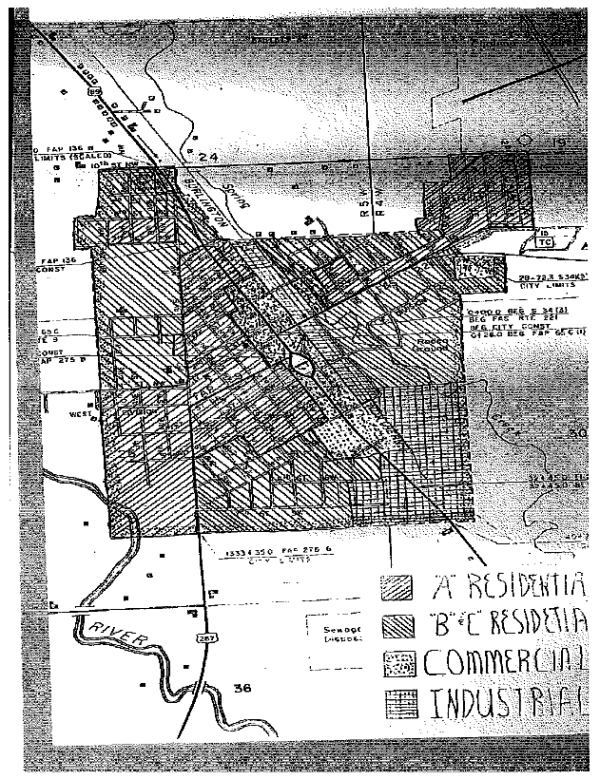
- The following exceptions shall apply to the above stated restrictions for residential zones A, B and C.
- Trucks, truck tractors, trailers, semi-trailers, buses, and school buses may be temporarily parked for the expeditious loading and unloading of such vehicles, and for the parking of a truck, truck tractor, trailer, or semi-trailer while such vehicle is being used in connection with the construction or repair of buildings, service calls, or the moving of household goods.
- All recreational vehicles, campers, and horse trailers or other vehicles which may be pulled or trailed behind a motor vehicle will be allowed to park for 72 consecutive hours on city streets, with the exception of Main Avenue North and South, 1st Street Northeast, Division Street West, and 7th Avenue SW to the city limits.
- Persons seeking waiver of any parking restrictions covered by this section because of special need or business requirements may, by written request, petition the City Council for a special parking permit. The City Council may, after public hearing, issue said special parking permit for a period not to exceed one year per parking area.
- Notice. The City Council shall, after receiving written request for a special parking permit, publish notice one time in a local newspaper of general circulation of the general nature of the permit requested, and set the matter for public hearing at the next regular meeting of the City Council.
- Hearing. The decision of the City Council as to whether or not to issue a special parking permit after public hearing shall be final.
- Fee. The city shall charge a $25 fee for each separate special parking permit.
- Permit issued. A special parking permit may be issued for a particular vehicle or a particular location, but a special parking permit shall be required for each separate location.
- Permit specifications. The special parking permit shall particularly describe the particular location as to address and size of parking area permitted and specify the use for which the permit is granted.
- Permit regulations. No special parking permit area may interfere with public safety, normal traffic flow, nor infringe on private property other than that owned, leased, or otherwise vested or used by legal right by the person receiving the special parking permit.
- Revocation of special permit. The City Council may, upon receiving a written complaint and proper written notice to the permit holder, and after public hearing of the City Council, revoke any special parking permit issued hereunder, when, in the City Council’s opinion, it is in the best interest of the city to do so. The City Council shall have the discretion to determine whether to hold a hearing on the complaint. No permit shall be revoked without opportunity for hearing.
- Renewal of special permit. Once a special parking permit has been issued, the City Council may, upon request from a permit holder, renew for another year without a public hearing upon condition the permit holder pay a new annual fee and there are no written protests made to the City Council regarding that permit. If the City Council receives a written protest, they must conduct a new public hearing before deciding whether to renew the special parking permit.
- The definition of “truck”, “truck tractor”, “trailer”, “semi-trailer”, “vehicle”, “motor vehicle”, “school bus”, “bus”, “axle”, and “gross weight” under state law, as described in MCA Title 61, or its successor, shall be applicable for the purposes of this section.
- Violation of any provisions of this section shall be a misdemeanor which is punishable by fine or imprisonment as provided in MCA § 61-8-711, or its successor. Each day such violation continues is a separate offense.
(Prior Code, § 10-14-15) (Ord. 233, passed 11-5-1984) Penalty, see § 70.99
72.31 Signs Or Markings Indicating Angle Parking
72.32 Obedience To Signs Or Markers
No person shall stand or park a vehicle in a roadway other than parallel with the edge of the roadway headed in the direction of lawful traffic movement, and with the right-hand wheels of the vehicle within 18 inches of the curb or edge of the roadway, except as otherwise provided in this subchapter.
(Prior Code, § 10-13-1) Penalty, see § 70.99
- The Public Works Director, with the approval of the City Council, shall determine upon what streets angle parking shall be permitted, and shall mark or sign such streets, but such angle parking shall not be indicated upon any federal aid or state highway within the city unless the State Highway Commission has determined by resolution or order entered in its minutes that the roadway is of sufficient width to permit angle parking without interfering with the free movement of traffic.
- Angle parking shall not be indicated or permitted at any place where passing traffic would thereby be caused or required to drive upon the left side of the street.
(Prior Code, § 10-13-2) Penalty, see § 70.99
Upon those streets which have been signed or marked by the Public Works Director for angle parking, no person shall park or stand a vehicle other than at the angle to the curb or edge of the roadway indicated by such signs or markings, and in such a manner that said vehicle shall be entirely within the limits of the space so designated.
(Prior Code, § 10-13-3) Penalty, see § 70.99
73 Snowmobiles
73.02 License Required
73.03 Application
73.04 Issuance
73.05 Attachment Of License Plate
73.06 Inspection
73.07 Transfer Of Ownership
73.08 Rental Agencies
73.09 Traffic Laws Apply
73.10 Obedience To Traffic-Control Devices
73.11 Riding On Bicycles
73.12 Speed
73.13 Emerging From Alley Or Driveway
73.14 Clinging To Vehicles
73.15 Carrying Articles
73.16 Parking
73.17 Riding On Sidewalks
73.18 Lamps And Other Equipment
- It shall be unlawful for any person to do any act forbidden or fail to perform any act required herein.
- The parent of any child and the guardian of any ward shall not authorize or knowingly permit any such child or ward to violate any of the provisions of this subchapter.
- These regulations applicable to bicycles shall apply whenever a bicycle is operated upon any public thoroughfare or public path set aside for the exclusive use of bicycles.
(Prior Code, § 10-18-1) Penalty, see § 73.99
It shall be unlawful for any person, residing in the municipality, to ride or propel a bicycle on any public thoroughfare unless such bicycle has been licensed and a license plate is attached thereto.
(Prior Code, § 10-18-2) Penalty, see § 73.99
Application for a bicycle license and license plate shall be made to the City Clerk. A fee of $0.25 for two years shall be paid before such license is issued.
(Prior Code, § 10-18-3) Penalty, see § 73.99
- The City Clerk, upon receiving proper application therefor, is authorized to issue a bicycle license which shall be effective until the end of the calendar year.
- The City Clerk shall not issue a license for any bicycle when he or she knows the applicant is not the owner of or entitled to the possession of such bicycle.
- The City Clerk shall keep a record of the number of such license, the date issued, the name and address of the person to whom issued, the number on the frame of the bicycle, and a record of all bicycle license fees collected.
(Prior Code, § 10-18-4) Penalty, see § 73.99
- The City Clerk, upon issuing a license, shall also issue a license plate bearing the license number assigned to the bicycle, which shall include the name of the municipality and the calendar year.
- Each license plate shall be firmly attached to the bicycle in such a position as to be plainly visible.
- It shall be unlawful for any person to remove a license plate from a bicycle during the period for which issued, except upon a transfer of ownership, or in the event the bicycle is dismantled.
(Prior Code, § 10-18-5) Penalty, see § 73.99
The City Clerk shall inspect each bicycle before licensing the same and shall refuse a license for any bicycle which he or she determines is in unsafe mechanical condition.
(Prior Code, § 10-18-6)
Upon the sale or transfer of a licensed bicycle, the licensee shall remove the plate and shall either surrender the same to the City Clerk or may upon proper application, but without payment of an additional fee, have said plate assigned to another bicycle owned by the applicant.
(Prior Code, § 10-18-7)
A rental agency shall not rent or offer any bicycle for rent unless the bicycle is licensed and a license plate is attached thereto.
(Prior Code, § 10-18-8) Penalty, see § 73.99
Every person riding a bicycle shall be granted all of the rights and shall be subject to all of the duties applicable to the driver of a vehicle, except as to those provisions of law which by their nature can have no application.
(Prior Code, § 10-18-9)
- Any person operating a bicycle shall obey the instructions of official traffic-control signs, signals, and other control devices applicable to vehicles, unless otherwise directed by a police officer.
- Wherever authorized signs are erected indicating that no right, left, or U-turn is permitted, it shall be unlawful for any person operating a bicycle to disobey the directions of any such sign, except where a person dismounts from the bicycle to make such turn, in which event such person shall then obey the regulations applicable to pedestrians.
(Prior Code, § 10-18-10)
- A person propelling a bicycle shall not ride other than astride a permanent and regular seat attached thereto.
- Persons riding bicycles upon a roadway shall not ride more than two abreast, except on paths or parts of roadways set aside for the exclusive use of such.
- Whenever a usable path for bicycles has been provided adjacent to a roadway, bicycle riders shall use such path.
(Prior Code, § 10-18-11) Penalty, see § 73.99
It shall be unlawful for any person to operate a bicycle at a speed greater than is reasonable and prudent under the conditions then existing.
(Prior Code, § 10-18-12) Penalty, see § 73.99
The operator of a bicycle emerging from an alley, driveway, or building shall upon approaching a sidewalk or the sidewalk area extending across any alleyway, yield the right-of-way to all pedestrians approaching on said sidewalk, and upon entering the roadway, shall yield the right-of-way to all vehicles approaching on said roadway.
(Prior Code, § 10-18-13) Penalty, see § 73.99
It shall be unlawful for any person riding upon any bicycle to attach the same or himself or herself to any vehicle upon any public thoroughfare.
(Prior Code, § 10-18-14) Penalty, see § 73.99
It shall be unlawful for any person operating a bicycle to carry any package, bundle, or article which prevents the rider from keeping at least one hand on the handlebars.
(Prior Code, § 10-18-15) Penalty, see § 73.99
It shall be unlawful for any person to park a bicycle in such a manner as to interfere or obstruct pedestrian traffic.
(Prior Code, § 10-18-16) Penalty, see § 73.99
The City Clerk is authorized to erect signs on any sidewalk or roadway prohibiting the riding of bicycles thereon, and when such signs are in place, it shall be unlawful for any person to disobey the same.
(Prior Code, § 10-18-17) Penalty, see § 73.99
- Every bicycle, when in use at night time, shall be equipped with a lamp on the front which shall emit a white light visible from a distance of at least 500 feet to the front and a red reflector on the rear of a type which shall be visible from all distances from 50 feet to 300 feet to the rear, when directly in front of lawful upper beams of headlamps on a motor vehicle. A lamp emitting a red light visible from a distance of 500 feet to the rear may be used in addition to the red reflector.
- It shall be unlawful for any person to operate a bicycle unless it is equipped with a bell or other device capable of giving a signal audible for a distance of at least 100 feet, except that a bicycle shall not be equipped with any siren or whistle.
- Every bicycle shall be equipped with a brake which will enable the operator to make the braked wheel skid on dry, level, clean pavement.
(Prior Code, § 10-18-18) Penalty, see § 73.99
73.31 Regulations
73.32 Exceptions To Regulations
73.33 Equipment Required
73.34 Traffic Regulations
73.99 Penalty
For the purpose of this subchapter, the following definitions shall apply unless the context clearly indicates or requires a different meaning.
OPERATOR. Includes every person who operates or is in actual physical control of the operation of a snowmobile.
OWNER. Includes every PERSON as defined herein, other than a lien holder or other person having a security interest only, holding record title to a snowmobile, and entitled to the use or possession thereof.
PERSON. Includes an individual, partnership, association, corporation, and any other body or group of persons, whether incorporated or not, and regardless of the degree of formal organization.
ROADWAY. Includes only those portions of any highway, road, or street improved, designed, or ordinarily used for travel or parking of motor vehicles.
SNOWMOBILE. Includes any self-propelled, track driven vehicle, designed primarily for travel on snow, ice or natural terrain, which may be steered by wheels, skis, or runners, and which is not otherwise registered or licensed under the laws of the state.
(Prior Code, § 10-20-1) (Ord. 199, passed 12-1-1975)
It shall be unlawful for any person to operate a snowmobile under the following circumstances:
- On any street or alley within the city;
- On private property of another without the express permission to do so by the owner or occupant of said property;
- On public school grounds, park property, playgrounds, recreational areas, and golf courses without express provision or permission to do so by the proper public authority;
- In a manner so as to create loud, unnecessary, or unusual noise so as to disturb or interfere with the peace and quiet of other persons;
- In a careless, reckless, or negligent manner so as to endanger the safety of any person or the property of any other person;
- Without having such snowmobile registered as provided for by statute, except that this provision shall not apply to the operation of a snowmobile on the private property of the owner by the owner or a member of his or her immediate family;
- Within the right-of-way of any public street within the city, unless the operator shall have a valid driver’s license; and
- Without the necessary equipment meeting the standards of noise level as may be set by federal or state law or regulation.
(Prior Code, § 10-20-2) (Ord. 199, passed 12-1-1975) Penalty, see § 73.99
- Notwithstanding the prohibitions of this subchapter, the City Council may, by permit, allow supervised and regulated events or programs conducted in a recreation area of the city in which snowmobiles may be used. The City Council shall have the authority to designate such areas.
- A snowmobile may be operated on the roadway of any highway, street, or alley located within the boundaries of the city, excepting on Main Street, between 4th Street NW and 5th Street SW, for the purpose of proceeding out of the city and returning into the city. No snowmobile shall be operated within one block of Teton County Rest Home, the hospital, the schools, and Skyline Lodge. No snowmobile may be operated in proceeding out of the city after 10:00 p.m., nor before 7:00 a.m.
- A snowmobile making a crossing of a street or highway shall make such crossing at an angle of approximately 90 degrees to the direction of the highway. The snowmobile shall make a complete stop before entering upon any part of the highway. A snowmobile shall yield right-of-way to all motor vehicles at all times, at all intersections.
(Prior Code, § 10-20-3) (Ord. 199, passed 12-1-1975) Penalty, see § 73.99
- Mufflers which are properly attached and which reduce the noise of operation of the vehicle to the minimum noise necessary for operating the vehicle, and no person shall use a muffler cutout, bypass, or similar device on said vehicle, conforming to all federal and state laws and regulations.
- Adequate brakes in good working condition and at least one headlight and one taillight, and headlights and taillights must be on at all times during operation.
(Prior Code, § 10-20-4) (Ord. 199, passed 12-1-1975
- Each person operating a snowmobile shall strictly observe all traffic signs and signals and all other traffic rules and regulations applicable thereto, and shall obey the orders and directions of any police officer of the city authorized to direct or regulate traffic.
- Snowmobiles shall not be operated within the city limits at a speed in excess of 15 mph.
(Prior Code, § 10-20-5) (Ord. 199, passed 12-1-1975) Penalty, see § 73.99
- Any person violating any provision of this chapter for which no specific penalty is prescribed shall be subject to § 10.99 of this code of ordinances.
- Violation of §§ 73.30 through 73.34 shall be a misdemeanor and punishable by fine or imprisonment or both as fixed by the provisions of this code.
(Prior Code, § 10-20-6) (Ord. 199, passed 12-1-1975)
74.02 Schedule II Through Streets Designated
74.03 Schedule III No Through Truck Traffic
74.04 Schedule IV Commercial Truck Routes
- No person shall drive a motor vehicle at a speed greater than the speed set forth in the following schedule on the streets or parts of streets as follows:
- Fifteen mph, 24 hours a day, every day of the year, on the four contiguous streets of the city school property that intersect with each other identified as follows:
- 7th Avenue NW between 1st Street NW and 3rd Street NW;
- 10th Avenue NW between 1st Street NW and 3rd Street NW;
- 1st Street NW between 7th Avenue NW and 10th Avenue NW; and
- 3rd Street NW between 7th Avenue NW and 10th Avenue NW.
- Fifteen mph, 24 hours a day, every day of the year, on the contiguous street and avenue of the city mini-park property that intersect with each other identified as follows:
- Between the two posted 15 mph signs located on 3rd Street SW between 1st Avenue SW and 3rd Avenue SW, each said sign located approximately 150 feet from the nearest property line of said mini-park; and
- Between the two posted 15 mph signs located on 2nd Avenue SW between 2nd Street SW and 5th Street SW, each said sign located approximately 150 feet from the nearest property line of said mini-park.
- Fifteen mph, 24 hours a day, every day of the year, on the contiguous streets and avenues surrounding the Choteau Baseball Complex, identified as follows: beginning at the intersection of 2nd Avenue N.E. and 1st Street S.E. and continuing in a circular direction on the existing road around the baseball complex to the intersection of E. Division Street, and then continuing again in a circular direction on the existing road around the baseball complex until the road meets again with 1st Street S.E.; and
- Twenty five mph on all streets and avenues within the city limits, except as herein otherwise provided.
- Fifteen mph, 24 hours a day, every day of the year, on the four contiguous streets of the city school property that intersect with each other identified as follows:
- Alleys are for local access, and no person shall use an alley as a through street. The speed limit for all alleys within the city limits shall be five mph.
(Prior Code, § 10-6-1) (Ord. 309, passed 6-4-2014) Penalty, see § 70.99
- The following are hereby declared to be through streets for the purpose of this code; traffic will stop when entering:
- Main Street, both sides, entire length; and
- All regularly designated state or federal highways.
- Provided, however, the Public Works Director, with the approval of the City Council, may declare other streets in the city to be through streets when deemed necessary.
(Prior Code, § 10-9-1)
- There shall be no through truck traffic by individuals driving trucks in excess of 8,000 pounds using the following streets and avenues or a portion thereof, of the city, hereinafter designated.
- 1st Street NW
- 2nd Street SW
- 3rd Street SW
- 1st Avenue NW
- 7th Avenue NW
- 9th Avenue NE
- 10th Avenue NE
- 11th Avenue NE
- 12th Avenue NE
- Rice Avenue
- A violation of division (A) above shall subject the driver of said truck to the penalty provided in § 10.99 of this code of ordinances.
(Prior Code, § 10-10-17) (Ord. 280, passed 5-4-1999; Ord. 308, passed 2-5-2014) Penalty, see § 70.99
- It is unlawful and constitutes a misdemeanor punishable as provided in MCA § 61-10-147 for any person to drive or operate, or for the owner to cause or knowingly permit to be driven or operated, any truck, not involved in local services as defined in division (B) below, upon the streets and avenues of the city except upon the truck routes designated as follows.
- 7th Street SW
- Airport Road
- Secondary Highway 220
- Secondary Highway 221
- U.S. Highway 89
- U.S. Highway 287
- For the purpose of this schedule, the following definitions shall apply unless the context clearly indicates or requires a different meaning.
LOCAL SERVICE. Limiting the authorized use of city streets or avenues to those trucks which have either a point of origin or destination for immediate business purposes or personal purposes, within the limits of the city, or a point of origin or destination which is only accessible via city streets or avenues.
PERSONAL PURPOSES. Transient and non-business purposes.
TRUCK. Any motor vehicle designed, used, or maintained primarily for the transportation of property, which has a gross vehicle weight of over 20,000 pounds. - In any court hearing, unless credible evidence is produced demonstrating either a “personal purpose” or an “immediate business purpose”, within the limits of the city, by a bill of lading or routing schedule, for an address within the limits of the city, the operation of such truck on a prohibited street or avenue shall be prima facie evidence of a violation of this schedule.
(Prior Code, § 10-10-18) (Ord. 293, passed 8-7-2001) Penalty, see § 70.99
CHAPTER 91: BLACKOUT AND AIR RAID REGULATIONS
CHAPTER 92: FIRE PREVENTION
CHAPTER 93: NOISE REGULATIONS
CHAPTER 94: NUISANCES; HEALTH AND SANITATION
CHAPTER 95: PARK REGULATIONS
CHAPTER 96: STREETS AND SIDEWALKS
CHAPTER 97: TREES AND SHRUBBERY
90.02 Authority Of City Animal Control Officer
90.03 Vaccination And Licensing Of Dogs And Cats
90.04 Violations Under This Chapter
90.05 Seizure Or Impoundment Of Dogs And Other Animals Within The City
90.06 Fines And Costs Of Impoundment
90.99 Penalty
For the purpose of this chapter, the following definitions shall apply unless the context clearly indicates or requires a different meaning.
ANIMAL. Every living brute creature, whether domestic or wild, fowl or mammal and shall include, but not be limited to, horses, mules, asses, cattle, sheep, goats, chickens, ducks, turkeys, cats, and dogs.
AT LARGE. The presence of an animal away from the premises of the owner, and not under the control of the owner or person authorized by the owner to have control, either by leash, cord, chain, or otherwise.
CONTROL. Obedient to a competent person’s commands, or within the proper limits of the premises or vehicle, controlled by the owner or other person consenting thereto.
DOGS. All canines, whether male or female, neutered or unneutered.
GUARD OR ATTACK DOG. A dog trained to attack any person or creature coming upon the premises containing such dog, or dogs trained to attack upon command.
IMPOUND. To sequester an animal at a place provided by the city for the keeping or the holding of animals.
KENNEL. Any lot, building, structure, or premises where three or more sexually unaltered dogs or cats over the age of four months are kept or maintained for sale or for the business of boarding, training, or breeding for a fee.
NUISANCE ANIMAL or PUBLIC NUISANCE. The keeping of any animal which disturbs the peace and quiet or endangers the repose or health of persons by biting or by frequent or habitual barking, howling, or yelping, or which defecates, urinates, scratches, or digs in any lawn, tree, shrub, plant, building, or any other property, private or public, other than the property of the owner, or any dog which upsets or disturbs garbage cans or disturbs or strews garbage belonging to any person. A PUBLIC NUISANCE shall also include the keeping or maintenance of any pen enclosure, stable, or building for any animal or animals which is offensive to neighbors or passersby, or which is injurious to the health of the neighborhood.
OWNER. Any person who owns, keeps, or harbors an animal.
POUND. All places where impounded animals are to be confined, whether by a public agency or by a private person or persons, under contract or agreement with a public agency.
VACCINATE. The inoculation of a dog or other animal.
VETERINARIAN. A duly licensed doctor of veterinary medicine.
VICIOUS DOG. A dog which shows a propensity to attack, bite, scratch, or harass people or other animals without provocation.
(Prior Code, § 4-2-1) (Ord. 225, passed 2-17-1981; Ord. 243, passed 3-17-1987; Ord. 256, passed 11-6-1990; Ord. 296, passed 1-7-2003)
- The city shall assign or designate a person or persons as City Animal Control Officer, hereafter termed, “Officer”, who shall have and is vested with the authority to enter upon premises upon which any animal is kept for the purpose of taking up, seizing, or impounding any animal found running at large, or to ascertain if any of the provisions of this chapter or any state laws relating to the cruelty of animals, or the care, treatment, or impoundment of animals is being violated, provided there is probable cause to believe there is a violation. The Officer shall have the authority to employ the use of a tranquilizer gun or any other animal control device in common use within the state. The Officer has authority to take up and impound all animals in violation of any section of this chapter, and shall be and hereby is authorized to issue citations for violations of the provisions of this chapter. The Officer is also hereby authorized to shoot animals when, upon reasonable belief, that animal is placing a person in immediate or proximate danger.
- Upon such terms as the city deems appropriate, it may enter into agreements with a person or persons to seize animals found at large and to impound animals found at large.
(Prior Code, § 4-2-2) (Ord. 296, passed 1-7-2003)
- Every owner of a dog or cat, which dog or cat is over four months of age, shall cause such dog or cat to be vaccinated with a rabies vaccine administered by a veterinarian. Revaccination of each dog or cat shall be administered by a veterinarian within two years of any prior vaccination.
- Every owner of a dog or cat, which dog or cat is over four months of age, shall purchase a dog or cat license from the city. Such license shall be purchased from the City Clerk on or before January 31 of each year, and each owner shall be required to purchase an annual license fee for each dog or cat in the amount of $5. After January 31 of each year, during the year, within 15 days after a dog or cat reaches the age of four months, or within 15 days after any dog or cat over the age of four months is acquired or brought into the city, each owner shall procure a license for said dog or cat and such owner shall be required to pay the fees herein required of such owner. The fee of the license for a spayed or neutered dog or cat shall be one-half of the amount required in this division.
- Any owner who fails to procure a dog or cat license for each dog or cat within the city during the time allowed shall, in addition to any other penalty provided by this code, be subject to an additional $10 delinquent assessment, and said assessment shall be added to the license fee provided for in division (B) above.
- The owner, upon application for dog or cat license, shall state the age, sex, color, and breed of the animal and shall further certify, by written document supplied by the administrating veterinarian, the most recent rabies vaccination date and the date of the dog or cat was neutered or spayed, if a reduced license fee is sought by the owner. In addition, the owner shall give his or her name, address, and place, if different from owner’s address, where the dog or cat will be kept.
- The owner shall permanently affix or cause to be affixed to the dog or cat, the license tag purchased for that dog or cat, and said dog or cat shall thereafter, at all times, have the dog or cat tag attached to it.
- Dog or cat license tags shall not be transferable between owners or from one to another dog or cat.
- Dogs or cats belonging to non-residents of the city, which are licensed and vaccinated in another jurisdiction, for the valid period of such license, are exempt from the license and vaccination requirements of this chapter. All other dogs or cats within the city are subject to the license requirements of this chapter.
- Any person keeping or harboring any “guard or attack dog” within the city, as defined in this chapter, shall immediately register with the City Clerk a description of such dog, giving the address of the premises where the dog will be kept within the city, and the name of the owner of the dog. The fee for the licensing of a guard or attack dog shall be $15. In addition, the owner or person harboring or keeping such dog shall keep said dog under strict physical control, confined within a physical enclosure from which said dog cannot be reasonably expected to escape, and within which other persons or animals cannot reasonably be expected to enter. If, at any time, the guard dog is not within the physical enclosure, such animal must be on a leash not greater than six feet in length and must be muzzled. The owner or person harboring such dog shall post, in a conspicuous place on the premises, containing such dog, a sign of not less than 12 inches by 12 inches in dimension, bearing the legend:
Beware: Dangerous Dog on Premises.
(Prior Code, § 4-2-3) (Ord. 225, passed 2-17-1981; Ord. 263, passed 3-16-1993)
- No person shall own, harbor, keep, or have control of any unlicensed dog or cat in the city, or permit or allow any unlicensed dog or cat to remain on any premises under control or possession of such person, contrary to the provisions of this chapter.
- No owner shall permit his or her dog or cat to be “at large”, as defined in this chapter.
- No person who is the owner, possessor, or keeper of any dog or other animal shall permit such animal to create a “public nuisance”, as defined in this chapter.
- No person shall own, harbor, or keep a vicious dog within the city.
- No person shall own, harbor, or keep a “guard or attack dog”, as described in this chapter, unless such dog is licensed, registered, and confined or muzzled and leashed within the strict physical control of the owner at all times.
- No owner or other person harboring or keeping a female dog in heat shall permit such dog to be or remain upon any public place in the city, or to be or remain upon private property within the city, unless such dog is confined in a physical enclosure from which such dog cannot reasonably be expected to escape, and within which no other dog may obtain access, except for the purpose of planned breeding.
- No owner or keeper of any dog or other animal shall abandon said animal in the city.
- No person shall own, keep, or harbor any animal that is infected with a disease transmissible to a human, or disease which otherwise constitutes a public health hazard. No person shall permit such infected animal to be or to remain within the city other than in the custody of a veterinarian.
- Upon the demand made by an officer for reasonable cause, any person owning or controlling any dog or cat, or in possession of the premises in which a dog or cat is located, shall exhibit such dog or cat, and any license which is issued to such dog or cat. The term “reasonable cause” shall include, but not be limited to, a licensing canvass conducted by the city, or its contractual agent.
- Every person owning or having control of any horses, mules, asses, cattle, sheep, goats, chickens, ducks, or turkeys, except the domesticated cat, or any wild animals capable of domestication, shall keep the same within or upon his or her own premises at all times, except when animals are necessarily passing through the public street, at which times the animal or animals shall be tended by some person competent to control and prevent them from damaging or troubling any person or property.
- No person shall keep swine or roosters in the city. Swine or roosters may not be brought within the limits of the city, except for marketing purposes, or when traveling through the city on a direct route to a destination outside of the city.
- No person shall keep or maintain a kennel in the city.
- It is unlawful for any person to break open, damage, destroy, or carry away any animal trap owned by the city and used for the purpose of catching any animal in violation of this chapter.
(Prior Code, § 4-2-4) (Ord. 225, passed 2-17-1981; Ord. 263, passed 3-16-1993; Ord. 275, passed 6-2-1998; Ord. 321, passed 11-19-2024) Penalty, see § 90.99
Every officer or authorized person is authorized to seize and impound any dog or cat which such officer or authorized person reasonably believes to be an unlicensed dog or cat, a stray dog or cat, a dog or other animal which is “at large”, a vicious dog, or attack dog which is not properly licensed and confined as provided in this chapter, or a rabid, diseased, or injured animal. The Officer or authorized person may impound said dog or other animal as provided herein.
- If the seized animal is an unlicensed dog or other animal in violation of any of the provisions of this chapter, it may be held at an impoundment facility, if one is available, for a term of up to four days.
- If the animal is “at large” and legally licensed, with license tag attached, it may be held for a term of up to four days, and the registered owner of said animal shall be given notice of the impoundment.
- If a dog is a vicious dog, it shall be held for a period of not more than five days during which term the City Judge shall conduct a hearing, with prior notice to the owner, if known, as to whether the dog is so vicious to be a menace to the health, safety, or welfare of the community. If the animal is deemed to be so vicious, the City Judge shall order it destroyed within five days. If the animal is not deemed to be vicious, it shall be released and returned to the owner, but the owner shall be assessed with the feeding, care, and other expenses of the impoundment, together with fines or penalties for violation of any other section of this chapter. Provided, however, if a dog is believed to be rabid, it shall be quarantined in the pound for a term of 14 days and, if found to be rabid, it shall be destroyed. Dogs may be deemed vicious after proper hearing, without being held in the pound.
- It is hereby declared the duty of every owner of any animal to know its whereabouts at all times. In the event that any animal is impounded, the owner shall redeem the same within four days of the date of impoundment or the owner shall be deemed to have forfeited all right, title and interest therein, and such animal shall be subject to sale or disposal by the Officer or authorized person as provided herein. If the impounded animal is properly licensed and wearing a valid tag, then actual or written notice shall be given to the owner. Written notice shall be mailed to the owner of any such animal to the address listed on the license application, and notice is deemed complete upon placing such notice in the mail. Actual notice may be given to an owner by phone or in person. If the owner fails to redeem said impounded animal within four days of the date of actual or written notice, then the owner shall be deemed to have abandoned the animal and forfeited all right, title and interest therein, and such animal shall be subject to sale, adoption, or disposal by the Officer or authorized person as provided herein.
- At any time after the expiration of the impoundment period, if the animal is unclaimed, and penalties, costs, and other charges have not been paid as to such animal, then the animal is subject to sale, adoption, or disposal. Animals to be disposed of shall be put to death by order of the City Judge in a humane manner or disposed of by other appropriate order, providing for permanent removal of the animal from the city limits. Any unclaimed animal suffering from infectious disease shall not be released but must be put to death.
(Prior Code, § 4-2-5) (Ord. 225, passed 2-17-1981; Ord. 296, passed 1-7-2003)
- The owner of any dog or animal impounded, at any time before the disposal of such animal, shall redeem such animal by paying to the City Clerk or City Judge, the fees, charges, fines, and if not previously paid, the license tax prescribed by this chapter accruing up to such time of the redemption.
- The costs of impoundment and care for any such animal so impounded shall be assessed against the owner as is provided for in the current contracts between the city and any private or public agency authorized by the city as the impoundment center for animals impounded within the city. A copy of the current contract will be on file in the office of the City Clerk.
- Whenever an animal is to be put to death under this chapter, except for infection with rabies, the owner or other person may apply to the City Judge for permission to remove the animal permanently from the city. Upon the filing of each person’s written agreement to remove such animal and to be responsible for the permanent absence of such animal from the city, the City Judge may, in his o her discretion, order such animal to be removed from the city instead of being put to death.
(Prior Code, § 4-2-6) (Ord. 225, passed 2-17-1981)
- Any person violating § 90.04(C) or § 90.04(K) which involves a “nuisance animal” or “public nuisance” is guilty of a misdemeanor, and upon conviction thereof, shall be punished by a fine for first offense of $50 to $250, for second offense of $75 to $250, and third offense of $100 to $250. Any person violating any other provision of this chapter is guilty of a misdemeanor, and upon conviction thereof, shall be punished for the first offense by a fine of $100, and upon conviction of a second or additional offense by a fine of not less than $150.
- It is further provided that the City Judge, in addition to the fine as set forth in division (A) above, may order the defendant to abate forthwith, or within a reasonable time as he or she shall order, the violation for which the defendant was found guilty.
- Every person violating provisions of this chapter shall be guilty of a separate offense for each day or portion thereof during which such violation continues, and shall be punishable therefor as is provided in this section.
- Notwithstanding any of the provisions to the contrary hereinabove set forth in this chapter, any person violating any provision of this chapter relative to cats is guilty of a misdemeanor, and upon conviction thereof, shall be punished by a fine of $5 for the first such offense, and on subsequent convictions, shall be punished by a fine of $10.
- Any person violating § 90.04(M) is guilty of a misdemeanor, and upon conviction thereof, shall be punished by a fine of $5 for the first such offense, and on subsequent convictions, shall be punished by a fine of $10.
(Prior Code, § 4-2-6) (Ord. 262, passed 12-15-1992; Ord. 263, passed 3-16-1993; Ord. 307, passed 2-5-2013; Ord. 321, passed 11-19-2024)
91.02 Orders, Rules, And Regulations To Be In Writing
91.03 Effect Of Orders, Rules, And Regulations
91.04 Special Police; Identifying Emblem
91.05 Unauthorized Warning Or All-Clear Signals Prohibited
91.06 Liability
91.07 Lights; Public Nuisance
91.08 Rules And Regulations Suspended
91.09 Conflict With State Or Federal Statutes
In order to protect life and property in the city from enemy action, the Commander of the Citizens Defense Corps is authorized and directed to carry out blackouts and air raid protection measures in the city at such times and for such periods as are authorized or ordered by the Army or Navy, and to promulgate such orders, rules, and regulations as may be necessary to ensure the success of the blackouts and air raid protection measures, and to protect life and property during said periods, and to these ends, he or she may cause the demolition of buildings and other structures. The orders, rules, and regulations shall include traffic movements of emergency or other vehicles, evacuation of residents, congregation of persons on public streets, sidewalks, and in public places or buildings, but this enumeration shall not be taken as a limitation on the power to promulgate orders, rules, regulations governing any subject, persons, or property which must be regulated in order to ensure the proper carrying out of any duly authorized blackout or raid protection measure. Practice blackouts and air raid drills may be carried out at such times and for such periods as the Commander of the Citizens Defense Corps shall in his or her discretion deem appropriate or necessary, but subject always to the orders and directions of the Army or Navy, and the orders, rules, and regulations authorized herein.
(Prior Code, § 4-6-1) (Ord. 90, passed 6-1-1942)
All orders, rules, and regulations authorized by the provisions of this chapter for the conduct of the general public shall be in writing, and shall be available for public inspection at the place and during the hours fixed by the Commander of the Citizens Defense Corps.
(Prior Code, § 4-6-2) (Ord. 90, passed 6-1-1942)
Any order, rule, or regulation promulgated pursuant to the authority conferred by the provisions of this chapter shall be in force and effect from the time of promulgation until amended or repealed by the City Council.
(Prior Code, § 4-6-3) (Ord. 90, passed 6-1-1942)
The Mayor may appoint for a specified time as many special police, without pay, from among residents of the city as may be deemed advisable for service in connection with any blackout or air raid protection measure. During the term of service of such special police, they shall possess all the powers and privileges and perform all the duties of privates in the standing police force of the city. The special police must wear such identifying emblem as may be prescribed by the Mayor, and it shall be unlawful for any special police officer to attempt to carry out any order, rule, or regulation promulgated under the authority conferred by the provisions of this chapter when he or she is not wearing said identifying emblem.
(Prior Code, § 4-6-4) (Ord. 90, passed 6-1-1942)
Any unauthorized person who shall operate a siren or other device so as to simulate a blackout signal or air raid, or the termination of a blackout or air raid, shall be deemed guilty of a violation of the provisions of this chapter.
(Prior Code, § 4-6-5) (Ord. 90, passed 6-1-1942) Penalty, see § 10.99
The provisions of this chapter are an exercise by the city of its governmental functions for the protection of the public peace, health, and safety, and neither the city, the agents, and representatives of the city, or any individual, receiver, firm, partnership, corporation, association, or trustee, or any of the agents thereof, in good faith carrying out, complying with, or attempting to comply with any order, rule, or regulation promulgated pursuant to the provisions of this chapter shall be liable for any damage sustained to person or property as the result of said activity.
(Prior Code, § 4-6-6) (Ord. 90, passed 6-1-1942)
Any light displayed contrary to any order, rule, or regulation promulgated pursuant to the provisions of this chapter constitutes a public nuisance, and when deemed necessary in order to protect life or property during a blackout or air raid, the police or the special police authorized herein, are authorized and directed to enter upon any premises within the city using reasonable force, and extinguish lights or take other necessary action to make effective any order, rule, or regulation promulgated under the authority conferred by this chapter.
(Prior Code, § 4-6-7) (Ord. 90, passed 6-1-1942)
At all times when the orders, rules, and regulations made and promulgated pursuant to the provisions of this chapter shall be in effect, they shall supersede all existing ordinances, orders, and regulations insofar as the latter may be inconsistent therewith.
(Prior Code, § 4-6-8) (Ord. 90, passed 6-1-1942)
The provisions of this chapter shall not be construed so as to conflict with any state or federal statute, or with any military or naval order, rule, or regulation.
(Prior Code, § 4-6-9) (Ord. 90, passed 6-1-1942)
92 Flammable Liquids
92 Fireworks
92.02 Open Burning
Campfires in the city park shall be limited to city fire pits only.
(Prior Code, § 6-2-13) (Ord. 270, passed 2-4-1997)
Cross-reference:
Park Regulations, see Ch. 95
Open burning within the city limits, with the exception of barbecue grills, fireplaces, and wood stoves, shall be prohibited unless a burn permit is issued by the City Clerk and approved by the Fire Chief.
(Prior Code, § 6-2-14) (Ord. 270, passed 2-4-1997)
92.21 Delivery Of Flammable Liquids
92.22 Uniform Fire Code
92.23 Misdemeanor
For the purpose of this subchapter, the following definitions shall apply unless the context clearly indicates or requires a different meaning.
FLAMMABLE LIQUIDS. Any liquid used as fuel for the operation of any motor driven vehicle or motor driven engine.
RETAIL OR WHOLESALE OUTLET. Any business engaged in the retail sale or wholesale of flammable liquids.
TANK VEHICLE or TANK CAR. Any vehicle used for the transportation of flammable liquids.
(Prior Code, § 6-3-1) (Ord. 247, passed 10-20-1987)
In all deliveries of flammable liquids to any retail outlet or wholesale outlet within the corporate limits of the city, the operator or other competent person shall be in attendance at all times while a tank vehicle or tank car is discharging cargo. Whenever practical, the tank vehicle or tank car shall be positioned so that the operating controls and the discharging end of the hose or hoses are both in view of the operator or other competent person.
(Prior Code, § 6-3-2) (Ord. 247, passed 10-20-1987)
All flammable liquids shall be delivered and controlled in accordance with the Uniform Fire Code of the state.
(Prior Code, § 6-3-3) (Ord. 247, passed 10-20-1987)
Any person violating the provisions of this subchapter shall be deemed guilty of a misdemeanor.
(Prior Code, § 6-3-4) (Ord. 247, passed 10-20-1987) Penalty, see § 92.99
92.36 Sale Of Fireworks; Use Of
92.37 Possession Of Explosive Material Prohibited
92.99 Penalty
For the purpose of this subchapter, the following definition shall apply unless the context clearly indicates or requires a different meaning.
FIREWORKS. Firecrackers, Roman candles, torpedoes, sky rockets, whirling sprays, fire fountains, and all powderous explosives commonly known as fireworks.
(Prior Code, § 6-4-1) (Ord. 48, passed 8-8-1917)
- Fireworks may be sold for the period of June 24 through July 5, and December 29 through 31, each year within the city limits by permit only from the office of the City Clerk, after approval by the City Council.
- The use of fireworks within the city in any manner or means or for any purpose is prohibited except:
- For the period of July 1 through July 4 each year. Fireworks can be set off within the city limits from 11:00 a.m. to midnight each day; and
- For the period of December 31 from 6:00 p.m. to 1:00 a.m. the following morning.
(Prior Code, § 6-4-2) (Ord. 312, passed 3-21-2017) (Ord. 320, passed 11-19-2024)Penalty, see § 92.99
The sale or possession of any illegal dangerous mechanical device or of any other illegal explosive material calculated to explode or burn by reason of external or mechanical application shall be construed a violation of the provisions of this subchapter.
(Prior Code, § 6-4-3) (Ord. 272, passed 2-4-1997) Penalty, see § 92.99
- Any person violating any provision of this chapter for which no specific penalty is prescribed shall be subject to § 10.99 of this code of ordinances.
- Any person violating the provisions of §§ 92.35 through 92.37 regarding the use of fireworks shall be fined $50.
- Any person violating the provisions of §§ 92.35 through 92.37 regarding the sale of fireworks shall be fined $50 per each sale.
(Prior Code, § 6-4-2) (Ord. 312, passed 3-21-2017)
93.02 Loud Noises Prohibited
93.03 Prohibited Acts
93.04 Noise Levels Limitations; DB(A) Levels
93.05 Noise Levels; Maximum Permissible For Motorized Vehicles
93.06 Exemptions
93.07 Property Owner Liable
93.08 Permit For Relief
93.09 Violation; Additional Remedy; Injunction
93.99 Penalty
For the purpose of this chapter, the following definitions shall apply unless the context clearly indicates or requires a different meaning.
AMBIENT NOISE. The noise which exists in the applicable zone in the absence of the sound emitted by the source being measured in that zone, being the total effect of all other sounds coming from near and far.
dB(A). Sound levels in decibels measured on an “A” scale of a standard sound level meter.
DECIBEL. The sound pressure level, in decibels, in a logarithmic unit used to express the magnitude of sound pressure with respect to a reference sound pressure.
EMERGENCY WORK. Work made necessary to restore property to a safe condition following a calamity, or work required to protect persons or property from exposure to danger or potential danger.
HEALTH. An optimal state of physical, mental, and emotional well-being and not merely the absence of disease.
(Prior Code, § 4-10-1) (Ord. 289, passed 8-15-2000)
It is unlawful for any person to make or cause to be made any excessive, sustained, or unusually loud noise, or any noise measured or unmeasured which either annoys, disturbs, injures, or endangers the comfort, repose, health, peace, or safety of any reasonable person of normal sensitivity within the limits of the city.
(Prior Code, § 4-10-2) (Ord. 289, passed 8-15-2000) Penalty, see § 93.99
It is unlawful to perform any of the following acts within the city:
- Horns and signaling devices. Repeatedly sounding any horn or signaling device on any truck, automobile, motorcycle, or other vehicle on any street or public place of the city except as a warning signal;
- Sound amplifying equipment. Using, operating, or permitting the use of any radio receiving set, musical instrument, amplifier, television, tape player, phonograph, or other machine or device for the production or reproduction of sound in such a manner as to disturb the quiet, comfort, or repose of any normally sensitive and reasonable person, or the operation of any such sets, instruments, amplifier, television, radio, phonograph, machine, or device in such a manner as to be in violation of this chapter;
- Loudspeakers and amplifiers for commercial purposes. Using or operating within the city a loudspeaker or sound amplifying equipment in a fixed or movable position or mounted upon any sound truck for the purpose of giving instructions, directions, talks, addresses, lectures, or transmitting music to any person or assemblages of persons in or upon any street, alley, sidewalk, park, place, or public property without first obtaining a permit;
- Yelling and shouting. Repeated yelling, shouting, hooting, or whistling on the public streets, alleys, or parks at any time in such a manner as to annoy or disturb the quiet, comfort, or repose of any normally sensitive and reasonable person;
- Animals. Owning, keeping, having in possession, or harboring any animals which by frequent, sustained, or habitual crowing, howling, barking, meowing, squawking, or any other noise in such a manner as to disturb the quiet, comfort, or repose of any normally sensitive and reasonable person;
- Exhausts. Discharging into the open air the exhaust of any engine, stationary internal combustion engine, motorboat, or motor vehicle, except through a muffler or other device which will effectively prevent loud or explosive noises therefrom;
- Defect in vehicle or load. Operating any truck, trailer, automobile, motorcycle, or vehicle so out of repair or so loaded in such a manner as to create loud and unnecessary grating, grinding, rattling, or other noises;
- Loading, unloading, and opening containers. Loading, unloading, opening, or other handling of boxes, crates, containers, garbage containers, or other objects in such a manner as to disturb the quiet, comfort, or repose of any normally sensitive and reasonable person;
- Construction projects or repair of buildings. Operating equipment or performing any construction or repair work between the hours of 10:00 p.m. and 7:00 a.m. on buildings, structures, or projects, or operating any pile driver, excavator, pneumatic hammer, derrick, hoist, or other construction type device in such a manner as to disturb the quiet, comfort, or repose of any normally sensitive and reasonable person; and
- Exemption clause. Any of the above acts performed for emergency work for the safety, welfare, and public health of the citizens of the city, and to the extent that the noise thereby created is reasonably necessary for the public benefit will not be construed to be in violation of this chapter.
(Prior Code, § 4-10-3) (Ord. 289, passed 8-15-2000; Ord. 321, passed 11-19-2024) Penalty, see § 93.99
It is unlawful for any person to exceed the maximum permissible decibel limits on noise emitting from any source or sources in residential, business, and industrial districts as set out in this section.
- The noise shall be measured on a sound level meter meeting current American National Standards Institute standards, operated on the “A” weighted scale.
- Noise will be measured at a distance of 25 feet from the source or at the boundary of the lot, whichever is the greater distance. Noise radiating from properties or buildings in excess of the dB(A) established for the zone and times in Table I of this section shall constitute prima facie evidence that such noise is excessive or unusually loud.
TABLE I
Maximum LimitsZones 8:00 a.m. to 8:00 p.m. 8:00 p.m. to 8:00 a.m. Residential (A, B and C) Districts 55 dB(A) 50 dB(A) Business/Residential District 65 dB(A) 60 dB(A) Central Business District 65 dB(A) 60 dB(A) Highway Business District 70 dB(A) 65 dB(A) General Industrial District 80 dB(A) 75 dB(A) - At boundaries between zones, the lower of the dB(A) level shall be applicable.
- To be in violation, the source or sources of noise must be identifiable and the level without regard to the ambient must exceed the limitations in Table I of this section.
- Construction projects in all zones shall be subject to the maximum permissible noise levels specified for the general industrial zone.
- All railroad rights-of-way shall be considered as industrial districts for the purpose of this chapter.
(Prior Code, § 4-10-4) (Ord. 289, passed 8-15-2000; Ord. 290, passed 6-19-2001) Penalty, see § 93.99
It is unlawful to operate a motorized vehicle within the city limits which emits noise in excess of the limits specified in Table II of this section.
- Noise from a vehicle noise source using a public right-of-way shall be measured at a distance of at least 25 feet from the center of the nearest traffic lane or 25 feet from the vehicle noise source on a sound level meter of standard design and operated on the “A” weight scale.
- To be in violation, the source or sources of noise must be identifiable and the level without regard to the ambient must exceed the limitations in Table II of this section.
TABLE II
Maximum Permissible Noise Levels for Motor VehiclesMotorcycles, snowmobiles, minibikes, and other self-propelled vehicles 80 dB(A) measured at 25 feet Passenger cars 80 dB(A) measured at 25 feet Trucks and buses: Over 10,000 pounds 88 dB(A) measured at 25 feet Under 10,000 pounds 80 dB(A) measured at 25 feet
(Prior Code, § 4-10-5) (Ord. 289, passed 8-15-2000) Penalty, see § 93.99
The following uses and activities shall be exempt from noise regulation:
- Noise of safety signals and warning devices;
- Noise resulting from any authorized emergency vehicle, when responding to an emergency call or acting in time of emergency;
- Noise resulting from emergency work or noise for which a special permit has been granted;
- Noise resulting from the operating of motorized lawn mowers fitted with an operating muffler between the hours of 7:00 a.m. and 10:00 p.m.;
- Noise caused by home or building repair, grounds maintenance, or street and infrastructure repair and maintenance between the hours of 7:00 a.m. and 10:00 p.m.;
- Athletic events held in stadiums, courts, pools, or parks; and
- Noise resulting from marching bands while practicing or parading.
(Prior Code, § 4-10-6) (Ord. 289, passed 8-15-2000)
It shall be a violation of this chapter for any person to knowingly permit any disturbance described in this chapter upon premises owned or occupied by him or her.
(Prior Code, § 4-10-7) (Ord. 289, passed 8-15-2000) Penalty, see § 93.99
- Applications for a permit for relief from the noise regulation designated in this chapter on the basis of undue hardship or for special events open to the public may be made to the City Council. The City Council may delegate the responsibility for examining and responding to the applications to a Council member or members or the Mayor or city employee.
- Any permit granted by the City Council shall contain all conditions upon which the permit has been granted and shall specify a reasonable time that the permit shall be effective, and any other requirements or conditions. The City Council may grant the permit applied for if the City Council finds that:
- Additional time is necessary for the applicant to alter or modify the activity or operation to comply with this chapter, and no other reasonable alternative is available to the applicant;
- The activity, event, operation, or noise source will be of temporary duration, cannot be performed in a manner that would otherwise comply with this chapter, and granting the permit is in the public interest; or
- The City Council may prescribe any conditions or requirements consistent with this chapter deemed necessary to minimize adverse effects upon the community or surrounding neighborhood.
(Prior Code, § 4-10-8) (Ord. 289, passed 8-15-2000)
As an additional remedy, the operation or maintenance of any noise source in violation of any provision of this chapter and which causes discomfort and annoyance to any reasonable person of normal sensitivity or which endangers the comfort, repose, health, or peace of residents in the area shall be a public nuisance and shall be subject to abatement summarily by a restraining order or injunction issued by a court of competent jurisdiction.
(Prior Code, § 4-10-10) (Ord. 289, passed 8-15-2000)
Any person, including an owner, who is convicted of a violation of this chapter shall, for each offense, be fined in a sum of not more than $300 or imprisoned not to exceed 90 days, or both. Each day such violation is committed or permitted to continue shall constitute a separate offense.
(Prior Code, § 4-10-9) (Ord. 289, passed 8-15-2000)
94 Anti-Litter Regulations
94.02 Premises To Be Kept Clean
94.03 Deposit Of Ashes
94.04 Notice To Abate Nuisance; Assessment
94.05 Nuisance Weeds
94.06 Violation
No person shall throw, place, or leave any dead carcass, carrion, fish, entrails, or any garbage, manure, dirt, filth, straw, or rubbish, or any other offensive, combustible, nauseous, or unhealthy matter, in or upon any street, sidewalk, or lot, or upon any public or private grounds or lots, or suffer or permit any such matter to accumulate or remain upon his or her premises, or in the street or alley adjacent thereto, for such length of time as to become a nuisance, or injurious to the health, or comfort or offensive to the inhabitants of the city.
(Prior Code, § 7-3-1) (Ord. 10, passed 5-19-1913) Penalty, see § 10.99
- No owner or occupant of any house, building, or premises shall suffer the same to become nauseous, offensive, or injurious to the health or comfort of the inhabitants of the city.
- It shall be lawful for the Mayor, City Council, Health Officer, any police officer, or the Sheriff to order the owner or occupant of any house, building, or premises to cleanse the same, or to remove or abate any nuisance therein or thereon, or which said owner or occupant may have deposited in any street or alley adjacent thereto, as often as said official may deem it necessary for the health, comfort, or convention of the inhabitants of the city.
(Prior Code, § 7-3-2) (Ord. 10, passed 5-19-1913) Penalty, see § 10.99
No person shall deposit any straw, ashes, leaves, grass, tin cans, or other rubbish or foreign matter, in any street, gutter, alley, or upon any public or unenclosed private ground or property within the city limits.
(Prior Code, § 7-3-3) (Ord. 10, passed 5-19-1913) Penalty, see § 10.99
Whenever any nauseous, unwholesome, unhealthy, offensive, or unsightly matter is allowed to accumulate or remain for an unreasonable length of time upon any private property, or upon any street adjacent thereto, in such a manner as to constitute a menace to the health of, or to be or become offensive to, any of the inhabitants of the city, the owner or occupant of said premises shall promptly remove such matter when given notice as provided in § 94.02 of this subchapter, and upon his or her failure to do so within one week, the same may be done by the city and the cost thereof, together with interest at the rate of 6% per annum from the date of such removal, may be assessed against the property and included in the next general tax levy and collected the same as any other taxes, or it may be recovered with interest in a civil action at the suit of the city.
(Prior Code, § 7-3-4) (Ord. 10, passed 5-19-1913)
Statutory reference: Generally, see MCA § 7-5-4104(1)
- Defined. “Nuisance weeds” are all weeds, grass, and other wild and uncared for vegetation growing to a height in excess of eight inches, and/or those designated “noxious” by the County Weed District, on premises located within the corporate limits of the city.
(Prior Code, § 7-3-5) - Deemed a nuisance. It is a public offense and a nuisance for any person to maintain, cause, permit, or suffer any growth of “nuisance weeds”, as defined in division (A) above, to exist in or upon any premises in the city owned by such person or upon boulevards or the one-half of any public roads, streets, or alleys adjacent thereto
(Prior Code, § 7-3-6) - Notice to abate nuisance weeds; assessment. Seven days subsequent to posting or mailing of the notice, if action has not been taken by the property owner, the same may be done by the city, and the cost assessed against the property and included in the next general tax levy and collected the same as any other taxes, or it may be recovered in a civil action by suit of the city.
(Prior Code, § 7-3-9) (Ord. 255, passed 11-6-1990)
- City Superintendent to serve notice. It shall be the duty of the City Superintendent of the city, or his or her authorized representative, to enforce the provisions of this subchapter and upon a determination that a violation of this subchapter exists, shall ascertain the name and mailing address of the owner of the premises and the description of the premises where the violation exists. The name and mailing address of the owner of the property may be obtained from the current assessment list maintained by the office of the County Assessor. Written notice of violation shall be served upon the owner directing that the nuisance weeds be cut within seven days of the mailing of the notice. Furthermore, if the nuisance weeds are classified as noxious by the County Weed District, it will be at the discretion of the City Superintendent as to whether or not these weeds will be sprayed with an appropriate herbicide. This decision will be determined by the stage of growth, as well as the time of year. Seven days following the spraying, noxious weeds will be cut and, where directed by the City Superintendent, removed from the premises. In either instance, if appropriate action has not been initiated by the property owner, the following action will be taken: the city will cause the nuisance weeds to be cut and, where appropriate, noxious weeds to be sprayed, cut, and removed.
(Prior Code, § 7-3-7) - Notice procedure. Notice of violation shall be made by either:
- Posting a copy of the notice on the premises; or
- Mailing a copy of the notice to the owner by first class United States mail. The notice shall be deemed complete on the day the notice is posted or mailed.
(Prior Code, § 7-3-8) (Ord. 255, passed 11-6-1990)
94.21 Definitions
94.22 Litter In Public Places Unlawful
94.23 Placement Of Litter In Receptacles; Scattering
94.24 Sweeping Litter Into Gutters Prohibited
94.25 Merchants' Duty To Keep Sidewalks Free Of Litter
94.26 Litter Thrown By Persons In Vehicles
94.27 Truckloads Causing Litter
94.28 Litter In Parks
94.29 Litter In Lakes And Fountains
94.30 Commercial Handbills; Public Places
94.31 Commercial And Non-Commercial Handbills; Vehicles
94.32 Depositing Commercial And Non-Commercial Handbills; Uninhabited Or Vacant Premises
94.33 Prohibiting Distribution Of Handbills; Posted Property
94.34 Distributing Commercial And Non-Commercial Handbills At Inhabited Private Premises
94.35 Litter From Aircraft
94.36 Posting Notices Prohibited
94.37 Litter On Occupied Private Property
94.38 Owner To Maintain Premises Free Of Litter
94.39 Litter On Vacant Lots
94.40 Clearing Of Litter From Open Private Property By City
This subchapter shall be known and may be cited as the anti-litter regulations.
(Prior Code, § 8-13-1) (Ord. 144, passed 12-18-1961)
For the purpose of this subchapter, the following definitions shall apply unless the context clearly indicates or requires a different meaning.
AIRCRAFT. Any contrivance now known or hereafter invented, used, or designated for navigation or for flight in the air. AIRCRAFT shall include helicopters and lighter than air dirigibles and balloons.
AUTHORIZED PRIVATE RECEPTACLE. A litter storage and collection receptacle as required and authorized in Chapter 51 of the code.
COMMERCIAL HANDBILL. Any printed or written matter, any sample or device, dodger, circular, leaflet, pamphlet, paper, booklet, or any other printed or otherwise reproduced original, or copies or any matter of literature which:
- Advertises for sale any merchandise, product, commodity, or thing;
- Directs attention to any business or mercantile or commercial establishment, or other activity, for the purpose of either directly or indirectly promoting the interest thereof by sales;
- Directs attention to or advertises any meeting, theatrical performance, exhibition, or event of any kind, for which an admission fee is charged for the purpose of private gain or profit, but the terms of this subsection shall not apply where an admission fee is charged or a collection is taken up for the purpose of defraying expenses incident to such meeting, theatrical performance, exhibition, or event of any kind, when either of the same is held, given, or takes place in connection with the dissemination of information which is not restricted under the ordinary rules of decency, good morals, public peace, safety, and good order, provided, that nothing contained in this clause shall be deemed to authorize the holding, giving, or taking place of any meeting, theatrical performance, exhibition, or event of any kind, without a license, where such license is or may be required by any law of the state, or under any of the provisions of this code; or
- While containing reading matter other than advertising matter, is predominantly and essentially an advertisement, and is distributed or circulated for advertising purposes, or for the private benefit and gain of any person so engaged as advertiser or distributor.
GARBAGE. Putrescible animal and vegetable wastes resulting from the handling, preparation, cooking, and consumption of food.
LITTER. Includes GARBAGE, REFUSE and RUBBISH as defined herein and all other waste material which, if thrown or deposited as herein prohibited, tends to create a danger to public health, safety, or welfare, or presents an unsightly appearance.
NEWSPAPER. Any newspaper of general circulation as defined by general law, any newspaper duly entered with the Post Office Department of the United States, in accordance with federal statute or regulation, and any newspaper filed and recorded with any recording officer, as provided by general law, and in addition thereto, shall mean and include any periodical or current magazine regularly published with not less than four issues per year, and sold to the public.
NON-COMMERCIAL HANDBILL. Any printed or written matter, any sample, or device, dodger, circular, leaflet, pamphlet, newspaper, magazine, paper, booklet, or any other printed or otherwise reproduced original or copies of any matter of literature not included in the aforesaid definition of a commercial handbill or newspaper.
PARK. A park, reservation, playground, beach, recreation center, or any other public area in the city, owned or used by the city and devoted to active or passive recreation.
PRIVATE PREMISES. Any dwelling, house, building, or other structure, designed or used either wholly or in part for private residential purposes, whether inhabited or temporarily or continuously uninhabited or vacant, and shall include any yard, grounds, walk, driveway, porch, steps, vestibule, or mailbox belonging or appurtenant to such dwelling, house, building, or other structure.
PUBLIC PLACE. Any and all streets, sidewalks, boulevards, alleys, or other public ways, and any and all public parks, squares, spaces, grounds, and buildings.
REFUSE. All putrescible and non-putrescible solid wastes, except body wastes, including garbage, rubbish, ashes, street cleanings, dead animals, abandoned automobiles, and solid market and industrial wastes.
RUBBISH. Non-putrescible solid wastes, consisting of both combustible and non-combustible wastes, such as paper, wrappings, cigarettes, cardboard, tin cans, yard clippings, wood, glass, bedding, crockery, and similar materials.
VEHICLE. Every device in, upon, or by which any person or property is or may be transported or drawn upon a highway, including devices used exclusively upon stationary rails or tracks.
(Prior Code, § 8-13-2) (Ord. 144, passed 12-18-1961)
No person shall throw or deposit litter in or upon any public place within the city except in public receptacles or in authorized private receptacles for collection, or in official city dumps.
(Prior Code, § 8-13-3) (Ord. 144, passed 12-18-1961) Penalty, see § 10.99
Persons placing litter in public receptacles or in authorized private receptacles shall do so in such a manner as to prevent it from being carried or deposited by the elements upon any public place.
(Prior Code, § 8-13-4) (Ord. 144, passed 12-18-1961)
No person shall sweep into or deposit in any gutter, or other public place within the city, the accumulation of litter from any building or lot or from any public or private sidewalk or driveway. Persons owning or occupying property shall keep the sidewalk in front of their premises free of litter.
(Prior Code, § 8-13-5) (Ord. 144, passed 12-18-1961) Penalty, see § 10.99
No person owning or occupying a place of business shall sweep into or deposit in any gutter or other public place within the city, the accumulation of litter from any building or lot or from any public or private sidewalks or driveway. Persons owning or occupying places of business within the city shall keep the sidewalk in front of their business premises free of litter.
(Prior Code, § 8-13-6) (Ord. 144, passed 12-18-1961) Penalty, see § 10.99
No person, while a driver or passenger in a vehicle, shall throw or deposit litter upon any public place within the city.
(Prior Code, § 8-13-7) (Ord. 144, passed 12-18-1961) Penalty, see § 10.99
No person shall drive or move any truck or other vehicle within the city unless such vehicle is so constructed or loaded as to prevent any load or contents of litter from being blown or deposited upon any public place.
(Prior Code, § 8-13-8) (Ord. 144, passed 12-18-1961) Penalty, see § 10.99
No person shall throw or deposit litter in any park within the city except in public receptacles and in such a manner that the litter will be prevented from being carried or deposited by the elements upon any part of the park or upon any public place. Where public receptacles are not provided, all such litter shall be carried away from the park by the person responsible for its presence and properly disposed of elsewhere.
(Prior Code, § 8-13-9) (Ord. 144, passed 12-18-1961) Penalty, see § 10.99
No person shall throw or deposit litter in any fountain, pond, lake, stream, or any other body of water in a park or elsewhere within the city.
(Prior Code, § 8-13-10) (Ord. 144, passed 12-18-1961) Penalty, see § 10.99
No person shall throw or deposit any commercial or non-commercial handbill in or upon any public place within the city. Nor shall any person hand out or distribute or sell any commercial handbill in any public place, provided, however, that it shall not be unlawful on any sidewalk, street, or other public place within the city for any person to hand out or distribute, without charge to receiver thereof, any non-commercial handbill to any person willing to accept it.
(Prior Code, § 8-13-11) (Ord. 144, passed 12-18-1961) Penalty, see § 10.99
No person shall throw or deposit any commercial or non-commercial handbill in or upon any vehicle, provided, however, that it shall not be unlawful in any public place for a person to hand out or distribute without charge to the receiver thereof, a non-commercial handbill to any occupant of a vehicle who is willing to accept it.
(Prior Code, § 8-13-12) (Ord. 144, passed 12-18-1961) Penalty, see § 10.99
No person shall throw or deposit any commercial or non-commercial handbill in or upon any private premises which are temporarily or continuously uninhabited or vacant.
(Prior Code, § 8-13-13) (Ord. 144, passed 12-18-1961) Penalty, see § 10.99
No person shall throw, deposit, or distribute any commercial or non-commercial handbill upon any private premises, if required by anyone thereon not to do so, or if there is placed on said premises in a conspicuous position near the entrance thereof, a sign bearing the words: “no trespassing”, “no peddlers or agents”, “no advertisement”, or any similar notice, indicating in any manner that the occupants of said premises, do not desire to be molested or have their right of privacy disturbed, or to have any such handbills left upon such premises.
(Prior Code, § 8-13-14) (Ord. 144, passed 12-18-1961) Penalty, see § 10.99
- Prohibition. No person shall throw, deposit, or distribute any commercial or non-commercial handbill in or upon private premises which are inhabited, except by handing or transmitting any such handbill directly to the owner, occupant, or other person then present in or upon such private premises, provided, however, that in case of inhabited private premises which are not posted, as provided in this subchapter, such person, unless requested by anyone upon such premises not to do so, shall have the authority to place or deposit any such handbill in or upon such inhabited private premises, if such handbill is so placed or deposited as to secure or prevent such handbill from being blown or drifted about such premises or sidewalks, streets, or other public places, and except that mailboxes may not be so used when so prohibited by federal postal law or regulations.
- Exemption for mail and newspapers. The provisions of this section shall not apply to the distribution of mail by the United States, nor to newspapers.
(Prior Code, § 8-13-15) (Ord. 144, passed 12-18-1961) Penalty, see § 10.99
No person in an aircraft shall throw out, drop, or deposit within the city any litter, handbill, or any other object.
(Prior Code, § 8-13-16) (Ord. 144, passed 12-18-1961) Penalty, see § 10.99
No person shall post or affix any notice, poster, or other paper or device, calculated to attract the attention of the public, to any lamp post, public utility pole, or shade tree, or upon any public structure or building, except as may be authorized or required by law.
(Prior Code, § 8-13-17) (Ord. 144, passed 12-18-1961) Penalty, see § 10.99
No person shall throw or deposit litter on any occupied private property within the city, whether owned by such person or not, except that the owner or person in control of private property may maintain authorized private receptacles for collection in such a manner that litter will be prevented from being carried or deposited by the elements, upon any street, sidewalk, or other public place or upon any private property.
(Prior Code, § 8-13-18) (Ord. 144, passed 12-18-1961) Penalty, see § 10.99
The owner or person in control of any private property shall at all times maintain the premises free of litter, provided, however, that this section shall not prohibit the storage of litter in authorized private receptacles for collection.
(Prior Code, § 8-13-19) (Ord. 144, passed 12-18-1961)
No person shall throw or deposit litter in any open or vacant private property within the city whether owned by such person or not.
(Prior Code, § 8-13-20) (Ord. 144, passed 12-18-1961) Penalty, see § 10.99
- Notice to remove. The City Clerk, on information from any police officer, or otherwise, is hereby authorized and empowered to notify the owner of any open or vacant private property within the city or the agent of such owner to properly dispose of litter located on such owner’s property which is dangerous to public health, safety, or welfare, or tends to present an unsightly appearance. Such notice shall be by registered mail, addressed to said owner, at his or her last known address.
- Action upon noncompliance. Upon the failure, neglect, or refusal of any owner or agent so notified to properly dispose of litter dangerous to the public health, safety, or welfare within ten days after receipt of written notice, provided for in division (A) above, or within 15 days after the date of such notice, in the event the same is returned to the City Post Office Department because of its inability to make delivery thereof, provided the same was properly addressed to the last known address of such owner, or agent, the city is hereby authorized and empowered to pay for the disposing of such litter or to order its disposal by the city.
- Charge included in tax bill. When the city has effected removal of such dangerous litter or has paid for its removal, the actual cost thereof, plus accrued interest at the rate of 6% per annum from the date of the completion of the work, if not paid by such owner prior thereto, shall be charged to the owner of such property on the next regular tax bill forwarded to such owner by the city, and said charge shall be due and payable by said owner at the time of payment of such bill.
- Recorded statement constitutes lien. Where the full amount due the city is not paid by such owner within 30 days after the disposal of such litter, as provided for in divisions (A) and (B) above, then, and in that case, the City Clerk shall cause to be recorded in the office of the city a sworn statement showing the cost and expense incurred for the work, the date the work was done, and the location of the property on which said work was done. Said costs and expenses shall be collected in the manner fixed by law for the collection of taxes. Sworn statements recorded in accordance with the provisions hereof shall be prima facie evidence that all legal formalities have been complied with and that the work has been done properly and satisfactorily, and shall be full notice to every person concerned that the amount of the statement, plus interest, constitutes a charge against the property designated or described in the statement, and that the same is due and collectible as provided by law.
(Prior Code, § 8-13-21) (Ord. 144, passed 12-18-1961)
95.99 Penalty
Cross-reference:
Campfires, see § 92.01
- Unlawful. It is unlawful for any person to violate any of the following rules and regulations while within any city park.
- Littering or dumping. Littering or dumping debris or garbage on or within city park land;
- Destruction, defacement, or dismantling. Destruction, defacement, or dismantling of any park equipment, park furnishings, park fixtures, trees, shrubs, grass, flowers, or other plants or facilities on city park land; and
- Overnight camping. Overnight camping in excess of three consecutive days in any one spot on city park land or in excess of six days, whether consecutive or not, on any city park land during a 60-day period. The term “overnight camping” includes sleeping or staying on the park ground or in cars, trucks, trailers, tents, or other shelters between the hours of 10:30 p.m. and 5:00 a.m.
- Fee for overnight stay. Persons who use the city park for overnight camping shall pay a fee in an amount to be determined by resolution of the City Council. The fee shall be assessed for each “vehicle” for each period of overnight camping. The term VEHICLE shall mean a car, truck, recreational vehicle, motorcycle, or any other motor vehicle or bicycle used on the highway.
(Prior Code, § 8-14-1) (Ord. 284, passed 10-5-1999; Ord. 287, passed 7-11-2000) Penalty, see § 95.99
Any person violating any of the provisions of this chapter shall be guilty of a misdemeanor, and, on conviction thereof, shall be fined in an amount not to exceed $500 for each violation and imprisonment up to ten days. Each day in which such violation continues shall be deemed a separate offense.
(Prior Code, § 8-14-2) (Ord. 284, passed 10-5-1999)
96 Sidewalks And Curbs
96 Street Grades
96 Excavations
96.02 Street Maintenance District
96.03 Railroad Crossings
96.04 Removal Of Snow And/Or Ice
96.05 Fuel Pump Placement
All poles carrying telegraph, telephone, electric light, or other wires shall be erected in the alleys, provided, however, that whenever it is impossible or impracticable to properly serve the public from the alleys, such poles may be erected on the streets, under the written permission of the Mayor.
(Prior Code, § 8-4-1) (Ord. 42, passed 8-23-1915)
Statutory reference: Generally, see MCA § 7-13-4106
District created; assessment method. There is established within the city a Street Maintenance District comprising all of the city for the purposes set forth in MCA §§ 7-12-4401 et seq. The assessment method for the district shall be set by the Council in accordance with MCA § 7-12-4422.
(Prior Code, § 8-5-1) (Ord. 123, passed 3-1-1954)
- Crossings to be lighted. Any person owning and operating any railroad track or route within the limits of the city, the motive power of which is steam or otherwise, shall place or cause to be placed, and shall maintain, at the intersection or crossing of said track with each and every public street, alley, road, or highway, within the limits of the city, a light or lights equal to an illumination of 60 candlepower, and such light shall be kept in good working order, and shall be lighted during all the hours of darkness, and shall be so placed as to light the crossing of said track over the public street, alley, road, or highway in such manner that persons using the crossing may be able to plainly see the same when approaching thereto.
- Failure to comply; assessment. In case the owner of any such railroad track or route fails to comply with the provisions of this section after reasonable notice, the City Council may cause the same to be done, and it may assess the expense thereof against such owner, and such assessment shall constitute a lien on any property belonging to such owner within the limits of the city and may be collected as other taxes.
(Prior Code, Ch. 8-8) (Ord. 17, passed 1-5-1914)
- It shall be the duty of the owner and tenant of any premises within the city limits to keep the sidewalk in front of and abutting his or her premises free and safe for pedestrians and with all reasonable dispatch to remove snow, ice, slush, mud, and other threats to safe foot travel, and to prevent the accumulation of the same upon such sidewalks. The sidewalks abutting such owner’s or tenant’s premises must be cleared by such owner or tenant from the night’s accumulation of snow or ice or other impediment before 11:00 a.m., following such accumulation thereof in business and industrial districts. All snow or ice or other impediment shall be removed from residential areas within 24 hours after any such accumulation. It shall be the duty of such tenant or owner of said premises to keep the sidewalks in front of the premises free and safe for pedestrians, and to prevent the continuance and accumulation of the materials described herein upon such sidewalks.
- Polish or smoothness resulting from any cause which renders a sidewalk dangerous and unsafe, shall be sanded, and where there is permanent polish or smoothness on a sidewalk, the surface of the sidewalk shall be repaired.
- If the aforesaid parties shall fail to comply with the provisions of this section, the city shall cause any and all obstructions to be removed or smoothness or polish repaired, and shall bill the cost thereof, together with a reasonable charge for administration and supervision, to the said parties. If said charges are not paid within 60 days, the City Council shall pass a resolution assessing said charges as a special tax against the premises.
- Nothing contained in §§ 96.20 through 96.42 of this chapter shall be construed to release the owners or tenants of real estate from the duty of keeping the sidewalk in front of or adjoining their respective premises at all times in a safe and passable condition and in good and thorough state of repair, but such duty is hereby expressly enjoined and imposed upon all such owners and tenants.
(Prior Code, § 8-10-1) (Ord. 217, passed 12-18-1979) Penalty, see § 96.99
No person shall be given a permit to construct, install, or build any gasoline, oil, or any other kind of pump or piece of machinery, to serve the public, on the sidewalk curbing or upon the sidewalk, but that any such pump or vending machine must be placed within the boundaries upon the property of abutting owner, nor shall any permit be given to use the sidewalk as part of a driveway to serve the public from pumps adjacent to the sidewalk.
(Prior Code, § 8-11-1) (Ord. 102, passed 9-10-1949) Penalty, see § 96.99
96.21 Plans And Specifications
96.22 City Council May Order Repair Of Sidewalk
96.23 Notice To Construct Sidewalk
96.24 Contractor To Construct Sidewalk
96.25 Assessment Of Cost
96.26 Sale Of Property Assessed
96.27 Interest On Assessments
96.28 Width Of Sidewalks
96.29 Material
96.30 Crosswalks Required
96.31 Consent Of City Council Required Before Construction
96.32 Areaways; Bond Required
96.33 Areaway; Openings
96.34 Dangerous Sidewalks; Repair Of
96.35 Owners To Maintain Sidewalk
96.36 Wet Cement; Trespassing
96.37 Merchandise On Sidewalks
96.38 Animals On Sidewalks Prohibited
96.39 Debris On Sidewalks Unlawful
96.40 Expectorating On Sidewalks
96.41 Duty Of Police Officer
96.42 Driveways; Construction Of
All sidewalks and curbs constructed or to be constructed within the corporate limits shall be subject to and in accordance with the provisions of this subchapter.
(Prior Code, § 8-1-1) (Ord. 24, passed 4-21-1914)
The City Council may, at any time, let to the lowest responsible bidder, a contract for the construction of all cement concrete sidewalks and curbs in accordance with the plans and specifications therefor prepared by the engineer and approved by the City Council, which plans and specifications shall provide for the method of construction and the material contemplated during the period of such contract, and the method of payment therefor.
(Prior Code, § 8-1-2) (Ord. 24, passed 4-21-1914)
The City Council may order sidewalks or curbs constructed in front of any lot or parcel of land under the special improvement district law, or the City Council may order the construction or reconstruction of any sidewalk or curb without the formation of a special improvement district, and assess the cost thereof to the abutting property.
(Prior Code, § 8-1-3) (Ord. 24, passed 4-21-1914)
Whenever the City Council shall order any such sidewalk or curb constructed, such order shall be entered upon the minutes of the City Council and shall name the street along which sidewalk or curb is to be constructed. After the making of such order, the City Clerk shall give written notice thereof or by publication once a week for a period of four weeks in one of the newspapers published in the city, describing in such notice the termini, course, width, and character of the walk or curb so ordered and allowing a period of 30 days during which owners so desiring may construct or cause to be constructed the walk or curb abutting their property, and further providing, that all such walks or curbs so ordered remaining unbuilt at the expiration of said 30 days from the date of the notice or the first publication thereof, shall be constructed by the contractor for the construction of concrete sidewalks and curbs.
(Prior Code, § 8-1-4) (Ord. 24, passed 4-21-1914)
At the expiration of 30 days from the date of the first publication of the notice, the City Engineer shall notify the contractor to build such portions of the sidewalk or curb ordered that may not yet be built, and the contractor shall at once proceed to construct such walk or curb in accordance with the provisions of this chapter and the plans and specifications governing his or her contract at the time of such construction.
(Prior Code, § 8-1-5) (Ord. 24, passed 4-21-1914)
The total cost of all sidewalks and curbs constructed by the contractor in accordance with the orders of the City Council, which total cost shall include that of the sidewalk proper, as well as that of any grading, handrailing, private crossings, and all other necessary expenses, shall be assessed as a special assessment against the property in front of which such sidewalk or curb is built or constructed. The property occupying street corners shall be assessed for all that part of such sidewalk therein which is within the street intersection, unless otherwise specially ordered by the City Council.
(Prior Code, § 8-1-6) (Ord. 24, passed 4-21-1914)
All the costs and expenses of building and constructing any and all sidewalks and curbs in the city shall be defrayed by special assessment payable in installments extending over a period of eight years, and the City Council shall issue special improvement bonds or warrants, and levy and collect assessments to pay the same. When one payment becomes delinquent, all payments shall, at the option of the City Council, by appropriate resolution duly adopted, become delinquent, and the whole property shall be sold in the same manner as other property is sold for taxes.
(Prior Code, § 8-1-7) (Ord. 24, passed 4-21-1914)
Upon all payments after the first, the City Clerk-Treasurer shall collect simple interest at the rate of 6% per annum from the date when the first payment becomes delinquent, and he or she shall receive payment in full and give receipts therefor for the entire special assessment on any property with accrued interest at any time the same may be tendered by the owner or agent.
(Prior Code, § 8-1-8) (Ord. 24, passed 4-21-1914)
All sidewalks hereafter to be built or constructed in the city shall be of the following widths.
- Business streets or avenues:
- Main Avenue, 15 feet to face of curb;
- Division Street, for one block east and west of Main Avenue, 15 feet to face of curb;
- First Street North, for one block east and west of Main Avenue, 15 feet to face of curb;
- Second Street North, for one block east and west of Main Avenue, 15 feet to face of curb; and
- Third Street North, for one block east and west of Main Avenue, 15 feet to face of curb.
- All avenues except Main Avenue, and all streets except those herein designated as business streets are for the purposes of this subchapter considered as residence streets, and the regulation width of all walks on residence streets and avenues shall be five and one-half feet, the inner line of all residence walks shall be two and one-half feet from the property line, and the face of curbs shall be 23 feet from the property line, provided, the City Council may order a walk of less than regulation width on any business street in locations sparsely built upon or only partially improved, but the additional width may be at any time ordered, when in the opinion of the City Council, the same is necessary, or a temporary walk may be built as provided in § 96.29 of this subchapter, provided, further, that sidewalks shall be located along the curb and as part of the curb on the following blocks: blocks numbered 14, 15, 16, 17, 18, 19, 20, 21, 22, and 23, Sherburne’s Addition.
- And it is further provided that sidewalks shall be located along the curb and as a part of the curb on the following blocks:
- Blocks numbered 13, 14, 15, 17, 18, 19, 20, 21, 22, 23, 24, 25, 26, 27, 28, 29, 30, 31, 32, 33, and 34 of Hobson’s Addition and Swenson’s Addition; and
- Tracts A, B, C, and D of Hobson’s Addition to the city.
- And it is further provided that sidewalks shall be located along the curb and as a part of the curb on the following blocks:
- Blocks numbered 6, 7, 8 of Sherburne’s Addition, the tract known as “school grounds”; and
- Looney tract, block 34, 35 of Hazlett’s Second Addition.
- And it is further provided that sidewalks shall be located along the curb and as a part of the curb on the following blocks: blocks numbered 3, 4, 5, 6 and 7 of Hobson’s Addition.
- And it is further provided that sidewalks shall be located in the Country Club Addition, along the curb and as a part of the combination curb and gutter in all blocks of the Country Club Addition to the townsite of Choteau.
- And it is further provided that sidewalks shall be located in the Cowgill Addition, along the curb and as a part of the combination curb, and gutter in all blocks of the Cowgill Addition to the townsite of Choteau
(Prior Code, § 8-1-9) (Ord. 128, passed 6-4-1956; Ord. 143, passed 6-19-1961; Ord. 165, passed 12-18-1967; Ord. 176, passed 6-2-1969; Ord. 184, passed 10-2-1972; Ord. 186, passed 1-3-1973)
Hereafter, all sidewalks and curbs to be constructed where street grades have been established shall be composed only of cement concrete, and all such sidewalks and curbs, whether built by property owners or by the contractor, must conform to the established lines and grades and to the plans and specifications current for the year in which the walks and curbs were constructed, provided the City Council may order temporary sidewalks of other material to be constructed to meet a necessity or contingency, and such temporary walks shall be removed and permanent walks built when so ordered by the City Council.
(Prior Code, § 8-1-10) (Ord. 24, passed 4-21-1914)
It shall be the duty of every person owning any lot or parcel of land bordering or abutting upon any parked street, upon which said lot there is situated any buildings or improvements, to construct a crosswalk extending from the property line of the lot to the curb, so as to permit access to the property without injury to the grass border of the parking or boulevard. All such crosswalks shall conform to grade and to the plans and specifications current for the year in which such walks are built.
(Prior Code, § 8-1-11) (Ord. 24, passed 4-21-1914)
No person shall construct any sidewalk, crosswalk, or curb, or any of the improvements mentioned in this subchapter without the consent of the City Council, and then strictly in accordance with the current plans and specifications for such work, and under the supervision of the Engineer, and reasonable charges for the services of the Engineer will be made by the city.
(Prior Code, § 8-1-12) (Ord. 24, passed 4-21-1914) Penalty, see § 96.99
Property owners desiring to utilize the space underneath the sidewalk on business streets shall make written application to the City Council therefor, specifying therein the purpose for which same is to be used. The application shall be accompanied by a plan thereof showing the character and dimensions of the vault or areaway, the sidewalk proper and its support, as well as all openings and passageways through the walk, and the City Council is hereby empowered to regulate the construction and subsequent use of all such vaults and areaways, and the granting by the City Council of a permit to occupy and use such space shall not be construed nor considered as a permanent grant to any part of the street or highway, but the permit may be revoked and the area space reverted to and be utilized by the city at any time public necessity requires it. The City Council, in its discretion, may require the applicant for such permit to file a bond in the penal sum of $2,000 for the full and complete protection of the city against any and all litigation growing out of the granting of such permit and the use of such areaway or space, and to save and keep the city safe and harmless from any and all loss or damage arising from or out of the use of the space, structure, or any of the openings through the sidewalk, and as a guarantee of the maintenance of the sidewalk in a convenient, safe, and passable condition for public use.
(Prior Code, § 8-1-13) (Ord. 24, passed 4-21-1914)
- Stairways to basements or areaways shall be conformed to that part of the sidewalk adjacent to the building line, and shall not exceed the following widths: for 15-foot walk, three and one-half feet; for 12-foot walk, three feet.
- Trapdoors through sidewalks for the moving of merchandise to and from basements and areaways shall be substantially constructed of iron, and when closed, shall be firm, unyielding, and of strength equal to that required in the sidewalk proper, and shall in no case be allowed to project above or be depressed below the surface of the sidewalk. Coal holes and like openings through the sidewalks for admission of fuel shall not exceed 24 inches in maximum dimensions, and shall be provided with cast iron rims and covers, suitably roughed having top surface of same set into the walk flush with the surface of sidewalk. Trap doors, coal holes, and like openings in the sidewalks shall at all times be kept closed and securely fastened from the lower side, except when in actual use during such times as they remain open, they shall be guarded by an attendant who shall remain continually thereby, and during the time such coal hole, trapdoor, or opening may remain open, the same shall be further guarded by a barricade placed about such opening in such manner that it may be noticed by persons passing nearby.
(Prior Code, § 8-1-14) (Ord. 24, passed 4-21-1914)
Any sidewalks which now are, or which may by reason of deterioration or decay, or by reason of unevenness, steps, too rapid slopes, or from accidental damage or from any cause whatsoever, becomes dangerous to public safety, may be condemned by the City Council and ordered rebuilt, repaired, or newly built as in their judgment may be most expedient. Any sidewalks that may suddenly develop a dangerous condition to public safety, thus requiring immediate attention, may be condemned by the Street Commissioner and he or she is hereby empowered to close such walk or walks to public travel, or he or she may proceed to immediately repair and restore said sidewalks, as in his or her judgment may be the most expedient, and all costs for sidewalks maintenance shall be by and at the expense of the owner of the abutting property, and may be assessed and collected as a special sidewalk tax to the property affected.
(Prior Code, § 8-1-15) (Ord. 24, passed 4-21-1914)
It shall be the duty of the owners of any premises in the city to keep the sidewalk in front of and adjoining their premises in good, safe, and substantial condition, and the owners shall see that all breaks or unsoundness resulting from any cause whatsoever be repaired with all possible dispatch and when, by reason of the construction or repair of sidewalks, sections thereof are removed or rendered dangerous or impassible to the public, or in case the walk has been temporarily removed during the construction of a building, such spaces or openings shall be securely fenced or barricaded, and from sundown until sunrise red lights, shall be maintained thereon as long as such condition exists. The Street Commissioner may require a temporary plank walk to be constructed around such dangerous walk or barricaded space, the same to extend from sidewalk to sidewalk on each side of such space, opening, or obstruction.
(Prior Code, § 8-1-16) (Ord. 24, passed 4-21-1914)
It shall be unlawful for any person to tramp, step on, or in any manner trespass upon any cement or concrete sidewalk or curb in course of construction before such walk or curb has been opened to public use.
(Prior Code, § 8-1-17) (Ord. 24, passed 4-21-1914) Penalty, see § 96.99
It shall be unlawful for any person to store, keep, deposit, or place any coal bin, ash or swill barrel, wagon, plow, goods, wares or merchandise, personal property, or any other obstruction upon any sidewalk. When merchandise is moved across sidewalks to and from buildings, the same shall be done in an expeditious manner and shall not be allowed to obstruct the sidewalk unnecessarily.
(Prior Code, § 8-1-18) (Ord. 24, passed 4-21-1914) Penalty, see § 96.99
It shall be unlawful hereafter for any person to ride or drive any horse, mule or other animal, buggy, wagon, automobile, or other vehicle along, over, or on any of the sidewalks, or to push any cart or wheelbarrow thereon, provided that this section shall not be construed to apply to baby carriages or carts.
(Prior Code, § 8-1-19) (Ord. 24, passed 4-21-1914) Penalty, see § 96.99
It shall be unlawful for any person to throw or deposit fruit peelings, handbills, advertising matter or devices, sweepings, scrub water, or any refuse of any kind from any store, saloon, office, or other building or to throw, place, or deposit any of them in any place from which they may be blown upon any of the sidewalks, or to do damage in any way to any of the sidewalks.
(Prior Code, § 8-1-20) (Ord. 24, passed 4-21-1914) Penalty, see § 96.99
It shall be unlawful for any person to spit, hawk, or expectorate upon any sidewalk or street crossing.
(Prior Code, § 8-1-21) (Ord. 24, passed 4-21-1914) Penalty, see § 96.99
It shall be the duty of the police officer to familiarize himself or herself with the provisions of this subchapter and enforce the provisions thereof, and he or she shall report to the City Clerk all defective sidewalks that come to his or her notice, and the particulars of any accident that may occur of which he or she may have or obtain knowledge.
(Prior Code, § 8-1-22) (Ord. 24, passed 4-21-1914)
- No person shall build or cause to be built, any driveway entering the premises of said person from any street within the business district which shall be more than 30 feet in width measured at the curb of the street.
- No person shall be permitted to have more than one driveway for each business located on any one street within the business district.
(Prior Code, § 8-1-23) (Ord. 173, passed 6-17-1968) Penalty, see § 96.99
Statutory reference: Generally, see MCA §§ 7-14-4102, 7-14-4105, 7-14-4106, 7-14-4122, 7-14-4123, and 7-15-4125
96.56 Grades Of Streets And Avenues
96.57 Curb Grades
96.58 Sidewalk Grades
96.59 Grade Points
- The benchmark established by the United States geological survey at Main Avenue South and 1st Street S.E. be, and the same is hereby designated as the official benchmark of the city, and to which all elevations and grades are hereby referred.
- The location and description of said benchmark is more particularly described as follows: a regulation USGS benchmark consisting of a two-inch iron pipe with brass cap upon which is inscribed the following: U.S. Geological Survey B.M. Elevation above Sea 3810 feet Butte. Located in front entrance to the Teton County Jail situated on Lots 1 and 2 Block A. Hamilton’s Addition to the city at the southeast corner of Main Avenue South and 1st Street S.E.
(Prior Code, § 8-3-1) (Ord. 125, passed 4-4-1955)
The grades of streets and avenues at the points designated are hereby established as the official grades of said streets and avenues. The grade points being the block corners, respectively at streets and avenues hereinafter named.
(Prior Code, § 8-3-2) (Ord. 125, passed 4-4-1955)
Curb grades at all points at right angles with property line shall be at an elevation determined by a fall of 2-1/2% from property line grade to top of curb.
(Prior Code, § 8-3-3) (Ord. 125, passed 4-4-1955)
Sidewalk grades in business districts and in improved residence districts shall be determined in the following manner: a rate of 2-1/2% inclination from the established grade at property line of curb grade shall determine the elevation and inclination of all sidewalks.
(Prior Code, § 8-3-4) (Ord. 125, passed 4-4-1955)
- The slope or grade of streets shall be on straight lines connecting the points where the elevations are fixed, as provided by the provisions of this subchapter.
- Where the grade points at block corners of intersecting streets are at the same elevation thus creating a level grade, the sidewalks, curbs, and the centerline through the crown of the roadway shall each be on its respective level line, determined for the fixed grade points as described in § 96.56 of this subchapter, and the drainage of the roadway shall be secured by depressing the gutter grade opposite the block corners and elevating it at a point midway between the fixed grade points.
City limits Block corners on north side of 3rd Street S.W. 3800.80 Block corners on south side of 3rd Street S.W. 3800.80 Block corners on north side of 4th Street S.W. 3800.50 City limits Block corners on south side of 4th Street S.W. 3800.50 Block corners on north side of 7th Street S.W. 3799.40 Block corners on south side of 7th Street S.W. 3799.40 East Court Street Block corners on north side of 1st Street S.E. 3809.45 Block corners on south side of East Division Street 3811.90 8th Avenue N.E. Block corners on south side of East Division Street 3811.98 Block corners on north side of East Division Street 3811.98 Block corners on south side of 1st Street N.E. 3814.43 Block corners on north side of 1st Street N.E. 3814.43 Block corners on south side of 2nd Street N.E. 3815.18 8th Avenue N.E. Block corners on north side of 2nd Street N.E. 3815.18 8th Avenue N.W. Block corners on north side of West Division Street 3811.45 Block corners on south side of 1st Street N.W. 3812.58 Block corners on north side of 1st Street N.W. 3812.58 Block corners on south side of 2nd Street N.W. 3815.08 Block corners on north side of 2nd Street N.W. 3815.08 Block corners on south side of 3rd Street N.W. 3816.33 Block corners on north side of 3rd Street N.W. 3816.33 8th Avenue S.W. Block corners on north side of 2nd Street S.W. 3806.47 Block corners on south side of 1st Street S.W. 3809.45 Block corners on north side of 1st Street S.W. 3809.45 Block corners on south side of West Division Street 3811.45 5th Avenue N.E. Block corners on north side of East Division Street 3811.20 Block corners on south side of 1st Street N.E. 3813.65 Block corners on north side of 1st Street N.E. 3813.65 5th Avenue N.E. Block corners on south side of 2nd Street N.E. 3814.40 Block corners on north side of 2nd Street N.E. 3814.40 Block corners on south side of 3rd Street N.E. 3816.15 Block corners on north side of 3rd Street N.E. 3816.15 Block corners on south side of 4th Street N.E. 3818.60 5th Avenue S.W. Block corners on north side of 7th Street S.W. 3797.20 Block corners on south side of 7th Street S.W. 3797.20 Block corners on south side of 4th Street S.W. 3800.10 Block corners on north side of 4th Street S.W. 3800.10 Block corners on south side of 3rd Street S.W. 3804.00 5th Avenue S.W. Block corners on north side of 3rd Street S.W. 3804.00 Block corners on south side of 2nd Street S.W. 3805.06 Block corners on north side of 2nd Street S.W. 3805.06 Block corners on south side of 1st Street S.W. 3807.86 Block corners on north side of 1st Street S.W. 3807.86 1st Avenue N.E. Block corners on north side of East Division Street 3812.00 Block corners on south side of 1st Street N.E. 3815.00 Block corners on north side of 1st Street N.E. 3815.00 Block corners on south side of 2nd Street N.E. 3815.75 Block corners on north side of 2nd Street N.E. 3815.75 Block corners on south side of 3rd Street N.E. 3817.50 Block corners on north side of 3rd Street N.E. 3817.50 Block corners on south side of 4th Street N.E. 3819.60 Block corners on north side of 4th Street N.E. 3819.60 Block corners on south side 5th Street N.E. 3821.35 Block corners on north side of 5th Street N.E. 3821.35 1st Avenue N.W. Block corners on north side of West Division Street 3811.90 Block corners on south side of 1st Street N.W. 3815.41 Block corners on north side of 1st Street N.W. 3815.41 Block corners on south side of 2nd Street N.W. 3816.16 Block corners on north side of 2nd Street N.W. 3816.16 Block corners on south side of 3rd Street N.W. 3817.91 Block corners on north side of 3rd Street N.W. 3817.91 Block corners on south side of 4th Street N.W. 3819.31 Block corners on north side of 4th Street N.W. 3819.31 Block corners on south side of 5th Street N.W. 3821.06 Block corners on north side of 5th Street N.W. 3821.06 Block corners on south side of 6th Street N.W. 3822.81 1st Avenue S.E. Block corners on south side of 5th Street S.E. 3803.58 Block corners on north side of 5th Street S.E. 3803.58 Block corners on south side of 4th Street S.E. 3805.33 Block corners on north side of 4th Street S.E. 3805.33 Block corners on south side of 3rd Street S.E. 3806.41 Block corners on north side of 3rd Street S.E. 3806.41 Block corners on south side of 2nd Street S.E. 3808.16 Block corners on north side of 2nd Street S.E. 3808.16 Block corners on south side of 1st Street S.E. 3809.91 Block corners on north side of 1st Street S.E. 3809.91 Block corners on south side of East Division Street 3811.66 Block corners on north side of 3rd Street S.W. 3804.80 Block corners on south side of 3rd Street S.W. 3804.80 Block corners on north side of 4th Street S.W. 3801.60 Block corners on south side of 4th Street S.W. 3801.60 1st Avenue S.W. Block corners on north side of 6th Street S.W. 3799.00 Block corners on south side of 6th Street S.W. 3799.00 Block corners on north side of 7th Street S.W. 3798.40 Block corners on south side of 7th Street S.W. 3798.40 Block corners on north side of 5th Street S.W. 3800.00 Block corners on south side of 5th Street S.W. 3800.00 Block corners on south side of 4th Street S.W. 3800.00 Block corners on north side of 4th Street S.W. 3800.00 Block corners on south side of 3rd Street S.W. 3803.60 Block corners on north side of 3rd Street S.W. 3803.60 Block corners on south side of 2nd Street S.W. 3806.65 Block corners on north side of 2nd Street S.W. 3806.65 Block corners on south side of 1st Street S.W. 3809.45 Block corners on north side of 1st Street S.W. 3809.45 1st Avenue S.W. Block corners on south side of West Division Street 3811.90 4th Avenue N.E. Block corners on north side of East Division Street 3811.98 Block corners on south side of 1st Street N.E. 3814.43 Block corners on north side of 1st Street N.E. 3814.43 Block corners on south side of 2nd Street N.E. 3815.18 Block corners on north side of 2nd Street N.E. 3815.18 Block corners on south side of 3rd Street N.E. 3816.93 Block corners on north side of 3rd Street N.E. 3816.93 Block corners on south side of 4th Street N.E. 3818.33 Block corners on north side of 4th Street N.E. 3818.33 4th Avenue N.W. Block corners on north side of West Division Street 3811.09 Block corners on south side of 1st Street N.W. 3812.70 Block corners on north side of 1st Street N.W. 3812.70 4th Avenue S.W. Block corners on north side of 6th Street S.W. 3799.67 Block corners on south side of 6th Street S.W. 3799.67 Block corners on north side of 7th Street S.W. 3797.45 Block corners on south side of 7th Street S.W. 3797.45 Block corners on south side of 4th Street S.W. 3800.40 Block corners on north side of 4th Street S.W. 3800.40 Block corners on south side of 3rd Street S.W. 3803.60 Block corners on north side of 3rd Street S.W. 3803.60 Block corners on south side of 2nd Street S.W. 3805.14 Block corners on north side of 2nd Street S.W. 3805.14 Block corners on south side of 1st Street S.W. 3808.64 Block corners on north side of 1st Street S.W. 3808.64 Block corners on south side of West Division Street 3811.09 Main Avenue North Block corners on north side of Division Street 3812.51 Block corners on south side of 1st Street 3817.07 Block corners on north side of 1st Street 3817.07 Block corners on south side of 2nd Street 3817.82 Block corners on north side of 2nd Street 3817.82 Block corners on south side of 3rd Street 3819.22 Block corners on north side of 3rd Street 3819.22 Block corners on south side of 4th Street 3820.62 Block corners on north side of 4th Street 3820.62 Block corners on south side of 5th Street 3822.02 Block corners on north side of 5th Street 3822.02 Block corners on south side of 6th Street 3824.47 Main Avenue South Block corners on north side of 6th Street S.W. 3797.50 Block corners on south side of 6th Street S.W. 3797.50 Block corners on north side of 7th Street S.W. 3796.20 Block corners on south side of 7th Street S.W. 3796.20 Block corners on south side of 5th Street 3798.20 Block corners on north side of 5th Street 3798.20 Block corners on south side of 4th Street 3801.60 Block corners on north side of 4th Street 3801.60 Block corners on south side of 3rd Street 3804.80 Block corners on north side of 3rd Street 3804.80 Block corners on south side of 2nd Street 3807.21 Block corners on north side of 2nd Street 3807.21 Block corners on south side of 1st Street 3808.96 9th Avenue N.E. Block corners on south side of 1st Street N.E. 3815.21 Block corners on north side of 1st Street N.E. 3815.21 Block corners on south side of 2nd Street N.E. 3815.96 9th Avenue N.E. Block corners on north side of 2nd Street N.E. 3815.96 9th Avenue N.W. Block corners on north side of West Division Street 3812.26 Block corners on south side of 1st Street N.W. 3813.39 Block corners on north side of 1st Street N.W. 3813.39 Block corners on south side of School Street 3814.64 Block corners on north side of School Street 3814.64 Block corners on south side of 2nd Street N.W. 3815.89 Block corners on north side of 2nd Street N.W. 3815.89 Block corners on south side of 3rd Street N.W. 3817.14 Block corners on north side of 3rd Street N.W. 3817.14 9th Avenue S.W. Block corners on north side of 2nd Street S.W. 3808.13 Block corners on south side of 1st Street S.W. 3810.26 Block corners on north side of 1st Street S.W. 3810.26 Block corners on south side of West Division Street 3812.26 2nd Avenue N.W. Block corners on north side of West Division Street 3812.65 Block corners on south side of 1st Street N.W. 3814.40 Block corners on north side of 1st Street N.W. 3814.40 Block corners on south side of 2nd Street N.W. 3815.15 Block corners on north side of 2nd Street N.W. 3815.15 Block corners on south side of 3rd Street N.W. 3816.90 Block corners on north side of 3rd Street N.W. 3816.90 Block corners on south side of 4th Street N.W. 3818.01 Block corners on north side of 4th Street N.W. 3818.01 2nd Avenue S.W. Block corners on north side of 5th Street S.W. 3801.00 Block corners on south side of 5th Street S.W. 3801.00 Block corners on north side of 6th Street S.W. 3800.20 2nd Avenue S.W. Block corners on south side of 6th Street S.W. 3800.20 Block corners on north side of 7th Street S.W. 3799.20 Block corners on south side of 7th Street S.W. 3799.20 Block corners on south side of 4th Street S.W. 3800.00 Block corners on north side of 4th Street S.W. 3800.00 Block corners on south side of 3rd Street S.W. 3802.80 Block corners on north side of 3rd Street S.W. 3802.80 Block corners on south side of 2nd Street S.W. 3806.00 Block corners on north side of 2nd Street S.W. 3806.00 Block corners on south side of 1st Street S.W. 3810.20 Block corners on north side of 1st Street S.W. 3810.20 Block corners on south side of West Division Street 3812.65 7th Avenue N.E. Block corners on south side of East Division Street 3811.20 Block corners on north side of East Division Street 3811.20 Block corners on south side of 1st Street N.E. 3813.65 Block corners on north side of 1st Street N.E. 3813.65 Block corners on south side of 2nd Street N.E. 3814.40 Block corners on north side of 2nd Street N.E. 3814.40 Block corners on south side of 3rd Street N.E. 3816.15 Block corners on north side of 3rd Street N.E. 3816.15 7th Avenue N.W. Block corners on north side of West Division Street 3810.42 Block corners on west side of 1st Street N.W. 3811.77 Block corners on east side of 1st Street N.W. 3812.27 Block corners on south side of 2nd Street N.W. 3814.27 Block corners on north side of 2nd Street N.W. 3814.27 Block corners on south side of 3rd Street N.W. 3815.52 Block corners on north side of 3rd Street N.W. 3815.52 Block corners on south side of 4th Street N.W. 3818.01 7th Avenue N.W. Block corners on north side of 4th Street N.W. 3818.01 Block corners on south side of 5th Street N.W. 3820.05 Block corners on north side of 5th Street N.W. 3820.05 Block corners on south side of 6th Street N.W. 3822.81 Block corners on north side of 6th Street N.W. 3822.81 7th Avenue S.W. Block corners on south side of 2nd Street S.W. 3805.12 Block corners on north side of 2nd Street S.W. 3805.12 Block corners on south side of 1st Street S.W. 3808.02 Block corners on north side of 1st Street S.W. 3808.02 Block corners on south side of West Division Street 3810.42 6th Avenue N.E. Block corners on south side of East Division Street 3810.42 Block corners on north side of East Division Street 3810.42 Block corners on south side of 1st Street N.E. 3812.87 Block corners on north side of 1st Street N.E. 3812.87 Block corners on south side of 2nd Street N.E 3813.62 Block corners on north side of 2nd Street N.E. 3813.62 Block corners on south side of 3rd Street N.E. 3815.37 Block corners on north side of 3rd Street N.E. 3815.37 6th Avenue S.W. Block corners on north side of 7th Street S.W. 3798.40 Block corners on south side of 7th Street S.W. 3798.40 Block corners on south side of 4th Street S.W. 3800.00 Block corners on north side of 4th Street S.W. 3800.00 Block corners on south side of 3rd Street S.W. 3802.50 Block corners on north side of 3rd Street S.W. 3802.50 Block corners on south side of 2nd Street S.W. 3805.06 Block corners on north side of 2nd Street S.W. 3805.06 10th Avenue N.W. Block corners on north side of West Division Street 3813.07 Block corners on south side of 1st Street N.W. 3814.20 Block corners on north side of 1st Street N.W. 3814.20 Block corners on south side of School Street 3815.45 Block corners on north side of School Street 3815.45 Block corners on south side of 2nd Street N.W. 3816.70 Block corners on north side of 2nd Street N.W. 3816.70 Block corners on south side of 3rd Street N.W. 3817.95 Block corners on north side of 3rd Street N.W. 3817.95 10th Avenue S.W. Block corners on north side of 1st Street S.W. 3811.07 Block corners on south side of West Division Street 3813.07 3rd Avenue N.E. Block corners on south side of 1st Street N.E. 3813.95 Block corners on north side of 1st Street N.E. 3813.95 Block corners on south side of 2nd Street N.E. 3814.40 Block corners on north side of 2nd Street N.E. 3814.40 Block corners on south side of 3rd Street N.E. 3816.15 Block corners on north side of 3rd Street N.E. 3816.15 Block corners on south side of 4th Street N.E. 3818.25 Block corners on north side of 4th Street N.E. 3818.25 3rd Avenue N.W. Block corners on north side of West Division Street 3811.87 Block corners on south side of 1st Street N.W. 3813.62 Block corners on north side of 1st Street N.W. 3813.62 Block corners on south side of 2nd Street N.W. 3814.37 Block corners on north side of 2nd Street N.W. 3814.37 Block corners on south side of 3rd Street N.W. 3815.52 Block corners on north side of 3rd Street N.W. 3815.52 3rd Avenue S.W. Block corners on north side of 5th Street S.W. 3802.00 Block corners on south side of 5th Street S.W. 3802.00 Block corners on north side of 6th Street S.W. 3799.50 Block corners on south side of 6th Street S.W. 3799.50 Block corners on north side of 7th Street S.W. 3798.80 Block corners on south side of 7th Street S.W. 3798.80 Block corners on south side of 4th Street S.W. 3802.00 Block corners on north side of 4th Street S.W. 3802.00 Block corners on south side of 3rd Street S.W. 3803.20 Block corners on north side of 3rd Street S.W. 3803.20 3rd Avenue S.W. Block corners on south side of 2nd Street S.W. 3805.22 Block corners on north side of 2nd Street S.W. 3805.22 Block corners on south side of 1st Street S.W. 3809.42 Block corners on north side of 1st Street S.W. 3809.42 Block corners on south side of West Division Street 3811.87 West Court Street Block corners on north side of 1st Street S.W. 3809.45 Block corners on south side of West Division Street 3811.90
(Prior Code, § 8-3-5) (Ord. 125, passed 4-4-1955)
Statutory reference: Generally, see MCA § 7-14-4201
96.71 Materials
96.72 Barricade
96.73 Compliance Required
96.99 Penalty
Every person who, except where such person is a public utility operating under a franchise or contract with the city, under which the public utility or person may construct, equip, lay, maintain, and operate pipe lines and appurtenances in, under, upon, over and across streets, avenues, alleys, highways, bridges, easements, and other public places within the city, shall make any excavation in, or dig any hole, drain, or ditch in, or in any way obstruct any thoroughfare, street, alley, or highway within the limits of the city without first having obtained a permit therefor from the City Council or its authorized representative. A fee of $5 shall be paid to the city for the issuance of such permit.
(Prior Code, § 8-9-1) (Ord. 141, passed 4-3-1961)
All materials excavated pursuant to such permit shall be hauled away by the permittee and the excavation backfilled with compacted gravel approved by the street foreperson. All cuts in paved areas shall be repaired by not less than three inches of plant mix oil and crushed gravel, firmly compacted and leveled to grade, so as to restore the excavated area to its original condition.
(Prior Code, § 8-9-2) (Ord. 139, passed 11-21-1960)
Any person who, after having obtained a proper permit to do so, makes any excavation, or digs any hole, drain, or ditch, or places any other obstruction in or upon any thoroughfare, street, alley, or highway within the city limits, must erect an efficient barricade around such excavation, drain, ditch, hole, or other obstruction and warning lights, shall be maintained therefrom from dark to daylight until such time as said thoroughfare, street, alley, or highway has been restored to safe and passable travel.
(Prior Code, § 8-9-3) (Ord. 139, passed 11-21-1960)
Any person who shall make any excavation in, or dig any hole, drain, or ditch in, or any way obstruct any thoroughfare, street, alley, or highway within the city limits, without first having obtained a permit therefor from the City Council or its duly authorized representative, shall be guilty of a misdemeanor.
(Prior Code, § 8-9-4) (Ord. 139, passed 11-21-1960) Penalty, see § 96.99
- Any person violating any provision of this chapter for which no specific penalty is prescribed shall be subject to § 10.99 of this code of ordinances.
- Any person violating the provisions § 96.01 shall be punished, upon conviction thereof, by a fine of not less than $5 nor more than $25 for each pole erected contrary to the provisions hereof, providing that the total fine, in any case, shall not exceed $300, and each such pole is hereby declared to be a nuisance and shall be at once removed, and each day that such pole is allowed to remain in position contrary to the provision of this chapter, after the same shall be ordered removed, shall constitute a separate and distinct offense and be punishable accordingly.
(Prior Code, § 8-4-2) - Violation of § 96.05 shall be deemed a misdemeanor and any person violating the provisions of this chapter may be fined in an amount from $5 and not to exceed $50 for each offense.
(Prior Code, § 8-10-1)
(Ord. 42, passed 8-23-1915; Ord. 217, passed 12-18-1979)
97.02 Definitions
97.03 Comprehensive City Tree Plan
97.04 Tree Species To Be Planted
97.05 Spacing
97.06 Distance From Curb And Sidewalk
97.07 Distance From Fire Hydrants
97.08 Pruning And Corner Clearance
97.09 Utilities
97.10 Responsibility For Tree Care
97.11 Pruning Standards
97.12 Tree Topping
97.13 Diseased Tree Removal On Private Property
97.14 Removal Of Stumps
97.15 Protection Of Trees
97.16 Arborist's License And Bond
97.17 Review By City Council
97.18 Boulevards
97.99 Penalty
The purpose of this chapter is to protect the health, safety, and welfare of both the public citizenry and the trees and vegetation in the city by establishing standards and regulations to control planting, removal, maintenance, and protection of all trees, shrubs, and vegetation; to establish a Tree Board; and to provide for the development of a comprehensive plan for the management of trees, shrubs, and vegetation on public property.
(Prior Code, § 8-7-1) (Ord. 298, passed 3-16-2004)
For the purpose of this chapter, the following definitions shall apply unless the context clearly indicates or requires a different meaning.
PARK TREES. Trees, shrubs, bushes, and all other woody vegetation in public parks.
STREET TREES. Trees, shrubs, bushes, and all other woody vegetation on land lying within the public right-of-way on either side of all streets, avenues, or alleys within the city.
(Prior Code, § 8-7-2) (Ord. 298, passed 3-16-2004)
The City Tree Board shall study, investigate, counsel, develop, and update as needed a written plan for the care, preservation, pruning, planting, replanting, removal, or disposition of trees, shrubs, and other vegetation in parks and along streets, avenues, and alleys. Such plan will be presented to the City Council, and upon its acceptance and approval, shall constitute the official comprehensive city tree plan. The tree plan shall be administered by the Public Works Director.
(Prior Code, § 8-7-4) (Ord. 298, passed 3-16-2004)
The City Tree Board shall develop and maintain a list of desirable trees for planting as street trees and park trees in three size classes based on mature height: small (under 20 feet), medium (20 to 40 feet), and large (over 40 feet). Efforts shall be made to ensure a sufficient diversity of tree species.
(Prior Code, § 8-7-5) (Ord. 298, passed 3-16-2004)
Street trees shall be planted no closer together than the following: small trees, 15 feet; medium trees, 25 feet; and large trees, 35 feet; except in special plantings designed or approved by the City Tree Board.
(Prior Code, § 8-7-6) (Ord. 298, passed 3-16-2004)
Street trees shall be planted no closer to any curb or sidewalk than two feet for small trees and three feet for medium or large trees.
(Prior Code, § 8-7-7) (Ord. 298, passed 3-16-2004) Penalty, see § 97.99
Street trees shall not be planted within ten feet of any fire hydrant.
(Prior Code, § 8-7-8) (Ord. 298, passed 3-16-2004) Penalty, see § 97.99
- All trees shall be pruned so that branches overhanging any street, avenue, or alley shall not severely obstruct the light from any street lamp or obstruct the view of any intersection, and so that there shall be a clear space of 13 feet above the street surface or eight feet above the sidewalk surface. Any dead, diseased, or dangerous trees, or broken or decayed limbs which constitute a menace to the safety of the public must be removed.
- Tree limbs that grow near high voltage electrical conductors shall be maintained clear of such conductors by the electric utility company in compliance with any applicable franchise agreements. A utility tree trimming policy must be reviewed by the utility company and the City Tree Board prior to any trimming by the utility company.
(Prior Code, § 8-7-9) (Ord. 298, passed 3-16-2004; Ord. 304, passed 4-10-2012)
Cross-reference:
Corner visibility, see § 153.58
Medium or large street trees shall not be planted under or within ten lateral feet of any overhead utility wire. Any size street tree shall not be planted within five lateral feet of any underground water line, sewer line, transmission line, or other utility.
(Prior Code, § 8-7-10) (Ord. 298, passed 3-16-2004) Penalty, see § 97.99
The adjoining property owner shall be responsible for the maintenance of street trees, including planting, pruning, removal, replacement, and disposal of any debris resulting from such maintenance. If it becomes apparent that maintenance is needed for any street trees, the property owner shall respond within 60 days to the City Tree Board with a plan for the maintenance.
(Prior Code, § 8-7-11) (Ord. 298, passed 3-16-2004)
All tree pruning of street trees or park trees shall conform to the ANSI A300 standards for tree care operations.
(Prior Code, § 8-7-12) (Ord. 298, passed 3-16-2004)
It shall be unlawful as a normal practice for any person, firm, or city department to top any street tree or park tree. TOPPING is defined as the severe cutting back of limbs to stubs larger than three inches in diameter within the tree’s crown to such a degree so as to remove the normal canopy and disfigure the trees. Crown reduction by a qualified arborist may be substituted, where appropriate. Trees severely damaged by storms or other causes, or certain trees under utility wires or other obstructions where other pruning practices are impractical may be exempted from this chapter at the determination of the City Tree Board.
(Prior Code, § 8-7-13) (Ord. 298, passed 3-16-2004) Penalty, see § 97.99
The city shall have the right to cause the removal of any diseased trees on private property within the city when such trees harbor insects or disease which constitutes a potential threat to other trees within the city. The City Tree Board will notify, in writing, the owners of such trees. Removal shall be done by said owners at their own expense within 60 days after the date of service of notice. In the event of failure of owners to comply with such provisions, the city shall have the authority to remove such trees and charge the cost of removal on the owner’s property tax.
(Prior Code, § 8-7-14) (Ord. 298, passed 3-16-2004)
All stumps of street and park trees shall be removed below the surface of the ground so that the top of the stump shall not project above the surface of the ground.
(Prior Code, § 8-7-15) (Ord. 298, passed 3-16-2004)
In order to maintain the overall forest, reasonable efforts shall be made to replace street and park trees that are removed, and to protect quality trees that are endangered. Street and park trees that are removed by decision of the City Tree Board or by natural causes shall be replaced on a one for one basis within one year, or as determined by the City Tree Board. The location and species of the replacement tree shall be determined by the Board. Trees of desirable species and good health shall be protected as much as possible from damage during construction, sidewalk repair, utilities work above and below ground, and other similar activities. The zone of protection shall include the area beneath the canopy of the tree.
(Prior Code, § 8-7-16) (Ord. 298, passed 3-16-2004)
The City Tree Board and/or the Public Works Director may require a licensed and bonded arborist to perform major maintenance or pruning of mature trees.
(Prior Code, § 8-7-17) (Ord. 298, passed 3-16-2004)
The City Council shall have the right to review the conduct, acts, and decisions of the City Tree Board. Any person may appeal any ruling or order of the City Tree Board to the City Council who may hear the matter and make final decisions. Appeals must be made within 30 days of the ruling or order.
(Prior Code, § 8-7-18) (Ord. 298, passed 3-16-2004)
- Definition. The terms BOULEVARD or BOULEVARDS, as used herein, shall mean all that area within the city, lying and being between the curb line and property line as laid out or surveyed by the Public Works Director.
- Planting prohibited. No person, firm or corporation shall plant any tree, shrub, grass, or seed or permanently place any obstructive material, matter or thing upon, or in any manner appropriate for private use, any boulevard or any part thereof in the city without the consent of the City Council first had and obtained.
- Cutting prohibited. No person, firm or corporation, shall cut, trim, mar, injure or damage any tree or shrub on the boulevards or along any street or highway within the city without the consent of the City Council.
(Ord. 72, passed 4-4-1932) Penalty, see § 97.99
- Any person or firm violating any provision of this chapter shall be, upon conviction or a plea of guilty, subject to a fine not to exceed $1,000.
- Any person, firm or corporation violating any of the provisions of § 97.18 shall be guilty of a misdemeanor and upon conviction thereof shall be punished by a fine of not less than $5 nor more than $100, or by imprisonment for a period of not more than 30 days or by both such fine and imprisonment.
(Prior Code, § 8-7-19) (Ord. 72, passed 4-4-1932; Ord. 298, passed 3-16-2004)
CHAPTER 111: CABLE TELEVISION
CHAPTER 112: GAMING
110.02 Definitions
110.03 Annual License Fee
110.04 Application For License
110.99 Penalty
All merchants who engage in the business of selling alcoholic beverages, including liquor, beer, and wine, and transient merchants, are required to purchase a city license prior to January 15 of each year.
(Prior Code, § 5-3-1) (Ord. 264, passed 5-3-1994)
For the purpose of this chapter, the following definitions shall apply unless the context clearly indicates or requires a different meaning.
PERMITTED AREA WITHIN CITY. The permitted area of the city is defined as that non-shaded area set forth in Exhibit A attached to Ordinance 279, available for inspection in the City Clerk’s office, and by this reference incorporated herein.
TRANSIENT MERCHANT. Otherwise called ITINERANT VENDOR or PEDDLER. Any person, whether acting as an owner, agent, consignee, or employee, not being a resident of the city, who engages in the temporary business of selling, delivering, or offering for sale, goods, wares and merchandise, and subscriptions within the permitted area of the city, as herein defined, and who, in furtherance of such purposes, uses or occupies the permitted streets, alleys, or sidewalks of the city or any structure, motor vehicle, or other place within the permitted area of the city for the exhibition and sale of such goods, wares, and merchandise.
(Prior Code, § 5-3-2) (Ord. 279, passed 4-6-1999)
The annual license fee required by those individuals or entities as set forth in § 110.01 of this chapter shall be as follows:
| All beverage license | $200 |
| Beer license | $75 |
| Special use beer permit | $5 |
| Transient merchant | |
| Annual | $30 |
| Wine license | $25 |
(Prior Code, § 5-3-3) (Ord. 264, passed 5-3-1994; Ord. 279, passed 4-6-1999)
All required licensees, as set forth in § 110.03 of this chapter, shall fill out in its entirety the required application form at the office of the City Clerk, and no license, as above set forth, shall be issued by said City Clerk until said application has been approved by the office of the City Clerk.
(Prior Code, § 5-3-4) (Ord. 264, passed 5-3-1994)
Any person, who first being advised of the provisions of this chapter, and who thereafter violates any provision of this chapter, is guilty of a misdemeanor, and upon conviction thereof, shall be punished by a fine of not less than $25 nor more than $100.
(Prior Code, § 5-3-5) (Ord. 264, passed 5-3-1994)
111.02 License Required
111.03 Application For License
111.04 Grant Of Authority
111.05 Term Of License
111.06 License Fee
111.07 System Construction And Extension
111.08 Safety Requirements
111.09 Conditions On Street Occupancy
111.10 Operational Standards
111.11 Indemnification Of City
111.12 Procedure Upon Termination
111.13 Approval Of Transfer
111.14 Local Office; Complaints
111.15 Compliance With Applicable Laws And Ordinances
111.16 Violations
111.17 Rights Reserved
111.99 Penalty
For the purpose of this chapter, the following definitions shall apply unless the context clearly indicates or requires a different meaning.
CATV. A cable television system as hereinafter defined.
CABLE TELEVISION SYSTEM. A system composed of, without limitation, antennas, cables, wires, lines, towers, wave guides, or any other conductors, converters, equipment, or facilities, designed, constructed, or wired for the purpose of producing, receiving, amplifying, and distributing by coaxial cable audio and/or visual radio television, electronic, or electrical signals to and from persons, subscribers, and locations in the license area.
EXPANDED CATV SERVICE. Any communications service, in addition to basic CATV service, provided by the licensee, either directly or as a carrier for their subsidiaries, affiliates, or any other person engaged in communications service, including, but not by way of limitation, pay television, burglar alarm service, date or other electronic transmission services, facsimile reproduction services, meter reading services, and home shopping services.
LICENSE AREA. The area within the corporate limits of the city.
LICENSEE. A grantee of rights under this chapter.
PROPERTY OF LICENSEE. All property owned, installed, or used by a company or companies in the conduct of a CATV business in the city.
REGULAR CATV SERVICE. The distribution of broadcast television and radio signals, and installation, disconnect, and reconnect of facilities required for said distribution.
STREET. The surface of and the space above and below any public street, right-of-way, road, highway, freeway, bridge, lane, path, alley, court, sidewalk, parkway, drive, communications, or utility easement, now or hereafter existing as such within the license area.
SUBSCRIBER. Any person or entity receiving regular CATV service.
(Prior Code, § 5-2-1) (Ord. 207, passed 3-7-1978)
No person shall engage in the business of operating a cable television system within the city, without first having obtained a license for such purpose, nor shall any person carry on said business at any other place or location other than the one designated in the license, and under such regulations as are hereinafter provided.
(Prior Code, § 5-2-2) (Ord. 207, passed 3-7-1978) Penalty, see § 111.99
- Application for a license to engage in the business of operating a cable television system will be made by the person or their duly designated agent by filing such application with the City Clerk. Such application shall contain the following information:
- The name and address of the applicant, and should the applicant be a corporation, the names and addresses of all officers and directors of said corporation;
- An outline of the general construction and operating plans of the applicant;
- A proposed schedule for the construction of the system and the commencement of the service or if the system is already in operation, a full and complete description, including maps and plans, of the system;
- A statement of the policy of the applicant concerning the extension of the system within the license area; and
- Such information as may be required to determine the legal, character, financial, technical, and other qualifications of the applicant.
- Within 30 days following receipt, the City Clerk shall submit said application to the City Council; the City Council shall, at a regular or special meeting, adopt a resolution to either approve the application as submitted, approve the application with modification, or deny said application.
(Prior Code, § 5-2-3) (Ord. 207, passed 3-7-1978)
- Upon the approval by the city of the legal, character, financial, technical, and other qualifications of the applicant, and the adequacy and feasibility of the applicant’s construction arrangements, at a full public proceeding affording due process, the city may grant to the applicant, the right, privilege, and license to engage in the business of operating a CATV system in the city for the purpose of providing regular CATV service and such aspects of expanded CATV service, if any, as the applicant may from time to time deem advisable. Said grant of authority may include the right and privilege to erect, install, construct, repair, replace, reconstruct, maintain, and retain in, on, over, under, upon, across, and along any public street, public way, and public place, now laid out or dedicated and all extensions thereof and additions thereto in the license area such poles, wires, cable, conductors, ducts, conduit vaults, manholes, amplifiers, appliances, attachments, and other property, as may be necessary and appurtenant to the CATV system; and in addition, so to use, operate, and provide similar facilities, or properties rented or leased from other persons, firms, or corporations, including, but not limited to, any public utility or other grantee licensed or permitted to do business in the city.
- The rights, privileges, and license to engage in the business of operating a CATV system in the city provided for in this section will not be exclusive, and the city reserves the right to grant similar rights, privileges, and licenses to any other person.
(Prior Code, § 5-2-4) (Ord. 207, passed 3-7-1978)
The license and rights herein granted shall be in force and effect for a term of 15 years after the effective date of the license. The license may be renewed for an additional 15-year period following a public proceeding called for the purpose of considering said renewal.
(Prior Code, § 5-2-5) (Ord. 207, passed 3-7-1978)
The annual fee to be paid by a licensee to the city shall be as provided by City Council action, and shall be paid by January 30 for that year.
(Prior Code, § 5-2-6) (Ord. 207, passed 3-7-1978)
Any person receiving a license under the terms of this chapter shall accomplish significant construction within one year after receiving certification from the Federal Communication Commission, and shall thereafter equitably and reasonably extend energized trunk cable within the license area as provided in the construction schedule set forth in the application for a license. Extensions of any system within the license area shall be made by the licensee in accord with the policy set forth in the application for a license.
(Prior Code, § 5-2-7) (Ord. 207, passed 3-7-1978)
- The licensee shall at all times employ ordinary care, and shall install and maintain in use commonly accepted methods and devices for preventing failures and accidents, which are likely to cause damage, injuries, or nuisances to the public.
- The licensee shall install and maintain its wires, cables, and fixtures, and other equipment in accordance with requirements of the ordinances, code, and regulations of the city, and in such a manner that they will not interfere with the installation of the city or public utilities serving the city.
- All structures and lines, equipment, and connections in, over, under, and on the streets, sidewalks, alleys, and public ways or places of the city, wherever situated or located, shall at all times be kept and maintained in a safe, suitable, substantial condition, and in good order and repair.
- The licensee shall maintain a force of one or more agents or employees at all times, and shall have sufficient employees to provide safe, adequate, and prompt service for its facilities.
(Prior Code, § 5-2-8) (Ord. 207, passed 3-7-1978)
- All transmissions and distribution structures, lines, and equipment erected by the licensee within the city shall be so located as to cause minimum interference with the proper use of the streets, alleys, and other public ways and places, and to cause minimum interference with the rights and reasonable convenience of property owners who join any of the said streets, alleys, or other public ways and places.
- In case of disturbance in the street, sidewalk, alley, public way, grass, or paved areas or any other public or private property, the licensee shall, at his or her own expense and in a manner approved by the City Clerk, replace and restore said street, sidewalk, alley, public way, grass or paved area, or any other public or private property in as good a condition as before the work involving such disturbance was done.
- If at any time the city shall lawfully elect to alter or change any street, sidewalk, alley, or other public way, the licensee, upon reasonable notice by the city, shall remove, relay, and relocate its poles, wires, cables, underground conduits, manholes, and other fixtures at its own expense.
- Any fixtures placed in any public way by the licensee shall be placed in such a manner as not to interfere with the usual travel on such public way.
(Prior Code, § 5-2-9) (Ord. 207, passed 3-7-1978)
The licensee shall operate and maintain its cable television system in full compliance with the standards set forth by the Federal Communications Commission.
(Prior Code, § 5-2-10) (Ord. 207, passed 3-7-1978)
The licensee shall at all times protect and hold harmless the city from all claims, actions, suits, liability, loss, expense, damages of every kind, and description (herein collectively referred to as “claims”), including investigation costs, court costs, and attorney fees, which may accrue to or be suffered or claimed by any person or persons arising out of the negligence of the licensee in the ownership, construction, repair, replacement, maintenance, and operation of the cable television system. The city shall give the licensee prompt written notice of any such claims filed against it.
(Prior Code, § 5-2-11) (Ord. 207, passed 3-7-1978)
Upon expiration of the license, if the licensee shall not have acquired an extension or renewal thereof and accepted the same, the licensee may enter upon the streets and public ways of the city, for the purposes of removing therefrom any or all of its property and otherwise. In so removing said property, the licensee shall refill, at its own expense, any excavation that shall be made by it, and shall leave said streets, public ways and places in as nearly as possible as good condition as that prevailing prior to the licensee’s removal of its property.
(Prior Code, § 5-2-12) (Ord. 207, passed 3-7-1978)
The licensee shall not sell or transfer its plant or system to another, other than a parent company or a wholly-owned subsidiary of the licensee, nor transfer any rights under this license to another, except as security for monies borrowed, without the City Council’s approval.
(Prior Code, § 5-2-13) (Ord. 207, passed 3-7-1978)
- The licensee shall maintain a business office or agent, which subscribers may telephone during regular business hours, so that CATV maintenance service shall be promptly available. Should a subscriber have a complaint regarding the quality of cable television service, equipment malfunction, or similar matters, the subscriber may file his or her complaint with the agent of the licensee. The licensee shall notify each subscriber, at the time of the initial subscription to the service of the licensee, of the procedures for reporting and resolving such complaints.
- The licensee shall keep a record of each complaint received and the action taken to resolve said complaint. Said records shall be filed with the City Council at the time any proceedings are initiated concerning rate changes or license renewal.
(Prior Code, § 5-2-14) (Ord. 207, passed 3-7-1978)
The licensee shall at all times during the life of this license be subject to all lawful exercise of the police power by the city. The licensee shall at all times comply with all of the requirements, at that time applicable, as imposed by the federal communications system. Failure to do so will be treated as a violation of this chapter.
(Prior Code, § 5-2-15) (Ord. 207, passed 3-7-1978)
From and after the effective date hereof, it shall be unlawful for any person to construct, install, or maintain within any public street in the city, or within any other public property of the city, or within any privately-owned area within the city, which has not yet become a public street, but is designated or delineated as a proposed public street on any tentative subdivision map, approved by the city, any equipment or facilities for distributing any television signals or radio signals throughout a CATV system, unless a license authorizing such use of such street, property or area has first been obtained, and unless such license is in full force and effect.
(Prior Code, § 5-2-16) (Ord. 207, passed 3-7-1978) Penalty, see § 111.99
- The right is hereby reserved to the city to adopt, in addition to the provisions contained herein, and in existing applicable ordinances, such additional regulations as it shall find necessary in the exercise of the police power, provided that such regulations, by ordinance or otherwise, shall be reasonable and not in conflict with the rights herein granted.
- The city shall have the right to inspect the books, records, maps, plans, and other like materials of the licensee at any time during normal business hours.
- The city shall have the right to supervise all construction or installation work performed subject to the provisions of this license and make such inspections as it shall find necessary to ensure compliance with the terms of the license and other pertinent provisions of law.
- Upon termination or cancellation of this license, as provided for herein, the city shall have the right to require the licensee to remove, at its own expense, all portions of the cable television system from all public ways within the city.
- The city reserves the right to establish a procedure by which it shall review and approve the rates set by the licensee, and the licensee agrees to cooperate fully with the City Council in connection with that review procedure, including, but not limited to, the requirement that all rate changes be reviewed, that there be a public hearing which the licensee will attend, and that the licensee provide such information as is necessary to determine a reasonable rate.
(Prior Code, § 5-2-20) (Ord. 207, passed 3-7-1978)
Any person violating or failing to comply with any of the provisions of this chapter shall be guilty of a misdemeanor, and for each day of violation or failure to comply, may be punished by a fine not to exceed $500 or by imprisonment for a term not to exceed six months, or by both such fine and imprisonment.
(Prior Code, § 5-2-17) (Ord. 207, passed 3-7-1978)
112 Licensing Provisions
112 Permits
112 Fees
112 Regulations
112.02 Definitions
This chapter may be cited as the “Gaming Ordinance”.
(Prior Code, § 4-8-1) (Ord. 192, passed 10-21-1974)
For the purpose of this chapter, the following definitions shall apply unless the context clearly indicates or requires a different meaning.
AUTHORIZED CARD GAME. The card games known as bridge, cribbage, hearts, panguingue, pinochle, pitch, rummy, whist, solo, and poker.
CARD GAME. Any game played with cards for which the prize is money or any item of value.
DEALER’S PERMIT. A permit issued by the city authorizing an individual to deal, supervise, participate in, conduct, and operate authorized card games and games of chance as an agent, servant, employee, or independent contractor for a licensee on a premises for which a gaming license or temporary license has been issued pursuant to this chapter, provided, however, that a dealer’s permit shall not be required for bingo, pitch, pinochle, and rummy.
EQUIPMENT.
- With respect to bingo, the receptacle and numbered objects drawn from it, the master board upon which such objects are placed as drawn, the cards or sheets bearing numbers, or other designations to be covered and the objects used to cover them, the boards or signs, however operated, used to announce, or display the numbers or designations as they are drawn, public address system, and all other articles essential to the operation, conduct, and playing of bingo; or
- With respect to raffles, the implements, devices, and machines designed, intended, or used for the conduct of raffles, and the identification of the winning number or unit, and the ticket or other evidence of right to participate in raffles.
GAME OF CHANCE. The specific kind of game of chance commonly known as:
- BINGO, in which prizes are awarded on the basis of designated numbers or symbols on a card which conforms to numbers or symbols selected at random, and such prizes must be in tangible personal property only and not in money, cash, stocks, bonds, evidences of indebtedness, or other intangible personal property, and must not exceed the value of $100 for each individual bingo award. The price for an individual bingo card shall not exceed $0.50. It shall be unlawful to, in any manner, combine any awards so as to increase the ultimate value of such award.
- RAFFLES, which are conducted by drawing for prizes. Prizes must be in tangible personal property only and not in money, cash, stocks, bonds, evidences of indebtedness, or other intangible personal property, and must not exceed the value of $1,000 for each individual raffle card. It shall be unlawful to, in any manner, combine any award so as to increase the ultimate value of such award.
GAMING LICENSE. A license issued by the city to a qualified person, under which it shall be lawful for the licensee to provide a place and equipment for the conduct of and operate games of chance and authorized card games, as provided in this chapter and the State Card Games Act and the Bingo and Raffles Law.
GAMING MACHINE. Any implement, device, equipment, or machine designed, intended, or used for the conduct of raffles or the receptacle and master board used for the conduct of bingo.
GAMING TABLE. A piece of furniture used as a surface for playing any authorized card game.
LICENSEE. The person to whom a license is issued.
MINOR. An individual under the age of 18 years.
PERSON. Every individual, copartnership, or corporation, who owns or operates premises which have been licensed for the sale of liquor, beer, food, cigarettes, or any other consumable product, or any person who owns or operates premises on which any game of chance is operated.
POKER MACHINES. Any machine, device, or equipment, which serves as a substitute for a card game legal within the state and for which there is the possibility of any cash or other prize of monetary value, other than the reward by the player of additional games. If the owner, operator, or distributor of such machine offers to or otherwise makes payment of any kind other than the allowance or permission of the individual to play additional games, such device is a POKER MACHINE.
PREMISES. Any building, structure, lot, or parcel of real property under the control of any person.
TEMPORARY LICENSE. A gaming license issued by this city for a specified period not to exceed one week.
(Prior Code, § 4-8-2) (Ord. 192, passed 10-21-1974; Ord. 195, passed 2-3-1975; Ord. 229, passed 5-3-1983) Penalty, see § 112.99
112.16 Restrictions On Licensing
112.17 Denial Of License
112.18 Application For License
112.19 Ineligibility Of Applicant
112.20 Owner Of Premises
112.21 Change Of Ownership
112.22 Names On License
112.23 Licensee Shall Report Leases
112.24 Applicant Deemed To Accept Risks
112.25 Refusal To Answer Questions
112.26 Furnishing Information
112.27 Separate License Application
112.28 Delivery Of Application; Investigation
112.29 Name Of Licensee
112.30 Investigation Of Licensee
112.31 Issuance Of Citation
112.32 Hearing; City Council Decision
112.33 Hearing Examiner
112.34 Examination Of Premises
112.35 Renewal Of License
112.36 Revocation Of License
112.37 Refusal Of Service
112.38 Employment Of Law Officer
112.39 Records Of Operation
112.40 Persons Who May Not Hold License
112.41 Restrictions Of Tables; License Amendment
112.42 Temporary License
112.43 Revocable Privilege
Gaming licenses may be issued to qualified applicants as herein provided, whereby the licensee shall be authorized and permitted to provide gaming tables for authorized card games and equipment for games of chance, and to operate and conduct authorized card games and games of chance. No person shall permit the operation or conduct of any card game or game of chance on his or her premises until he or she has obtained a gaming license.
(Prior Code, § 4-8-3) (Ord. 192, passed 10-21-1974) Penalty, see § 112.99
No gaming license or temporary license shall be issued to:
- A person who has been convicted of being a keeper or is keeping a house of ill fame;
- A person who has been convicted of pandering or other crimes or other misdemeanors opposed to decency and morality under the laws of the federal government or any state of the United States;
- A person whose license, issued under this chapter or the ordinance or resolution of any other city, town, or county in this state, relating to gaming, has been revoked for cause;
- A person who, at the time of application for renewal of any license issued hereunder, would not be eligible for such license upon a first application;
- A person who is not a citizen of the United States and who has not been a resident of the state for at least one year immediately preceding the filing of the application for a license;
- A person who is not the owner and operator of the business licensed for the sale of liquor, beer, food, cigarettes, or other consumable products;
- Minors; or
- A person who has been convicted of any crime or misdemeanor involving moral turpitude or violence against an individual.
(Prior Code, § 4-8-4) (Ord. 192, passed 10-21-1974)
- A gaming license may be denied if the City Council deems that the place or location for which the license is sought is unsuitable for the conduct of gaming operations.
- Without limiting the generality of the foregoing, the following places or locations may be deemed unsuitable:
- Premises located within the immediate vicinity of churches, hospitals, schools, and children’s public playgrounds;
- Premises located in a place where gaming would be contrary to a zoning ordinance; or
- Premises difficult to police by reason of physical layout or construction.
(Prior Code, § 4-8-5) (Ord. 192, passed 10-21-1974)
Prior to the issuance of a license, as herein provided, the applicant shall file with the City Clerk an application in writing, signed by the applicant and directed to the City Council, which application shall specify the location by street and number of the premises where authorized card games and games of chance are to be conducted under the license applied for. The application shall state the names of all individuals and persons financially interested in the premises, the license sought, or the business conducted on the premises. The application must be accompanied by satisfactory evidence that the applicant is currently licensed for the sale of liquor, beer, food, cigarettes, or any other consumable product, and the applicant must further authorize the Sheriff, or other authorized person, to investigate the applicant’s character, background, and associations, and the suitability of the premises for gaming. The license application shall set forth the number of gaming tables, not to exceed five, and the number of gaming machines, not to exceed ten that are to be used on the premises, and whether games of chance are to be conducted on the premises.
(Prior Code, § 4-8-6) (Ord. 192, passed 10-21-1974)
If any person or individual named on the application is ineligible for issuance of a gaming license or temporary license, none may be issued for that premises.
(Prior Code, § 4-8-7) (Ord. 192, passed 10-21-1974)
In all cases in which the premises wherein or whereon the gaming operation for which a gaming license is sought are not wholly owned by the applicant, the applicant shall furnish with his or her application a statement of the name and address of the owner or owners of such premises, a copy of all agreements whereby the applicant is entitled to possession of the premises, and such other information as the City Council may require. In all cases in which the premises are wholly or partly owned by the applicant, the applicant shall furnish to the City Council complete information pertaining to the interests held by any person other than the applicant, including interest held under any mortgage, deed of trust, bonds or debentures, pledge of corporate stock, voting trust agreement, or other device whatever, together, with such other information as the City Council may require.
(Prior Code, § 4-8-8) (Ord. 192, passed 10-21-1974)
Every licensee shall furnish to the City Council complete information pertaining to any change of ownership of any such interest in the premises wherein or whereon the licensed gaming is operated at least 30 days before the date of such change, or if the licensee is not a party to the transaction effecting such change of ownership immediately upon acquiring knowledge of such change of ownership or any contemplated change of ownership.
(Prior Code, § 4-8-9) (Ord. 192, passed 10-21-1974)
If the City Council determines that a landlord or financier by reason of the extent of his or her holdings, or his or her inherent control financially, cannot in fact be separated from the gaming operation, and that as a practical matter, a single entity exists regardless of the form of organization, it may require that all such persons be named on the license. Without limiting the generality of the foregoing, such a situation may be deemed to exist in any instance where any owner of premises leases the same to operators under terms which are not in accordance with usual and accepted business practice.
(Prior Code, § 4-8-10) (Ord. 192, passed 10-21-1974)
A licensee shall report to the City Council all leases to which it is a party on any premises where gaming is conducted not later than 30 days after the effective date of the lease, and shall include the following information:
- The name, address, and a brief statement of the nature of the business of the lessor;
- A brief description of the material terms of the lease; and
- A brief description of any business relationships between the licensee and the lessor other than by the lease.
(Prior Code, § 4-8-11) (Ord. 192, passed 10-21-1974)
An applicant for a gaming license is seeking the granting of a privilege, and the burden of proving his or her qualification to receive any license is at all times on the applicant. An applicant is deemed to accept any risk of adverse public notice, embarrassment, criticism, or other action of financial loss which may result from action with respect to an applicant, and expressly waives any claim for damages as a result thereof.
(Prior Code, § 4-8-12) (Ord. 192, passed 10-21-1974)
An applicant may claim any privilege afforded by the Constitution of the United States or of the state in refusing to answer questions. However, a claim of privilege with respect to any testimony or evidence pertaining to an application constitutes sufficient grounds for denial.
(Prior Code, § 4-8-13) (Ord. 192, passed 10-21-1974)
- Each applicant shall promptly furnish the City Council with all additional information pertaining to the application or to the individual applicant which the City Council may require. Failure to supply the information requested within five days after the request has been received by the applicant shall constitute grounds for delaying consideration of the application. Failure to supply the information within two weeks constitutes sufficient grounds for denial.
- The information may include:
- Personal history records for each individual partner, joint venturer, trustee, or corporate member who has any financial interest direct or indirect in the business entity;
- Fingerprint cards for each individual financially interested; and
- A copy of each of the following if applicable:
- Articles of incorporation and certificate of incorporation;
- Bill of sale;
- Joint venture agreement;
- Lease agreement;
- Management agreement;
- Partnership agreement;
- Purchase agreement; and
- Trust agreement.
(Prior Code, § 4-8-14) (Ord. 192, passed 10-21-1974)
A separate application is required for each premises for which a license is sought, irrespective of the ownership of such establishment.
(Prior Code, § 4-8-15) (Ord. 192, passed 10-21-1974)
Upon the filing of the application hereinabove prescribed with accompanying documents, accompanied by the evidence therein required and upon the payment of the required license fee, the City Clerk shall deliver the application and accompanying documents to the Sheriff or other authorized person, who shall conduct the investigation mentioned above and who shall within one month of receipt thereof, unless the City Council has granted an extension, deliver the application and accompanying documents to the City Council. If his or her investigation has revealed any information that would make the applicant ineligible for issuance of a license, he or she shall deliver evidence of the same to the City Council. The City Council shall, at its next regular meeting following receipt thereof, or at any special meeting called for that purpose, consider the application and shall notify the applicant of the hearing. The City Council may in its discretion, decline to authorize a license if the applicant is ineligible or in the judgment of the City Council, it will be in the best interests of the city to refuse such license. Upon such refusal, the license fee paid by the applicant, less the sum of $25, which shall be retained as an application fee, shall be returned to the applicant. The City Council may, in its discretion, require any individual named in the application to testify before it. Failure to appear and answer constitutes grounds for denial of the application. All proceedings of the City Council regarding the granting or declining of a license shall be at public meetings and are reviewable by a writ of review.
(Prior Code, § 4-8-16) (Ord. 192, passed 10-21-1974)
Every license issued pursuant to this chapter shall set forth the name of the person to whom it is issued, and the location by street and number of the premises where business is to be carried on by such licensee. If the licensee is a partnership, it shall set forth the names of the partners conducting the business, and if a corporation or association, the names of the officers and directors. The license shall be signed by the licensee or its president and shall be nontransferable, provided, however, that a transfer of any such license may be made on application to the City Council, accompanied by satisfactory evidence of the consent of the authority which has issued a license for the sale of liquor, beer, food, cigarettes, or any other consumable product on the premises that the license may be transferred. The license issued pursuant to this chapter shall be posted in a conspicuous place on the premises in respect to which it is issued, shall state the number of gaming tables and gaming machines authorized, and whether games of chance are authorized and shall be exhibited to any peace officer on request. It is unlawful for any licensee to operate more than one premises under one license.
(Prior Code, § 4-8-17) (Ord. 192, passed 10-21-1974) Penalty, see § 112.99
The City Council may, upon its own motion and shall upon a written, verified complaint of any other person, investigate the action and operation of any licensee hereunder, and shall have the power to temporarily suspend or permanently revoke a license issued under the provisions of this chapter for violation of any provision hereof.
(Prior Code, § 4-8-18) (Ord. 192, passed 10-21-1974)
Upon the filing with the City Council of a verified complaint charging the licensee with the commission of any act which would be the cause for the suspension or revocation of the license within one year prior to the date of filing said complaint, the City Council shall forthwith issue a citation directing the licensee to appear before the City Council or a hearings examiner appointed by said City Council, within ten days after the date of the service of said citation, and by filing his or her verified answer to the complaint show cause, if any, why his or her license should not be suspended or revoked. Service of the citation may be effected by mailing a true copy thereof with a true copy to the address of record or personally by any police officer. Failure of the licensee to answer shall be deemed an admission by him or her of the truthfulness of the charge made and thereon, the City Council shall be authorized to forthwith suspend or revoke the license.
(Prior Code, § 4-8-19) (Ord. 192, passed 10-21-1974)
Upon filing of the answer, the City Council or its hearings examiner shall fix the time and place of the hearing on the charges made, and not less than five days’ notice of said hearing shall be given to the complainant and the licensee. The notice of hearing shall be served in the same manner as the citation herein provided. With the notice of the hearing to the complainant, there shall be attached a true copy of the answer of the licensee. If either party has appeared by counsel, notice shall be served on counsel instead of on the party. At the hearing, the City Council or its appointed hearings examiner shall hear the evidence presented. The hearing shall be conducted in accordance with the rules of evidence in effect in the courts of the state. The complainant shall have the right to open and close the hearing. The City Council shall render its decision in writing stating the reasons therefor 20 days after conclusion of the hearing. Notice of the decision shall be served upon the parties or their counsel in the manner herein provided for other notices. Should the City Council determine to revoke, cancel, or suspend a license previously issued by it, the City Council shall notify the licensee in writing by registered mail at the address of such licensee giving reasons therefor. The action of the City Council is reviewable by writ of review.
(Prior Code, § 4-8-20) (Ord. 192, passed 10-21-1974)
Any hearing examiner appointed by the City Council must be an attorney licensed to practice law in the state. The hearing examiner shall report his or her findings and recommendations to the City Council in writing following the hearing. The hearing examiner’s findings shall not bind the City Council.
(Prior Code, § 4-8-21) (Ord. 192, passed 10-21-1974)
Any duly authorized representative of the City Council and any peace officer shall have the right at any time to make an examination of the premises of any licensee to determine whether this chapter and the State Card Games Act and Bingo and Raffles Law are being complied with.
(Prior Code, § 4-8-22) (Ord. 192, passed 10-21-1974)
After suspension or revocation of a license, the City Council shall have the power to renew the same, if in its discretion, a proper showing therefor has been made.
(Prior Code, § 4-8-23) (Ord. 192, passed 10-21-1974)
A license issued pursuant to this chapter may be suspended or revoked in the manner herein provided for the following reasons:
- If the licensee was originally ineligible for the license;
- For the conviction of a violation of the State Card Games Act, the State Bingo and Raffles Law, or a violation of the laws relating to conduct of sports pools, the same being RMC §§ 62-727 through 62-736, or for conviction of any crime involving moral turpitude or the use of violence, or any law of the United States, or any one thereof relating to gambling. The term CONVICTION, as used in this chapter, means conviction by any court having cognizance of the crime, whether or not said conviction is reversed or affirmed on appeal;
- On revocation of any license issued to the licensee for the sale of liquor, beer, food, cigarettes, or other consumable products on the premises;
- For operating a premises which is disorderly, a nuisance, public or private, or in which breaches of the peace or disturbances occur;
- Permitting persons who are visibly intoxicated to participate in gaming activity;
- Employing in any capacity in or about any licensed establishment any individual who has been denied a gaming license; or
- For a violation of this chapter, if such a violation is found to have occurred by the City Council after hearing as herein provided, regardless of whether such violation results or resulted in a conviction in any criminal proceedings.
(Prior Code, § 4-8-27) (Ord. 192, passed 10-21-1974)
No licensee who has been issued a license pursuant to this chapter shall refuse any service to any individual by reason of such individual’s race, color, sex, culture, social origin, or political or religious ideas, but this section shall not be construed to prevent a licensee from refusing to serve or evicting from the premises, any disorderly or drunken individual or any individual improperly attired according to the general standard of the premises.
(Prior Code, § 4-8-28) (Ord. 192, passed 10-21-1974) Penalty, see § 112.99
No licensee shall employ any person in any capacity while that person is in the full-time employment of a law enforcement agency.
(Prior Code, § 4-8-29) (Ord. 192, passed 10-21-1974) Penalty, see § 112.99
Every holder of a gaming license shall maintain records adequate to reveal gross income and expense relating to gaming operations which shall be made available on demand to the City Council or its representatives.
(Prior Code, § 4-8-30) (Ord. 192, passed 10-21-1974)
No gaming license or temporary license shall be issued to or held by any person holding office in or employed by the city or the state or any political subdivision thereof, when the duties of such office or agency have to do with the enforcement of the gaming laws and these regulations.
(Prior Code, § 4-8-31) (Ord. 192, passed 10-21-1974)
No licensee operating authorized card games or games of chance, pursuant to this chapter, may operate at one time on the premises more than five gaming tables or more than ten gaming machines, and may not conduct more than two games of bingo or two raffles at any time, or more than the number of tables and machines authorized by his or her license, whichever is fewer. Any licensee may at any time increase the number of gaming tables or gaming machines authorized on his or her premises up to the maximum authorized by this chapter by first paying to the City Clerk the necessary fees and applying for a license amendment. The amendment shall be granted by the City Clerk on payment of the requisite fees, and shall be posted with the original license during the balance of the license year.
(Prior Code, § 4-8-36) (Ord. 192, passed 10-21-1974) Penalty, see § 112.99
Any person not otherwise licensed hereunder who desires to operate games of chance or authorized card games for a period not to exceed one week on any premises which have been licensed for the sale of liquor, beer, food, or cigarettes or other consumable products, or for which a gaming license has been issued, may apply to the City Clerk for a temporary license, which license shall be issued in the same manner as gaming licenses issued under this chapter, but which may be revoked by action of the City Council without hearing. Only two such temporary licenses may be issued to a person per year, and the year shall be that designated in § 112.71 of this chapter.
(Prior Code, § 4-8-37) (Ord. 192, passed 10-21-1974)
Any license or permit issued pursuant to this chapter shall be deemed to be a revocable privilege, and no holder thereof shall acquire any vested rights therein or thereunder.
(Prior Code, § 4-8-40) (Ord. 192, passed 10-21-1974)
112.56 Application For Dealer's Permit
112.57 Persons Prohibited Dealer's Permit
112.58 Dealer's Permit May Be Revoked
No licensee shall employ or contract with an individual to be a dealer, operator, or supervisor of any game of chance or authorized card game unless such individual has been issued a dealer’s permit.
(Prior Code, § 4-8-32) (Ord. 192, passed 10-21-1974) Penalty, see § 112.99
Any person desiring to obtain a dealer’s permit shall apply to the City Clerk for the same on an application form there provided. On payment of the prescribed fee, the City Clerk shall forward the application to the City Council, who shall issue the same, unless it finds that such person is ineligible for such permit.
(Prior Code, § 4-8-33) (Ord. 192, passed 10-21-1974)
No individual with an extensive police record, or whose reputation would bring discredit on the city or who has been convicted of any violation of the State Card Games Act, Raffles and Bingo Law, or laws relating to the conduct of sports pools, or of larceny or theft, or any crime of violence, or whose gambling license has been revoked or suspended by any city, county or state, may be issued a dealer’s permit.
(Prior Code, § 4-8-34) (Ord. 192, passed 10-21-1974)
A dealer’s permit may be revoked or suspended in the same manner as a gaming license issued hereunder for any of the causes listed in § 112.36 of this chapter.
(Prior Code, § 4-8-35) (Ord. 192, passed 10-21-1974)
112.71 Fees Paid In Advance
112.72 Collection Of Fees
The fees to be collected by the City Clerk with the application are as follows:
- For each gaming license, a fee of $50;
- For each table on a licensed premises, a fee of $100;
- For each gaming machine, a fee of $25;
- For each temporary license, a fee of $25;
- For each dealer permit, a fee of $25; and
- For each poker machine, a fee of $100.
(Prior Code, § 4-8-38) (Ord. 192, passed 10-21-1974; Ord. 246, passed 7-21-1987)
All fees for licenses, permits, or temporary licenses issued hereunder shall be paid in advance to the City Clerk. Licenses, except temporary licenses, which will state the precise term for which they are issued, and dealer permits, shall be issued for a period of one year, which shall commence on July 1 of each calendar year and expire on June 30 of the following year. The fee for said licenses shall be prorated by the number of quarter years remaining in the license year for which they are issued. The fees herein provided shall be payable annually.
(Prior Code, § 4-8-39) (Ord. 192, passed 10-21-1974)
All receipts from license fees and fines collected under the provisions of this chapter shall be paid into the city treasury.
(Prior Code, § 4-8-41) (Ord. 192, passed 10-21-1974)
112.86 Minors
112.87 Hours Of Operation
112.88 Lien; Seizure Of Property
112.89 Coin-Operated Poker Machines
112.99 Penalty
No gambling shall be carried on under any license issued under the provisions of this chapter except in the name of the licensee. No license shall be effective until a permit shall have been first secured under the laws of the United States, if such a permit is necessary or is required under such laws.
(Prior Code, § 4-8-24) (Ord. 192, passed 10-21-1974) Penalty, see § 112.99
No person under the age of 18 years may be permitted to participate in any card game or the game of chance held, operated, or conducted within the city for which the prize is money or any item of value.
(Prior Code, § 4-8-25) (Ord. 230, passed 9-6-1983) Penalty, see § 112.99
No game of chance or authorized card game may be operated in any premises, licensed hereunder, during the following hours:
- Sunday from 2:00 a.m. to 1:00 p.m.; or
- On any other day between 2:00 a.m. and 8:00 a.m.
(Prior Code, § 4-8-26) (Ord. 192, passed 10-21-1974) Penalty, see § 112.99
All property held or used for or on the premises for which a license is required by the provisions of this chapter is liable for such license and subject to a lien for the amount thereof, which lien has precedence of any other lien, claims, or other demands of the United States and the state, or either of them, and if any person fails or refuses to procure a license before the transaction of any games, the Sheriff, or other authorized person, must seize such property or any other property belonging to such persons, and sell it in the manner provided by law for foreclosure of agisters liens. Such procedure for the collection of such license shall be cumulative and in addition to any procedure and penalty imposed for violation of this chapter.
(Prior Code, § 4-8-43) (Ord. 192, passed 10-21-1974)
- For purposes of regulation under this section, coin-operated poker machines are deemed to be authorized card games under the State Card Games Act, MCA §§ 23-5-301 et seq.
- Any establishment owner, distributor, or operator using, renting, leasing, or gaining income from coin-operated poker machines is subject to MCA § 23-5-312, restricting the award of prizes in accordance therewith.
- Any establishment owner, distributor, or operator using, vending, leasing, or receiving any income from said coin-operated poker machine must have a gaming license, the fees for which are provided in § 112.70 of this chapter, together with a poker machine license for each of the machines on his or her premises.
(Prior Code, § 4-8-44) (Ord. 229, passed 5-3-1983)
Any person violating any provision of this chapter or the terms of his or her license shall be punished by a fine of not more than $300 and a jail sentence of not more than 90 days.
(Prior Code, § 4-8-42) (Ord. 192, passed 10-21-1974)
CHAPTER 131: WEAPONS
130 Curfew
130.02 Billposting
130.03 Broken Glass On Streets
130.04 Disturbing The Peace
130.05 Drunkenness
130.06 Lug Wheels
130.07 Playing Ball On Streets Prohibited
130.08 Vagrancy
130.09 Minor; Possession Of Beer Or Liquor
130.10 Peeping Persons
130.11 Riots
It shall be unlawful for any person to make, or assist in making, any riot, noise, or disturbance in the city, or aid or countenance any disorderly assemblage.
(Prior Code, § 4-1-1) (Ord. 10, passed 5-19-1913) Penalty, see § 130.99
Statutory reference: Generally, see RCM §§ 11-927 and 94-35-181
No person shall paste, or in any manner post up, any written or printed bill, notice, or advertisement, on any part of the outer walls of any building or on any fence, bridge, or other structure, or on any tree, or any telegraph, telephone or electric light, or other pole, within the city limits, without having obtained the consent of the owner thereof.
(Prior Code, § 4-1-2) (Ord. 10, passed 5-19-1913) Penalty, see § 130.99
No person shall throw or place in any highway any glass, nails, or other material likely to puncture or injure the rubber tire of any vehicle.
(Prior Code, § 4-1-3) (Ord. 106, passed 6-5-1950) Penalty, see § 130.99
Every person who wilfully and maliciously disturbs the peace of any neighborhood or person in the city, or within three miles of the city limits, by loud or unnatural noise, or by tumultuous or offensive conduct, or threatening, traducing, quarreling, challenging to fight, or fighting, or use any vulgar, profane, or indecent language or gestures within the presence, sight, or hearing of any person is guilty of a misdemeanor.
(Prior Code, § 4-1-4) (Ord. 45, passed 4-2-1917) Penalty, see § 130.99
Statutory reference: Generally, see RCM § 11-927
Any person being found drunk or intoxicated in the city or within three miles of the limits of the city shall be guilty of a misdemeanor.
(Prior Code, § 4-1-5) (Ord. 46, passed 4-2-1917) Penalty, see § 130.99
It shall be unlawful for any person to take, draw, propel, or run any traction engine upon, along, or across any concrete crosswalk within the city, or to cause the same to be done, without first laying down or causing to be laid down upon such concrete crosswalks, planks of the thickness of not less than three inches, upon which planks said traction engine shall be taken, drawn, propelled, or run, and, provided further, that such traction engine, or the wheels thereof, shall not in any manner be permitted to rest upon or touch such concrete crosswalk, and, provided further, that the use of planks as above provided shall not release any person from liability for any damage done to such concrete crosswalks by reason of the taking, drawing, propelling, or running any traction engine upon, along, or across such concrete walk.
(Prior Code, § 4-1-6) (Ord. 29, passed 3-1-1915) Penalty, see § 130.99
No person shall play ball, and it shall be unlawful for any person to throw any ball or snowball, or kick or play football, in any of the public streets, roads, alleys, or highways of the city.
(Prior Code, § 4-1-7) (Ord. 10, passed 5-19-1913) Penalty, see § 130.99
Statutory reference: Generally, see RCM § 11-943
Every person being a vagrant, as defined by the provisions of RCM § 94-35-248, within the city limits, shall be deemed guilty of a misdemeanor.
(Prior Code, § 4-1-8) (Ord. 10A, passed 9-15-1913) Penalty, see § 130.99
Statutory reference: Generally, see RCM §§ 11-936 and 94-35-248
Any person who shall not have reached the age of 21 years and who shall have in his or her possession beer or liquor, shall be guilty of a misdemeanor.
(Prior Code, § 4-1-9) (Ord. 161, passed 10-2-1967) Penalty, see § 130.99
- Definition. For the purpose of this section, the following definition shall apply unless the context clearly indicates or requires a different meaning.
PEEPING PERSONS. One who peeps through windows, doors or other like places on the premises of another, for the purpose of spying upon or invading the privacy of the person spied upon, and the doing of any act of a similar nature which involves the privacy of such persons. - Declared unlawful. It is unlawful for any person to be a peeping person on the premises of another, or to go upon the premises of another for the purpose of being a peeping person.
(Prior Code, § 4-1-10) (Ord. 235, passed 1-15-1985) Penalty, see § 130.99
- Definition. For the purpose of this section, the following definition shall apply unless the context clearly indicates or requires a different meaning.
RIOT. Any use of force or violence, disturbing the public peace, or any threats to use force or violence, if accompanied by immediate power of execution, by two or more persons, acting together, and without authority of law, is a RIOT. Any person who unlawfully participates therein is a “rioter”. - Violations.
- Whenever two or more persons, assembled and acting together, make any attempt or advance toward the commission of an act which would be a riot if actually committed, such persons shall be punishable under this section as rioters.
- Whenever two or more persons assemble together to do an unlawful act, and separate without doing or advancing toward it, or to do a lawful act in a violent, boisterous or tumultuous manner, such assembly is an unlawful assembly and may be dispersed.
- Every person remaining present at the place of any riot or unlawful assembly, after they have been lawfully warned to disperse, except city and police officers and persons assisting them in attempting to disperse the same, shall be guilty of violation of this section.
- Where any number of persons, whether armed or not, are unlawfully or riotously assembled, the Sheriff, police, or the officials governing the city, must go among the persons assembled, or as near to them as possible, and command them in the name of the city immediately to disperse.
- If the persons assembled do not immediately disperse, such authorized officers must arrest them, and to that end, may command the aid of all persons present or within the city, and in making such arrest or arrests, the authorized officers shall use such force as is reasonably necessary in making the arrest and that all persons assisting at the command of the officer or officers shall likewise be authorized to use the same degree of force.
- Every endeavor must be used by the officers authorized to make arrests in riots or riotous assembly within the city to induce or force the rioters to disperse before an attack is made upon them by which their lives are endangered, and that no officer or persons assisting shall fire upon such assembly of rioters unless he, she, or others are threatened by the imminence of great bodily harm or death at the hands of such rioters.
- Any able bodied male citizen who on command of the Sheriff of the city, or other officer authorized to disperse unlawful assemblies or riots in the city, shall fail or refuse to assist in the suppression of unlawful assemblies or riots, without lawful excuse, shall be guilty of a violation of this section.
(Prior Code, Ch. 4-7) (Ord. 156, passed 10-4-1965) Penalty, see § 130.99
130.26 Responsibility Of The Parents
130.99 Penalty
It shall be unlawful for any minor under the age of 18 years to loiter, idle, wander, stroll, or play in or upon the public streets, highways, roads, alleys, parks, playgrounds, or other public places and public buildings, cafes, theaters, and places of amusement and entertainment, vacant lots or other unsupervised places, between the hours of 10:30 p.m. and 5:00 a.m. of the next day on Sundays, Mondays, Tuesdays, Wednesdays, and Thursdays of each and every week and between the hours of 12:00 a.m. until 5:00 a.m. of the next day on Friday and Saturday of each week, provided, however, that during school vacation periods, the hours shall be the same as on Friday and Saturday, and provided, however, that the provisions of this section do not apply to a minor accompanied by his or her parents, guardian, or other adult person having the care and custody of the minor, or where the minor is upon an emergency errand or legitimate business directed by his or her parent, guardian, or other adult person having the care and custody of the minor. The provisions of this section shall not apply to a minor while engaged in any gainful occupation or employment for his or her livelihood or part of his or her livelihood, nor while going to and from such employment. Any minor under 18 years of age who is living with his or her parents or one of them, or guardian, or with any foster parent, who is absent from his or her home during the prohibited hours, shall carry with him or her, upon his or her person, the written permission of his or her parent, guardian, or foster parents to be absent from his or her home for some stated legitimate reason, except when the absence is due to gainful employment as above mentioned. Each violation of the provisions of this section shall constitute a separate offense.
(Prior Code, § 4-5-1) (Ord. 131, passed 5-18-1959; Ord. 271, passed 2-24-1997) Penalty, see § 130.99
It shall be unlawful for the parent, guardian, or other adult person having the care and custody of a minor under the age of 18 years to allow or permit such minor to loiter, idle, wander, stroll, or play in or upon the public streets, highways, roads, alleys, parks, playgrounds, or other public grounds, public places and public buildings, cafes, theaters, and places of amusement and entertainment, vacant lots, or other unsupervised places, between the hours of 10:30 p.m. and 5:00 a.m. of the next day on Sundays, Mondays, Tuesdays, Wednesdays, and Thursdays of each and every week, and between the hours of 12:00 a.m. and until 5:00 a.m. of the next day on Friday and Saturday of each week, provided, however, that during school vacation periods, the hours shall be the same as on Friday and Saturday, and provided, however, that the provisions of this section do not apply when the minor is accompanied by his or her parent, guardian, or other adult having the care and custody of the minor, or where the minor is upon an emergency errand or legitimate business directed by his or her parent, guardian, or other adult person having the care and custody of the minor, provided further, that any minor under 18 years of age who is living with his or her parents or one of them, or guardian, or with any foster parent or parents, who is absent from his or her home during the prohibited hours, shall carry with him or her upon his or her person the written permission of his or her parent, parents, guardian or foster parents, to be so absent from his or her home for some stated legitimate reason, except when the absence is due to gainful employment as above mentioned. Each violation of the provisions of this section shall constitute a separate offense. In any prosecution under this section, it shall not constitute a defense thereto that the parent, guardian, or other adult person having the care and custody of a minor under said age did not have knowledge that such minor did loiter, idle, wander, stroll, or play in or upon any of the above mentioned places, at any time between the above mentioned prohibited hours.
(Prior Code, § 4-5-2) (Ord. 131, passed 5-18-1959; Ord. 271, passed 2-24-1997) Penalty, see § 130.99
- Any person violating any provision of this chapter for which no specific penalty is prescribed shall be subject to § 10.99 of this code of ordinances.
- Any person convicted of the crime of being a peeping person, as set forth in § 130.10, shall be guilty of a misdemeanor and shall, for the first offense, be fined not to exceed $100 or be imprisoned in the county jail for a term not to exceed ten days or both. For a second and subsequent conviction within one year of a prior conviction, the fine shall to not exceed $500 and/or imprisonment in the county jail for a period not to exceed six months or both.
(Prior Code, § 4-1-10) - A minor under 18 years of age, violating the provisions of § 130.25, shall be guilty of a misdemeanor and shall be dealt with in accordance with the laws of the state regarding crimes and offenses committed by juveniles being persons under 18 years of age. Any parent, guardian, or other adult having the care and custody of a minor violating § 130.26 shall, upon trial and conviction thereof, be punished as provided by § 10.99 of this code of ordinances.
(Prior Code, § 4-5-3) (Ord. 131, passed 5-18-1959; Ord. 235, passed 1-15-1985)
131.02 Peace Officers; Lawful Use
131.03 Shooting Galleries
It shall be unlawful for any person to shoot or discharge any firearm, weapon, gun, rifle, shotgun, pistol, revolver, or any other form of firearm, air gun or rifle, or gun shooting or discharging shot or darts by means of compressed air, within the city limits, and any person violating the provisions of this chapter shall be guilty of a misdemeanor.
(Prior Code, § 4-4-1) (Ord. 188, passed 4-16-1973) Penalty, see § 10.99
The prohibition of § 131.01 of this chapter shall not be construed to forbid sheriffs, police, and any other duly authorized peace officer and their deputies from shooting or discharging any firearm within the city limits in the discharge of their duties.
(Prior Code, § 4-4-2) (Ord. 188, passed 4-16-1973) Penalty, see § 10.99
The prohibition of § 131.01 of this chapter shall not apply to licensed shooting galleries where such instrument can be fired, discharged, or operated in such a manner as to not endanger persons or property, and also in such manner as to prevent the projectile from traversing any grounds or space outside the limits of such gallery, and provided further that the City Council may by special permit authorize the operation of trap shoot within the city limits.
(Prior Code, § 4-4-3) (Ord. 188, passed 4-16-1973) Penalty, see § 10.99
CHAPTER 151: AUTOMOBILE TRAILER AND TRAILER CAMPS
CHAPTER 152: FLOODPLAIN AND FLOODWAY MANAGEMENT
CHAPTER 153: ZONING
150 Building Code
150 Awnings And Signs
150.02 Plan Review
150.03 Inspections
150.04 Inspector Qualifications And Duties
150.05 Factory-Built Buildings
150.06 Permit Fees
150.07 Territorial Application
150.08 Board Of Appeals
150.09 Violations
- Any person wishing to obtain a building permit shall submit a completed application to the Building Inspector.
- The Building Inspector shall specify the manner in which said application shall be completed:
- A description of the land which it will affect;
- The present use of any existing structures; and
- Plans and specifications indicating the entire scope of work.
- The applicant shall furnish such other documents as the Building Inspector deems relevant and necessary, in his or her discretion, for review of the proposed work.
- The Building Inspector may, in his or her discretion, waive any of the requirements hereunder when the proposed work is of an insubstantial nature or effect.
(Prior Code, § 3-1-1) (Ord. 310, passed 2-3-2015)
- The Building Inspector shall be responsible for coordination of building plan review and for issuance of building permits.
- Upon application by any person for a building permit, the Building Inspector shall review the plans for compliance with this code. The Building Inspector shall submit the plans to any other affected city departments for review and approval by the departments before issuing a permit.
- The building plan review shall be completed by the Building Inspector within 15 working days of submission of a completed application.
- The Building Inspector may, in certain cases, request the Building Codes Division, other state agencies, or design professionals to aid in the plan review process. In such cases, the Building Inspector may lengthen the completion of time for review by 20 working days when necessary.
- One such approved set of plans and specifications shall be retained by the Building Inspector as a public record, for a period of not less than 90 days from the date of completion of the work covered therein, and one set of approved plans and specifications shall be returned to the applicant, which set shall be kept on such building or work site at all times during which the work authorized thereby is in progress, and shall be open to inspection by public officials. Such approved plans and specifications shall not be changed, modified, or altered without authorization from the Building Inspector and all work shall be done in accordance with the approved plans.
(Prior Code, § 3-1-2) (Ord. 310, passed 2-3-2015)
- Inspections shall be conducted by the Building Inspector. Where other departments require inspection, the Building Inspector shall ensure they are conducted within the time frame allowed. Final inspections and issuance of certificates of occupancy shall be conducted in accordance with the International Building Code.
- Where applicable, the work listed below must be inspected prior to covering. Request for an inspection must be made 72 hours in advance:
- Footing;
- Foundation wall;
- Concrete slab;
- Under floor (crawl space);
- Frame (walls, trusses, rafters, floor, and the like);
- Energy efficiency (insulation, glazing, and the like);
- Wallboard;
- Final - issue certificate of occupancy; and
- Reroof/re-side - tear off, in progress, and final.
- Written inspection reports or verbal communication will be conveyed to the contractor, job superintendent, design professional, or owner with a copy or notation retained in the Building Inspector’s file should any discrepancies be observed.
- Depending on the scope of work, not all of the above inspections may be necessary. Circumstances may require additional site visits for consultation or discrepancy resolution.
(Prior Code, § 3-1-3) (Ord. 310, passed 2-3-2015)
- The Building Inspector shall possess adequate knowledge of the building trade and such other qualifications as may be prescribed by the City Council from time to time.
- As Building Inspector, his or her duties shall include those set forth in the International Building Code, as adopted by reference in the Administrative Rules of Montana (ARM) §§ 24.301.131 et seq., and in MCA Title 50, Chapter 60, as now or hereinafter amended.
(Prior Code, § 3-1-4) (Ord. 310, passed 2-3-2015)
Factory-built buildings bearing an insignia issued by the State Building Codes Division, Department of Labor and Industry, shall be subject to local government zoning, utility connections, building permit, and subsequent inspections for foundations and appurtenances to the structure (landings, stairs, decks, covered porches, and the like). Applications to the Building Official for the erection and utility connection shall be in accordance with the applicable codes.
(Prior Code, § 3-1-5) (Ord. 310, passed 2-3-2015)
Building permit fees shall be set and established by the City Council from time to time by appropriate resolution.
(Prior Code, § 3-1-6) (Ord. 310, passed 2-3-2015)
The jurisdictional area of the Building Department of the city shall be residential and commercial buildings and structures and permits therefor within the corporate limits of the city.
(Prior Code, § 3-1-7) (Ord. 310, passed 2-3-2015)
In order to determine the suitability of alternate materials and methods of construction, and to provide for reasonable interpretations of the provisions of the International Building Code, as adopted by reference in the Administrative Rules of Montana (ARM) §§ 24.301.131 et seq., there shall be and is hereby created a Board of Appeals, consisting of five members, who are qualified by experience and training to pass upon matters pertaining to building construction. The Board of Appeals shall be appointed by the Mayor with approval by the City Council and shall hold office at their leisure. The Board of Appeals shall adopt reasonable rules and regulations for conducting its investigations and shall render all decisions and findings, in writing, to the Building Official, with a duplicate copy to the applicant. The Board of Appeals may recommend to the City Council such new legislation as is consistent herewith.
(Prior Code, § 3-1-8) (Ord. 310, passed 2-3-2015)
It shall be unlawful for any person, firm, or corporation to erect, construct, enlarge, alter, repair, move, improve, remove, raze, convert, demolish, equip, use, occupy, or maintain any building or structure in the city, or cause or permit the same to be done, contrary to, or in violation of, any of the provisions of this subchapter.
(Prior Code, § 3-1-9) (Ord. 310, passed 2-3-2015) Penalty, see § 150.99
150.21 Building In Floodplain Area
- Codes adopted. Those certain codes known as “the State Building Code” referred to in MCA § 50-60-203 (2019), are hereby adopted by the city for the purpose of regulating buildings in the city and protecting the health and safety of the city’s citizenry, which codes consist of:
- The International Building Code (hereinafter referred to as “IBC”), 2018 Edition, as described in and amended by § 24.301.131, and ARM § 24.301.146, 1 and 2, and including IBC Appendix C (Group U - Agricultural Buildings) and Appendix H;
- The International Residential Code (hereinafter referred to as the “IRC”), 2018 Edition, as described in and amended by ARM § 24.301.154;
- The International Existing Building Code, 2018 Edition, as described in and amended by ARM § 24.301.171; and
- The International Swimming Pool and Spa Code, 2018 Edition, as described in and amended by ARM § 24.301.175.
- Codes incorporated. These codes are hereby adopted and incorporated herein as if fully set out in their entirety herein.
- Copy on file. One copy of each of the codes mentioned in division (A) above shall be on file with the City Clerk-Treasurer of the city for inspection by the public.
- Effect on future amendments to the State Building Code. Each and every provision of this subchapter shall be amended by the city within 90 days of notification of changes adopted by the Department of Labor and Industry, Building Codes Bureau, when and as any future amendments are made to the codes referred hereinabove, so as to conform to the amendments.
(Prior Code, § 3-2-1) (Ord. 310, passed 2-3-2015; Ord. 315, passed 5-19-2020)
- Building permit required. Within the tentatively designated floodplain area in the city, no new construction, substantial improvement to an existing structure, or moving or demolishing of an existing structure shall be allowed unless the person engaged in such construction improvement, moving, or demolishing has been granted a building permit by the city authorizing one or more of these enumerated activities with reference to a particular building or structure.
- The applicant for such permit, as part of his or her application, may be required to submit to the city such documentation as it may require to show that new construction or substantial improvement to existing structures will be reasonably safe from flooding.
- The applicant for such permit, as part of his or her application, must submit a record of elevations (in relation to mean sea level of the lowest floor, including basement) of all new or substantially improved structures located in the special flood hazard areas. If the lowest floor is below grade on one or more sides, the elevation of the floor immediately above must also be recorded.
- The City Clerk shall maintain for public inspection, and furnish upon request, the said record of elevations.
- Construction requirements. Within the tentatively designated floodplain area of the city, any proposed new construction or substantial improvement (including prefabricated and mobile homes) must:
- Be designed (or modified) and anchored to prevent flotation, collapse, or lateral movement of the structure;
- Use construction materials and utility equipment that are resistant to flood damage; and
- Use construction methods and practices that will minimize flood damage.
- Design of water and sewer systems. New or replacement water supply systems and/or sanitary sewage system must be designed to minimize or eliminate infiltration of floodwaters into the systems and discharges from the systems into floodwaters, and on-site waste disposal systems must be located so as to avoid impairment of them or contamination from them during flooding.
(Prior Code, § 3-2-2) (Ord. 208, passed 3-8-1978; Ord. 305, passed 4-17-2012)
Cross-reference:
Floodplain and Floodway Management, see Ch. 152
150.36 Sign Requirements
150.99 Penalty
It shall be unlawful hereafter for any person to erect, construct, maintain, or attach any awning to the front of any building in the city, unless the same shall be, at the lowest part, at least seven feet from the surface of the sidewalk along the front or sides of such building, and shall not project over to exceed three-fourths of the width of such sidewalk, and such awning shall be supported without posts, by iron brackets or iron framework attached firmly to the building so as to leave the sidewalk wholly unobstructed thereby, all to the satisfaction of the Street Commissioner or Engineer.
(Prior Code, § 3-3-1) (Ord. 28, passed 7-20-1914) Penalty, see § 150.99
It shall be unlawful hereafter for any person to erect, construct, maintain, or attach any sign, signboard, carved figure or emblem, tobacco sign, barber pole, bulletin board, private lamp, or light to any building so as to project over any sidewalk in the city, unless the same shall be, at the lowest part, at least eight feet from the surface of the sidewalk, and shall not project over to exceed three-fourths of the width of such sidewalk in the case of electrically lighted signs made of metal and glass, and one-half of the width of the sidewalk in the case of all other signs, and such sign, signboard, carved figure, or emblem shall be supported on posts or by safe and substantial iron brackets or frames attached firmly to the building. Supporting posts for such signs shall be so placed as to not obstruct the main traveled portion of the sidewalk, provided, however, that tobacco signs, carved figures, barber poles, and bulletin boards may be placed upon the sidewalk next to the building line, but shall not extend outwardly from said line to exceed two feet, nor in height to exceed six feet above the surface of the sidewalk, and be securely fastened so as to eliminate all danger of being tipped over by the wind or otherwise, and the fastening of all signs, signboards, carved figures or emblems, tobacco signs, barber poles, bulletin boards, private lamps, or light shall be to the satisfaction of the Street Commissioner or Engineer. Provided that when any sign as above described is placed on a street which is a federal, interstate, or state highway, the outermost portion of the overhanging device shall be at least five feet behind the face of the curb, or where there is no curb, from the shoulder of the road, and further, the lowest portion of the overhanging device shall be at least ten feet above the top of the curb or sidewalk or highway shoulder elevation.
(Prior Code, § 3-3-2) (Ord. 169, passed 3-18-1968) Penalty, see § 150.99
Statutory reference: Generally, see MCA § 7-21-4206
Any person, firm, or corporation violating any of the provisions of this chapter and Chapter 152 of this title shall be deemed guilty of a misdemeanor, and each such person shall be deemed guilty of a separate offense for each and every day during which any violation of any of the provisions of this chapter and Chapter 152 of this title is committed, continued, or permitted, and upon conviction of any such violation, such person shall be punishable by a fine of not more than $300 or by imprisonment for not more than 90 days, or by both such fine and imprisonment.
(Prior Code, § 3-1-9) (Ord. 310, passed 2-3-2015)
151.02 Duty Of City Council
151.03 Location Outside Camps
151.04 Permanent Occupancy
151.05 Application For A License; Issuance Of
151.06 Zoning Of Trailer Camps
151.07 Camp Plan
151.08 Water Supply
151.09 Service Buildings And Accommodations
151.10 Waste And Garbage Disposal
151.11 Number Of Occupants
151.12 Management
151.13 Applicability Of Plumbing, Electrical, And Building Regulations
151.14 Revocation And Suspension Of License
151.15 Hearing
151.16 Court Review
For the purpose of this chapter, the following definitions shall apply unless the context clearly indicates or requires a different meaning.
AUTOMOBILE TRAILER, TRAILER COACH, or TRAILER. Any vehicle or structure so designed and constructed in such manner as will permit occupancy thereof as sleeping quarters for one or more persons, or the conduct of any business or profession, occupation, or trade (or use as a selling or advertising device), and so designed that it is or may be mounted on wheels and used as a conveyance on highways or city streets, propelled or drawn by its own or other motive power, excepting a device used exclusively upon stationary rails or tracks.
TRAILER CAMP. Any park, trailer park, trailer court, court, camp, site, lot, parcel, or tract of land designed, maintained, or intended for the purpose of supplying a location or accommodations for any trailer coach or trailer coaches and upon which any trailer coach or trailer coaches are parked, and shall include all buildings used or intended for use as part of the equipment thereof, whether a charge is made for the use of the trailer camp and its facilities or not. TRAILER CAMP shall not include automobile or trailer sales lots on which unoccupied trailers are parked for purposes of inspection and sale.
UNIT. A section of ground in a trailer camp of not less than 1,000 square feet of unoccupied space in an area designated as the location for only one automobile and one trailer.
(Prior Code, § 5-1-1) (Ord. 137, passed 8-15-1960)
It is hereby made the duty of the City Council to enforce all provisions of this chapter as prescribed herein or such provisions as may hereafter be enacted, and for the purpose of securing such enforcement, any of the members of the City Council, or their duly authorized representatives, shall have the right and are hereby empowered to enter upon any premises on which any automobile trailers are located, or are about to be located, and inspect the same and all accommodations connected therewith at any reasonable time. The City Council is further empowered to issue orders granting, renewing, and revoking such permits and licenses as are provided for in accordance with the provisions of this chapter.
(Prior Code, § 5-1-2) (Ord. 137, passed 8-15-1960)
- It shall be unlawful, within the limits of the city, for any person to park any trailer on any street, alley or highway, or other public place, or on any tract of land owned by any person, occupied or unoccupied, within the city, except as provided in Chapter 153 of this title.
- Emergency or temporary stopping or parking is permitted on any street, alley, or highway for not longer than one hour, subject to any other and further prohibitions, regulations, or limitations imposed by the traffic and parking regulations for that street, alley, or highway.
- No person shall park or occupy any trailer on the premises of any occupied dwelling or on any lot which is not a part of the premises of any occupied dwelling, either of which is situated outside an approved trailer camp, except the parking of only one unoccupied trailer in an accessory private garage building, or in a rear yard in any district, is permitted providing no living quarters shall be maintained or any business practiced in said trailer while such trailer is so parked or stored.
- Provided, however, trailers may be parked in the city park for a period of not more than three days with permission of the city, provided, further that a longer period of stay may be obtained by special arrangement with the city.
(Prior Code, § 5-1-3) (Ord. 137, passed 8-15-1960) Penalty, see § 10.99
Automobile trailers shall not be used as a permanent place of abode or as a permanent dwelling or for indefinite periods of time, except that any such trailer properly connected with the city water supply and sanitary sewer systems, and constructed and located in a trailer camp and not inhabited by a greater number of occupants than that for which it was designed is permitted.
(Prior Code, § 5-1-4) (Ord. 137, passed 8-15-1960)
- It shall be unlawful for any person to establish, operate, or maintain upon any property owned or controlled by him or her, a trailer camp within the limits of the city, without having first secured a license therefor from the City Council, granted and existing in compliance with the provisions of this chapter. Such license shall expire one year from the date of issuance but may be renewed under the provisions of this chapter for additional periods of one year.
- The application for such license or the renewal therefor shall be filed with the City Clerk and shall be accompanied by a fee of $3 for each unit in the existing or proposed camp and a license bond in the sum of $1,000 to guarantee compliance with the provisions of this chapter. The application for a license or a renewal thereof shall be made on printed forms furnished by the city and shall include the name and address of the owner in fee of the tract (if the fee is vested in some person other than the applicant, a duly verified statement by that person, that the applicant is authorized by him or her to construct or maintain the trailer camp and make the application), and such a legal description of the premises, upon which the trailer camp is or will be located as will readily identify and definitely locate the premises. The application shall be accompanied by four copies of the camp plan showing the following, either existing or as proposed:
- The extent and area used for camp purposes;
- Roadways and driveways;
- Location of sites or units for trailer coaches;
- Location and number of sanitary conveniences, including toilets, washrooms, laundries, and utility rooms to be used by occupants of units;
- Method and plan of sewage disposal;
- Method and plan of garbage removal;
- Plan for water supply; and
- Plan for electrical lighting of units.
- Before such license may be issued, there must be a favorable recommendation by a majority of the City Council, and the premises must be inspected and approved by each of the members of the City Council or his or her duly authorized representative, as complying with all the provisions of this chapter and other provisions of this code relating thereto.
- Licenses issued under the terms of this chapter convey no right to erect any building, to do any plumbing work, or to do any electrical work.
(Prior Code, § 5-1-5) (Ord. 137, passed 8-15-1960) Penalty, see § 10.99
- No trailer camp shall be located in any residential zone or any other zone than a business district zone.
- The City Council may, in conformance with the zoning regulations, recommend, and the City Council may issue a license for the location of a trailer camp in any district in which licenses are herein prohibited, after a public hearing if, upon such hearing, the City Council finds that denial of such license will cause unnecessary hardship on the applicant and find in addition that the owners of all property within 200 yards of the proposed camp will not suffer unnecessary hardship by reason of the operation of the camp at the proposed location. The City Council shall file its findings and conclusions in writing with the City Clerk and serve copies on all parties present or represented at the hearing.
- No trailer or tourist camp shall be located within the limits of the city, unless city water and sewer connections and fire protection facilities are available.
- No occupied trailer camp or other building shall be located within the city limits within the recognized setback line for the zoning district in which such trailer is located no less than ten feet from any other building or vehicle or the boundary line of the tract on which located.
(Prior Code, § 5-1-6) (Ord. 137, passed 8-15-1960) Penalty, see § 10.99
- Every trailer camp shall be located on a well drained area, and the premises shall be properly graded so as to prevent the accumulation of storm or other waters.
- Units shall be clearly designated and the camp so arranged that all units shall face or abut on a driveway of not less than 16 feet in width, giving easy access from all units to a public street. Such driveway shall be graded and graveled or surfaced with other suitable material and maintained in good condition, having natural drainage into a city street, be well lighted at night, and shall not be obstructed.
- The camp shall be so laid out that no unit shall be located farther than 300 feet from the toilets and service buildings provided herein, and walkways to such buildings shall be paved as above and well lighted at night.
- Every trailer unit shall be furnished with an electric service outlet. Such outlet shall be equipped with an externally operated switch or fuse of not less than 30 amperes capacity, and a heavy duty outlet receptacle.
(Prior Code, § 5-1-7) (Ord. 137, passed 8-15-1960)
- An adequate supply of pure water, furnished through a pipe distribution system connected directly with the city water main, with supply faucets located not more than 200 feet from any trailer shall be furnished for drinking and domestic purposes.
- No common drinking vessels shall be permitted, nor shall any drinking water faucets be placed in any toilet room or water closet compartment.
- An abundant supply of hot water shall be provided at all times for bathing, washing, and laundry facilities.
(Prior Code, § 5-1-8) (Ord. 137, passed 8-15-1960)
- Every trailer camp shall have erected thereon, at a distance not greater than 200 feet from any unit it is designed to serve, a suitable building for housing toilets, showers, and laundry facilities as required by the provisions of this chapter, such building to be known as the “service building”.
- There shall be provided separate toilet rooms for each sex. Flush toilets provided with an adequate water supply shall be enclosed in separate compartments having a minimum width of three feet and shall be provided for each sex in the ratio of one toilet for each eight units or fraction thereof that are without individual sewer connection. Every male toilet room shall have one urinal for each 16 units but in no case shall any male toilet be without one urinal. Toilet rooms shall contain lavatories with hot and cold water in the ratio of one lavatory to every two or less water closets.
- Separate bathing facilities for each sex shall be provided with one shower enclosed in a compartment at least four feet square, for each eight units or fraction thereof that are without individual sewer connection. Each shower compartment shall be supplemented by an individual dressing compartment of at least 12 square feet.
- The above accommodations shall be based on the total camp capacity according to accepted plans.
- Floors of toilets and showers shall be concrete, tile, or similar material impervious to water and easily cleaned and pitched to a floor drain.
(Prior Code, § 5-1-9) (Ord. 137, passed 8-15-1960)
- All waste from showers, toilets, laundries, faucets, and lavatories shall be wasted into a sewer system extended from and connected with the city sewer system.
- All sanitary facilities in any trailer which are not connected with the city sewer system by means of approved connections shall be sealed and their use is hereby declared unlawful.
- Each faucet site shall be equipped with facilities for drainage of waste and excess water into the sewer. In no case shall any wastewater be thrown or discharged upon the surface of the ground or disposed of by means other than as herein provided.
- Every unit shall be provided with a substantial fly-tight metal garbage depository from which the contents shall be removed by the city garbage collection service, at the established rate.
(Prior Code, § 5-1-10) (Ord. 137, passed 8-15-1960) Penalty, see § 10.99
No trailer may be inhabited by a greater number of occupants than that for which it was designed.
(Prior Code, § 5-1-11) (Ord. 137, passed 8-15-1960) Penalty, see § 10.99
- In every trailer camp, there shall be a building in which shall be located the office of the person in charge of said camp. A copy of the camp license and this chapter shall be posted therein, and the camp register shall at all times be kept in said office.
- It is hereby made the duty of the attendant or person in charge together with the licensee to:
- Keep at all times a register of all guests (which shall be open at all times to inspection by state and federal officers and officers of the city) showing for all guests:
- Name and address;
- Dates of entrance and departure;
- License numbers of all trailers and towing or other automobiles;
- States issuing such licenses; and
- Place of last location, and length of stay.
- Maintain the camp in a clean, orderly, and sanitary condition at all times;
- See that the provisions of this chapter are complied with and enforced and report promptly to the proper authorities any violations of the provisions of this chapter or any other violations of law which may come to his or her attention;
- Report to the health office all cases of person or animals affected or suspected of being affected with any communicable disease;
- Maintain in convenient places, approved by the Fire Department, hand fire extinguishers in the ratio of one to each eight units;
- Prohibit the lighting of open fires on the premises; and
- Prohibit the use of any trailer by a greater number of occupants than that which it is designed to accommodate.
- Keep at all times a register of all guests (which shall be open at all times to inspection by state and federal officers and officers of the city) showing for all guests:
(Prior Code, § 5-1-12) (Ord. 137, passed 8-15-1960)
- All plumbing, electrical, building, and other work on or at any camp licensed under the provisions of this chapter shall be in accordance with the provisions of this code regulating such work unless the provisions of this chapter are specifically made inapplicable under the terms of this chapter.
- Nothing in the provisions of this chapter shall be interpreted so as to conflict with the state housing laws, state legislation regulating trailers, trailer camps, or any of the requirements of any other provisions of this code not mentioned or made inapplicable by the express terms of the provisions of this code of ordinances.
(Prior Code, § 5-1-13) (Ord. 137, passed 8-15-1960)
Cross-reference:
Building regulations, see Ch. 150
The City Council is hereby authorized to revoke any license issued pursuant to the terms of this chapter, if after due investigation, they determine that the holder thereof has violated any of the provisions of this chapter, or that any trailer or trailer camp is being maintained in an unsanitary or unsafe manner or is a nuisance.
(Prior Code, § 5-1-14) (Ord. 137, passed 8-15-1960)
Any person aggrieved by an order of the City Council granting, denying, renewing, or revoking a license for a trailer camp, under the provisions of this chapter, may file a written request for a hearing before the City Council within ten days after issuance of such order. The City Council shall give notice of a public hearing upon this request to be held in not less than five days after service of the notice on the person requesting the hearing. The City Council may also give notice of the hearing to other persons directly interested in the order in question. At such hearing, the City Council shall determine whether the granting, denial, renewal, or revocation of the license was in accordance with the provisions of this chapter, and shall issue a written findings of fact, conclusions of law, and an order to carry out its findings and conclusions. These findings of fact, conclusions of law, and order shall be filed with the City Clerk of the City Council and served by the City Council upon all parties appearing or represented at said hearing.
(Prior Code, § 5-1-15) (Ord. 137, passed 8-15-1960)
Any order either granting, denying, renewing, or revoking any license under the provisions of this chapter may be appealed to the district court in the same manner as appeals from any order under the building or zoning regulations of the city. Appeals from such orders must be taken within ten days after the order is issued. Upon any such appeal, the findings of fact of the City Council, if supported by substantial evidence, shall be conclusive.
(Prior Code, § 5-1-16) (Ord. 137, passed 8-15-1960)
152.02 Statutory Authority
152.03 Adoption By Reference
This chapter is passed in order to comply with the State Floodplain and Floodway Management Act (MCA Chapter 76-5) and to ensure compliance with the requirements for the continued participation by the city, in the national flood insurance program. Land use regulations which are hereby adopted are to be applied to all identified 100-year floodplains within local jurisdiction.
(Prior Code, § 3-4-1) (Ord. 258, passed 5-21-1991)
- Municipalities have authority to adopt ordinances as provided for in MCA § 7-1-4123, to promote the general public health and welfare.
- Other authority for municipalities and counties to adopt floodplain management regulations appears in MCA §§ 76-5-101 through 76-5-406.
(Prior Code, § 3-4-2) (Ord. 258, passed 5-21-1991)
This chapter adopts the set of comprehensive land use regulations attached hereto by reference, and on file in the city office, for identified 100-year floodplains within the city. Identification of 100-year floodplains is based on the “Federal Emergency Management Agency Flood Insurance Study”, dated October 3, 1983. All other ordinances are hereby repealed to the extent of any inconsistencies.
(Prior Code, § 3-4-3) (Ord. 258, passed 5-21-1991)
153 Zoning Districts And Regulations
153 Supplementary Regulations
153 Administration And Enforcement
153.02 Purpose
153.03 Authority
153.04 Definitions
153.05 Conflicting And Prior Regulations Repealed
153.06 Vesting
153.07 Provisions Of Chapter Declared To Be Minimum Requirements; Most Restrictive Standards Apply
153.08 Interpretation
153.09 Burden Of Proof
153.10 Liability
The regulations, standards, and procedures contained herein shall be known as the Zoning of the City of Choteau, Montana, and may be commonly referred to as zoning regulations or Zoning Code. These regulations constitute one component of the city-wide land development regulations that includes the official zoning map, subdivision regulations, and adopted city building codes.
(Prior Code, § 9-1-1) (Ord. 304, passed 4-10-2012)
- The primary purpose of these regulations is to promote the public health, safety, and general welfare through implementing the city growth policy.
- Other purposes of the Zoning Code are:
- To promote orderly and efficient growth and development;
- Provide for a strong and diversified economy;
- Protect public and private investment, and to provide a high degree of predictability and assurance to those wishing to invest in the community;
- To preserve and enhance community/neighborhood scale and character as and where recommended in the growth policy;
- Provide for efficient and cost effective community services and facilities; and
- Establish fair, effective, and efficient development review and decision-making processes and procedures that provide procedural due process for applicants and the general public.
(Prior Code, § 9-1-2) (Ord. 304, passed 4-10-2012)
In the state, statutory authority for cities and towns to enact and administer zoning codes is set forth in MCA Title 76, Chapter 2, Part 3. All regulations, standards, and procedures prescribed herein are found to be consistent with the provisions of MCA Title 76, Chapter 2, Part 3.
(Prior Code, § 9-1-3) (Ord. 304, passed 4-10-2012)
- Interpretation of commonly used terms and words.
- Words used in the present tense include the future tense.
- Words used in the singular include the plural, and words used in the plural include the singular, unless the natural construction of the wording indicates otherwise.
- The words “used for” shall include the meaning and application of “designed for”.
- The word “shall” is always mandatory.
- The word “encouraged” is directory, and is used to express an intent, although not necessarily a requirement.
- Where there appears to be a conflict between the content of the text of these regulations and any definition provided in this chapter, the text shall take precedent.
- Should any question of definition arise for a term not listed in this chapter or not defined elsewhere in these regulations, the Zoning Administrator, may, at his or her discretion, research the term and provide a definition for general use in administering and interpreting these regulations.
Definitions. For the purpose of this chapter, the following definitions shall apply unless the context clearly indicates or requires a different meaning.
ACCESS. The legal means of approach to provide vehicular and/or pedestrian physical entrance to a property.
ACCESS, SHARED. The joint and cooperative use of an access point and/or facility (such as a driveway) by two or more entities.
ACCESSORY. Customarily associated with and incidental and subordinate to.
ACCESSORY BUILDING. A building that is detached from the principal building on the same lot, and is customarily incidental and subordinate to the principal building and/or use of the property. Examples of ACCESSORY BUILDINGS include detached garages, storage/tool sheds, and material, supply, and merchandise storage structures on commercial and industrial property. Includes the term “accessory structure”.
ACCESSORY RESIDENTIAL UNIT (ARU). An independent and separate dwelling unit that is subordinate to a primary residential use of a property. Includes the terms “accessory apartment”, “garage apartment”, “granny flat”, and “mother-in-law apartment”.
ACCESSORY USE. A use of land or of a building or portion thereof that is customarily incidental and subordinate in area, extent, or purpose to the principal use, and is located on the same lot as the principal use.
ADULT BOOKSTORE. An establishment having all or a portion of its display area, stock in trade, or floor area used for the sale or rental of books, magazines, publications, tapes, films, video disks, or other media that is distinguished or characterized by an emphasis on sexually oriented and/or sexually explicit material, describing, relating to, or depicting sexual activities.
ADULT ENTERTAINMENT. An establishment, either with or without a liquor license, offering sexually oriented live entertainment which may include, but is not necessarily limited to, entertainers, male or female, performing disrobed, partially disrobed, or in the act of disrobing, and/or touching patrons in a sexually explicit or sexually suggestive manner.
ADULT RETAIL ESTABLISHMENT. A business that offers films, books, manuals, toys, likenesses, marital aids, and other items of a sexually explicit nature for sale to the general public.
AGRICULTURE. The use of land for farming, dairying, grazing, the growing of crops, or the raising and/or breeding of animals for meat and fiber. This definition does not include feed lots or slaughtering and/or packing facilities.
AUTO SALVAGE YARD. Any space, either inside or outside of a building, greater than 200 square feet in area, used for the storage, dismantling, disassembling, or salvaging wrecked or otherwise immobilized motor vehicles, including snowmobiles, motorcycles, trailers, and ATVs.
BED AND BREAKFAST ESTABLISHMENT. A private owner or manager occupied residence that rents rooms therein by the night or week to transient guests for compensation, and in which breakfast is provided only to room guests, the cost of which is included in the price of room. Terms of occupancy in a bed and breakfast shall be not more than 30 consecutive days. For purposes of these regulations, no BED AND BREAKFAST ESTABLISHMENT shall have more than six rooms available for rent, and all rooms shall be contained within the principal structure on the lot.
BUILDING. Any structure having a roof supported by columns or walls and intended for the shelter, housing, or enclosure of any individual, group of individuals, animal, process, equipment, goods, or material of any kind.
BUILDING HEIGHT. See HEIGHT, STRUCTURAL.
BUILDING PERMIT. A permit issued by the city and/or the State Department of Labor and Industries verifying that the project described in said permit meets all standards and requirements of the applicable international codes. Includes the terms “electrical permit”, “plumbing permit”, and “mechanical permit”.
CASINO. An establishment or any portion of an establishment that offers live and/or machine gambling to patrons. Includes the term “gambling enterprise” as defined in MCA § 23-5-112(16).
CHARACTER. Special physical features, characteristics, or scale of a structure or area that set it apart from its surroundings and contribute to its interest and/or individuality.
CHILD. A person under 13 years of age or a person with special needs, as defined by the Department of Public Health and Human Services, who is under 18 years of age or is 18 years of age and a full-time student expected to complete an educational program by 19 years of age.
CHILDCARE. See DAY CARE.
CHURCH. See RELIGIOUS INSTITUTION.
COMMUNITY RESIDENTIAL FACILITY. This term is defined by MCA § 76-2-411 and includes:
- A community group home for developmentally, mentally, or severely disabled persons that does not provide skilled or intermediate nursing care;
- A youth foster home, a kinship foster home, a youth shelter care facility, a transitional living program, or youth group home as defined in MCA § 52-2-602;
- A halfway house operated in accordance with regulations of the Department of Public Health and Human Services for the rehabilitation of alcoholics or drug dependent persons;
- A licensed adult foster family care home; or
- An assisted living facility licensed under MCA § 50-5-227.
CONDITIONAL USE. A use of land or structures allowed within a zoning district provided that the conditions specified in the district regulations for the use are met. A use of land or structures is not a CONDITIONAL USE and cannot be permitted as a conditional use unless the use is specifically listed in the applicable zoning district.
COTTAGE INDUSTRY. For purposes of these regulations, a cottage industry is a category of home-based business. (See § 153.53 of this chapter.)
CREDIT UNION. See FINANCIAL INSTITUTION.
DAY CARE. Care for children provided by an adult, other than a parent of the children or other person living with the children as a parent, on a regular or irregular basis, as applicable, for daily periods of less than 24 hours, whether that care is for daytime or nighttime hours. Also includes the term CHILDCARE.
DAY CARE CENTER. An out of home place in which day care is provided to 13 or more children on a regular or irregular basis.
DAY CARE HOME. A home-based childcare facility licensed by the State Department of Health and Human Services and providing day care for not more than 12 children. This term includes “family day care home” and “group daycare home” as defined in MCA § 52-2-703.
DINING AND DRINKING ESTABLISHMENT. Includes any type of restaurant, café, or coffee shop where patrons are served prepared food and/or beverages (including alcoholic beverages), for consumption on premises, for compensation. This term also includes the terms “bar”, “tavern”, “pub”, “public house”, “brew pub”, and “roadhouse”, and also includes “carry out” and “delivery” services for off-premises consumption of prepared foods. This term does not include “casinos”.
DRIVE-THROUGH FACILITIES. Site facilities and/or features that, by design, provide access to the site for customers to order, shop, make purchases, and/or generally conduct business while remaining in their motor vehicles. Includes the terms “drive-up facilities” and “drive-in facilities”.
DWELLING UNIT. One or more rooms, designed, occupied, or intended for occupancy as separate living quarters, with cooking, sleeping, and sanitary facilities provided within the unit for the exclusive use of a single family maintaining a household.
DWELLING UNIT, MULTI-FAMILY. A dwelling unit within a structure situated on a single lot and designed for and containing three or more separate dwelling units. This definition is inclusive of the terms “apartment”, “multi-family housing unit”, and “town home unit” when the town home structure contains three or more separate units.
DWELLING UNIT, SINGLE-FAMILY DETACHED. A structure designed and intended for residential use, that contains one dwelling unit, and is not attached or physically connected to any other dwelling by any means (except for an ARU which may be allowed by this chapter), and is surrounded by open space or yards.
DWELLING UNIT, TWO-FAMILY. A dwelling unit within a structure situated on a single lot and designed for and containing two separate and distinct dwelling units. This term includes the terms “duplex unit”, “twin home unit”, and “townhome unit” when the town home structure contains two dwelling units.
EXTRACTIVE INDUSTRIES. The business of removing minerals and other material from the ground; includes quarrying, the removal of sand, soil, stone, gravel, or clay, and all mining operations.
FAMILY. An individual, or two or more persons related by blood, marriage, or adoption, or, five or fewer individuals who need not be so related, living together as a single housekeeping unit.
FINANCIAL INSTITUTION. An establishment duly licensed by the state and/or federal government to provide banking, saving, brokerage, safe deposit, and other types and combinations of consumer financial services. Does not include offices whose sole function is brokerage and/or financial planning services.
FLOOR AREA RATIO (FAR). Gross floor area divided by gross lot area.
GRADE. Slope of the land, whether natural or human-made. Also, the percentage or ratio of rise or descent of a sloping surface. (Example: The grade of a street, or grade of a site or lot.) GRADE is measured as vertical rise (or descent) divided by a given horizontal distance. (Example: A lot on which the elevation rises ten feet from front to rear, and is 100 feet in depth, has a grade (or slope) of 10%; also expressed as a ratio of 1:10.)
GRADE, FINISHED. The final elevation of the average ground level adjoining a structure at all exterior walls after development. Also refers to the state of the land after grading and/or filling is complete.
GRADE, NATURAL. The elevation and/or slope of the land in its natural state, prior to any excavation, filling, or construction.
GRADING. Any stripping, cutting, filling, or stockpiling of earth or land in order to alter natural or preexisting grades for any reason, including development. Vegetation removal without any alteration of the terrain is not considered GRADING for purposes of these regulations.
GROCERY STORE. Permanent business establishment selling prepared or unprepared and packaged food items and miscellaneous household items at retail. Term includes “food co-op”, but does not include temporary uses, such as farm stands, produce stands, or mobile food vendors.
GROSS FLOOR AREA. The total floor area of a structure, including all hallways, stairs, restrooms, storage, lobbies, and other common areas. In residential situations, GROSS FLOOR AREA does not include basements that are totally below ground level and that do not have egress windows.
GROUND COVER. Grasses and other low growing plants, intended primarily to stabilize the soil. Also includes grass or low growing plants as part of a landscape treatment.
HEIGHT, STRUCTURAL. The mean linear distance from the ground level on finished grade at the midpoint and immediately adjacent to each of the walls of a structure to the highest point of the structure, not including antennas, chimneys, steeples, or roof-top mechanical devices. (See § 153.55 of this chapter.)
HOME-BASED BUSINESS. A business conducted from a residence and conducted primarily by the inhabitants thereof. (See § 153.53 of this chapter.)
HOME OCCUPATION. For purposes of these regulations, a category of home business. (See § 153.53 of this chapter.)
HOMELESS SHELTER. A facility providing temporary housing to indigent, needy, or homeless persons.
HOSPICE. A facility for the care of terminally ill persons.
HOTEL. A facility offering transient lodging accommodations to the general public, and which may include additional facilities and services, such as restaurants, meeting rooms, entertainment, personal services, and fitness/recreational facilities. Includes the term MOTEL, but does not include the terms BED AND BREAKFAST or TOURIST HOME.
JUNK. Any scrap, waste, reclaimable material, or debris, including vehicle parts, whether or not stored, for sale, or in the process of being dismantled, destroyed, processed, salvaged, stored, baled, disposed of, or for other use or disposition.
JUNK VEHICLE. An inoperable motor vehicle, or component parts thereof, meeting the definition set forth in MCA § 75-10-501.
KENNEL, BOARDING. An establishment in which dogs or other domesticated animals are housed, groomed, boarded, or trained, all for a fee for service.
KENNEL, BREEDING. The keeping, breeding, raising, showing, or training of four or more dogs over the age of six months, either for the personal enjoyment of the owner or occupant, or for compensation.
LANDSCAPE PLAN. A scaled drawing of a lot or site that depicts areas to be landscaped, and on which is shown some or all of the following:
- Proposed tree and plant species;
- Number of each species to be planted and installed size;
- Methods of protecting existing vegetation during construction;
- Proposed treatments of hard and soft surfaces;
- Proposed decorative features (if applicable);
- Grading plan (if applicable); and
- Buffers and screening devices.
LANDSCAPE RATIO (LSR). The amount of landscaped area measured in square feet divided by the gross lot area.
LANDSCAPING. For purposes of these regulations, trees, shrubs, grasses and other ground covers, and other materials, such as rock, wood chips, decorative features (birdbaths, sculpture, and the like), patterned walks, fountains, pools, and similar naturalistic features for the primary purpose of highlighting, complementing, or enhancing a structure(s) or any other development on a site or lot.
LAWFUL SIMILAR USE. A use that is not necessarily in the list of permitted or conditional uses for a particular zoning district, but which in the judgment of the Zoning Administrator, has similar characteristics, traffic generation, intensity of use, and neighborhood and community impacts as uses that are so listed. (See § 153.85 of this chapter.)
LODGING USE. The provision of temporary living quarters, with or without meals, for transient guests for a fee, and for a period of less than 30 days.
LOT. A unit of land described by letter or number in a legally recorded subdivision. Also includes a parcel of land described by metes and bounds, the description of which has been so recorded and appears on its deed. Term includes “lot of record”.
LOT COVERAGE. The amount of space on a lot or parcel taken up by principal and accessory structures; usually expressed as a percentage of the gross lot area.
LOT, DOUBLE FRONTAGE. A lot that fronts on one street with its side lot line lying adjacent to an intersecting street; a corner lot.
LOT, FLAG. A lot that is positioned, usually because of topography, behind other lots and connected to a street via a long narrow portion of the lot often called a “flag stem”.
LOT FRONTAGE. The area of a lot adjacent to the street right-of-way from which it gains access. Also refers to a measurement of the width of the lot at the street right-of-way.
LOT LINE, FRONT. The boundary segment of a lot that lies adjacent to the street from which the lot gains access and/or is addressed.
LOT LINE, REAR. The boundary segment of a lot that lies most opposite the front lot line.
LOT LINE, SIDE. Any boundary segment or segments connecting the front and rear lot lines.
LOT, THROUGH. A lot which fronts on one street and runs through to a parallel street in the rear.
LUMINAIRE, CUT-OFF. A complete lighting unit consisting of a light source, housing, and all necessary electrical, mechanical, and decorative parts, and which by design, limits the illumination to a specific area and does not allow glare to be encountered beyond the illuminated area.
MAJOR RECREATIONAL EQUIPMENT. Includes, but is not necessarily limited to, snowmobiles and snowmobile trailers, livestock trailers, boats and boat trailers, travel trailers (including pop-ups), pickup camper tops when not mounted on a vehicle, motor homes, tent trailers, as well as the cases, boxes, or containers used for transporting or shipping recreational equipment, whether or not occupied by such equipment.
MANUFACTURED HOME, CLASS A.
- Certified as meeting the mobile home construction standards of the U.S. Department of Housing and Urban Development;Single-family housing built off-site on a chassis, or otherwise designed and constructed to be transported to a site for installation and used when connected to required utilities. In addition, manufactured homes meet the following standards:
- Siding material which has the appearance of wood, masonry, or non-reflective metal siding;
- Is placed on a permanent foundation for which a building permit has been issued, or has perimeter skirting that resembles a conventional foundation of a site built home, and is constructed of brick, concrete, concrete block, or treated lumber, fiberglass or other viable material, excluding straw or hay bales; and
- The hitch or tongue has been removed from the unit.
- This definition does not include the terms “mobile home” or “house trailer” as set forth in MCA § 15-1-101.
MANUFACTURED HOME, CLASS B. A manufactured home meeting the mobile home construction and safety standards of the U.S. Department of Housing and Urban Development, but not meeting all criteria in divisions (1)(a) through (1)(f) of the definition of MANUFACTURED HOME, CLASS A.
MANUFACTURED HOME, CLASS C. A manufactured home which does not meet the mobile home construction and safety standards of the U.S. Department of Housing and Urban Development and is not build on a permanent foundation or does not have perimeter skirting that resembles a conventional foundation.
MANUFACTURED HOME PARK. An area designed for and occupied by two or more manufactured homes of any class where designated spaces are rented or leased to persons having their own manufactured homes. Also includes similar areas in which the manufactured home and the space are rented or leased to tenants.
MANUFACTURED HOME SUBDIVISION. A land subdivision in which lots are designated and sold specifically for placement of manufactured homes of any class.MOTEL. See HOTEL.NONCONFORMING LOT OF RECORD. Any legally created lot of record that conformed to prior regulations, but that does not conform to the standards set forth in these regulations for lot area, dimensions, or configuration. (See § 153.62 of this chapter.) NONCONFORMING STRUCTURE. A structure of any kind that was legal under prior regulations, but does not conform to these regulations in terms of setbacks, height, FAR, or LSR on the subject lot. (See § 153.62 of this chapter.)NONCONFORMING USE. A use of land that was allowed under prior regulations, but which does not conform to these regulations. (See § 153.62 of this chapter.)NUISANCE. A condition or situation that results in an interference with the enjoyment and use of property.OCCUPANT. An individual, individuals, or entity in actual possession of a premises.OFF-STREET PARKING. Spaces for automobiles that are provided, or are required to be provided under these regulations, on private property, usually on the same lot or parcel as the business, residence, or other entity served by the parking, and not located on a street or other public way.ORNAMENTAL TREE. A deciduous tree planted primarily for its beauty, color, flower, or leaf rather than primarily for screening purposes.PARAPET. The extension of the main walls of a structure above roof level.PARAPET, TOP OF. The highest point of a parapet, often used in the measurement of structural height.PERSONAL SERVICES. Establishments primarily engaged in providing services, for compensation, involving the care of a person or his or her personal goods or apparel.PRINCIPAL USE. The primary or predominant use of any lot or parcel.RECREATIONAL VEHICLE (RV). See MAJOR RECREATIONAL EQUIPMENT.RECYCLING CENTER. Land, building, and equipment used for the collection, sorting, and reshipping of used materials for eventual reuse in new products.RELIGIOUS INSTITUTION. A church, synagogue, temple, mosque, or other facility where prayer, worship, fellowship, and education are partaken in by persons of similar beliefs. Also, a special purpose building or complex of buildings that is architecturally designed or particularly adapted for the primary use of conducting formal religious services on a regular basis.RESIDENTIAL USE. Use of land and/or buildings for sleeping, eating, congregating, and general housekeeping by an individual, group of individuals (see FAMILY), or family for a period of 30 days or more.RESTAURANT. See DINING AND DRINKING ESTABLISHMENT.RETAIL. The business activity through which durable and non-durable goods of all kinds, including food and specialty items and household furnishings, are offered for sale to the general public. This term does not include sales of motor vehicles, trailers, trucks, and RVs, nor does it include the sale of medical marijuana.RETAINING WALL. A structure that is constructed between lands of different elevations in order to stabilize the surfaces, prevent erosion, and/or collapse, and protect other structures, such as homes and businesses.RUBBISH. Generic term for solid waste, excluding food waste and ashes, taken from residences, commercial establishments, and institutions.SCALE. The proportioned relationship of the size of parts to one another, as in the scale of buildings or of a neighborhood. Also, the relationship between distances on a map and actual ground distances.SCALE OF DEVELOPMENT. The relationship of a particular project or development, in terms of its size, height, bulk, intensity of use, and aesthetics, to its surroundings.SELF-STORAGE FACILITY. A building or group of buildings containing separate, individual, and private storage spaces or varying sizes available for lease or rent for varying periods of time. Includes the terms “mini-storage” and “mini-warehouses”.SETBACK. The distance between a structure and any given lot line (front, side, or rear).SETBACK LINE. The line that delineates the required minimum distance from any lot line, and establishes the area within which a principal or accessory structure may be erected or placed.SHRUB. A woody plant, smaller than a tree, consisting of several small branches from the ground or small branches near the ground; may be deciduous or evergreen.SIGN. An object, device, display, or structure, or part thereof, situated outdoors or indoors, that is intended and used to advertise, identify, display, direct, or attract attention to an object, person, institution, organization, business, product, service, event, or location by any means, including words, letters, figures, design, symbols, fixtures, colors, illuminated, or projected images.SIGN, OFF-PREMISES. A sign specifically designed to direct attention to a business, product, or service, or attraction that is not provided on the premises on which the sign is located; billboard.SIGN, TEMPORARY. A sign or advertising display constructed of cloth, canvas, fabric, plywood, or other light material, and designed or intended to be displayed for a relatively short period of time; not permanent.SMOKE SHACK. A four-sided building no larger than 96 square feet, one side of which is totally open. On the remaining three sides, there shall be continuous ventilation gaps of no less than eight inches in width between the wall and ceiling, and the wall and the floor.SPECIMEN TREE. A particularly impressive or outstanding example of a species because of its size, shade, age, or other trait that epitomizes the character of the species; in a landscape plan, species of trees that will grow the largest and are usually installed at the largest sizes of any other plant materials in the plan. May be coniferous or deciduous.STRUCTURE. A combination of materials, that when combined and assembled in the process of construction, form a substantial object for use, occupancy, or ornamentation, whether installed on, above, or below the surface of land or water; a combination of materials assembled and set upon the land for a beneficial use.SUBDIVISION. The division of a lot, tract, or parcel of land into two or more lots, or other divisions of land for sale, development, or lease. A division of land meeting the definition of subdivision set forth in MCA § 76-3-103.TAVERN. See DINING AND DRINKING ESTABLISHMENT.TELECOMMUNICATIONS FACILITY. A federal communications commission licensed facility, including at least one tower and support functions, designed and used for the purpose of transmitting, receiving, and relaying voice and data signals from various wireless communication devices and equipment. Does not include broadcast antennas, amateur radio transmission facilities, or antennas for public service communications, such as police, fire, and other emergency services.THEATER. A building or part thereof used to show motion pictures or theatrical productions including drama, dance, musical/concerts, or other live performances.TOURIST HOME. A lodging use of a residence where the entire residence or rooms therein are rented to transient guests, with or without meals, for compensation and for a term of occupancy of less than 30 days.TRAVEL TRAILER. See MAJOR RECREATIONAL EQUIPMENT.ZONING DISTRICT. As used in these regulations, this term refers to individual zoning districts, such as a residential, highway business, general industrial, and the like. The term does not refer to all zoned land within the city collectively.ZONING PERMIT. A permit issued by the city that verifies that the development described in the permit meets the applicable requirements of this chapter. (See §§ 153.75 through 153.81 of this chapter.)
(Prior Code, Ch. 9-5) (Ord. 304, passed 4-10-2012)
All prior ordinances and resolutions related to this chapter adopted March 2, 1982, as amended, are hereby repealed.
(Prior Code, § 9-1-4) (Ord. 304, passed 4-10-2012)
- Vested rights to proceed with any development initiated prior to the adoption and effective date of these regulations shall be established only by:
- Having obtained a zoning permit issued by the city under prior regulations; or
- In the case of a subdivision, having been issued a finding of sufficiency for a preliminary plat in compliance with the State Subdivision and Platting Act and local subdivision regulations. Approval or conditional approval of a preliminary plat establishes a right to proceed with a final plat under state law and local subdivision regulations. Approval or conditional approval of a preliminary plat, or recording of a final plat, does not establish a vested right for any particular use or development standards that might have existed under prior regulations.
- Vested rights to proceed with development under the provisions of these regulations shall be established only by:
- In the case of a subdivision, recording a final plat in full compliance with the State Subdivision and Platting Act, being MCA §§ 76-3-101 et seq., and local regulations, or as applicable; and
- Having a valid zoning permit in full compliance with these regulations. Permits may expire pursuant to § 153.80 of this chapter or be revoked pursuant to § 153.81 of this chapter. Any vested rights to proceed with development expire, or are revoked, with the zoning permit.
(Prior Code, § 9-1-5) (Ord. 304, passed 4-10-2012)
- In their interpretation and application, the provisions of this chapter shall be held to be minimum requirements to promote the health, safety, and general welfare.
- When future city regulations, or state or federal law impose additional standards on land use or development governed by these regulations, the most restrictive standards shall apply.
- These regulations do not nullify easements, covenants, deed restrictions, or other similar private agreements, but where any such private agreement imposes standards that are less restrictive than those adopted herein, these regulations shall apply.
(Prior Code, § 9-1-6) (Ord. 304, passed 4-10-2012)
All provisions of these regulations shall be interpreted as the minimum requirements necessary to protect the public health, safety, and general welfare, and to implement the city growth policy. These regulations are designed to be consistent with the growth policy, and shall be liberally construed to achieve its purpose, intent, policies, and recommendations. Actual interpretation of these regulations is the responsibility of the Zoning Administrator as set forth in § 153.85 of this chapter.
(Prior Code, § 9-1-7) (Ord. 304, passed 4-10-2012)
In all proceedings, hearings, and in all application and submittal materials, the burden of proof shall rest with the applicant or appellant, as applicable.
(Prior Code, § 9-1-8) (Ord. 304, passed 4-10-2012)
No individual, including members of the City Council, Board of Adjustment, Zoning Administrator, or any other city employee, who acts in good faith and without malice in the performance of duties assigned by these regulations, shall be held liable for errors or omissions in their administration.
(Prior Code, § 9-1-10) (Ord. 304, passed 4-10-2012)
153.26 Rules For Interpretation Of District Boundaries
153.27 Permitted, Conditional, And Prohibited Uses
153.28 Residential
153.31 CB Central Business District
153.32 HB Highway Business District
153.34 Planned Unit Development (PUD) Option
153.37 APD Airport Planned Development District
The following zoning districts and overlay are hereby established and are applicable to lands within the city as depicted on the official zoning map. For purposes of applying the zoning districts and interpreting their regulations according to the provisions of this chapter, these zoning districts have been formulated to implement the growth policy for the city and to realize the general purposes of the Zoning Code set forth herein. The districts and overlay shall be named and designated as follows:
| District Name | Map Designation |
| Residential | R |
| Airport Planned Development | APD |
| CB Central Business | CB |
| HB Highway Business | HB |
(Prior Code, § 9-3-1) (Ord. 304, passed 4-10-2012) (Ord. 319, passed 10-8-24)
- Boundaries indicated as approximately following streets, highways, or alleys shall be construed to follow the centerlines of said features.
- Boundaries indicated as approximately following platted lot lines shall be construed as following said lot lines.
- Boundaries indicated as approximately following the city limits shall be construed as following said city limits.
- Boundaries indicated as following railroad lines shall be construed to lie midway between the main tracks.
- Boundaries indicated as following rivers, creeks, or perennial or intermittent streams of any kind shall be construed to follow the thread of said streams. In the event that the thread of a river, creek, or stream shifts, the boundary shall be construed as moving with the thread, except when the thread of the stream is also a property boundary. In such a situation, the zoning district boundary shall be determined by the Zoning Administrator.
- Boundaries indicated as parallel to or extensions of features listed in divisions (A) through (E) above are so construed. Distances not specifically indicated on the official zoning map, or on established boundaries such as lot lines, are to be determined by the Zoning Administrator measuring the map according to its scale.
- Where physical or cultural features existing on the ground are at variance with those shown on the official zoning map or in other circumstances not addressed by divisions (A) through (F) above, the Zoning Administrator shall interpret the district boundaries.
(Prior Code, § 9-3-2) (Ord. 304, passed 4-10-2012)
- Permitted uses. All uses listed as “permitted uses” in each zoning district are permitted outright, and require only a zoning permit, building permit, and/or city business license as applicable. Only those uses specifically listed as permitted uses are so allowed in the applicable district.
- Conditional uses. All uses listed as “conditional uses” in each zoning district are permitted provided that all listed conditions are met. No hearings or conditional use permits are required. No uses other than those listed shall be allowed as conditional uses. Like permitted uses, conditional uses are subject to zoning permits, building permits, and/or city business license as may be applicable to the particular use.
- Prohibited uses. For some zoning districts, a list of uses that are expressly prohibited is provided. This list is provided for clarification and ease of interpretation only, and it is not in any way intended to be an exhaustive list of all uses that are prohibited in the applicable district. In general application of this Zoning Code, any use or uses not listed as “permitted” or “conditional” uses are prohibited.
(Prior Code, § 9-3-3) (Ord. 304, passed 4-10-2012) Penalty, see § 153.99
- Purpose. The Residential Zone is intended to preserve, enhance, and encourage single-family neighborhoods. This includes setting forth standards for the bulk and scale of residential structures so that properties do not become "overbuilt", and ensuring the open yard areas, street connectivity, and streetscapes that are critical to attractive and desirable neighborhoods.
- Principal permitted uses and structures. The following uses and structures are permitted outright in the Residential Zone (subject to zoning and building permits):
- Manufactured homes as defined in §153.04;
- Daycare home providing care for 15 or fewer children;
- Single-family detached dwelling units; and
- Duplex homes, town homes, and multi-family dwelling units.
- Accessory uses and structures. The following uses and structures are permitted as accessory uses in the Residential Zone:
- Cottage industries subject to §153.53 of this chapter;
- Home occupations subject to §153.53 of this chapter; and
- Structures that are customary and incidental to the primary residential use of the property including, but not necessarily limited to, detached garages, storage/tool sheds, greenhouses, workshops, and television satellite receiving dishes (not subject to zoning permit).
- Prohibited uses.
- Commercial and Industrial uses. Any and all commercial and industrial uses except those allowed under the conditional use of this zone.
- Class C manufactured homes. If a Class C manufactured home (as defined in §153.04) is removed for any reason, it may only be replaced by a Class A or B manufactured home, or a conventional site built dwelling unit.
- Dimensional standards.
- Setbacks:
- Front: 16 feet minimum, 30 feet maximum (see §153.54)
- Sides: six feet; and
- Rear: 16 feet;
- Maximum structural height: 35 feet;
- Minimum lot size: 6,000 square feet for single-family dwelling units; 9,000 square feet for two-family dwelling units (duplex, townhomes), and an additional 3,000 square feet for each additional dwelling unit of a multi-family dwelling unit. Multi-Family dwelling units of 4 units or more must provide off-street parking detailed in §153.58.
- Minimum lot width: 50 feet;
- Maximum floor area ratio (FAR): 0.40 (see FAR/LSR adjustment in division (5)(h) below);
- Minimum landscape ratio (LSR): 0.50 (see FAR/LSR adjustment in division (5)(h) below);
- Maximum lot coverage: 38%;
- FAR/LSR adjustment: for each 0.01 increase in LSR up to 0.60, the FAR may be increased by 0.01 up to a maximum of 0.50.
- Signs: On site signs as accessory uses are permitted in accordance with the provisions of the section §150.36.
- Parking: Off-street parking as an accessory use is permitted, but not required, except for multi-family residences of 4 or more homes, in accordance with section §153.58.
- Setbacks:
- Conditional uses. The following uses and structures are permitted as conditional uses in the Residential Zone subject to a zoning or building permit and the specific conditions listed herein:
- Accessory Dwelling Unit (ADU) subject to the following conditions in accordance with MT Code § 76-2-345(2023):
- One accessory dwelling unit is allowed by right on a lot or parcel that contains a single-family dwelling.
- An accessory dwelling unit may be attached, detached, or internal to the single-family dwelling on a lot or parcel.
- If the accessory dwelling unit is detached from or attached to the single-family dwelling, it may not be more than 75% of the gross floor area of the single-family dwelling or 1,000 square feet, whichever is less.
- Churches and other religious institutions subject to the following conditions:
- Off-street parking shall be provided in accordance with §153.58 of this chapter;
- All dimensional standards of the Residential Zone shall be met;
- Landscaping shall be provided pursuant to §153.51 of this chapter;
- No religious institution shall exceed 2,000 square feet gross floor area.
- Community Residential Facilities meeting the definition of MCA § 76-2-411, subject to the following conditions.
- The facility must be licensed by the State Department of Public Health and Human Services.
- Off-street parking shall be provided to all staff assigned to the facility.
- The minimum lot area shall be 10,000 square feet.
- Public/Semi-Public
- Purpose. The purpose of the Public/Semi-Public is to recognize and designate land for governmental and other public and semi-public facilities and services.
- Permitted uses. Uses permitted in the P/SP Zone include all governmental functions and facilities, including, but not necessarily limited to, the following:
- Federal, state, and local government buildings and offices;
- Hospitals and publicly operated clinics;
- Public libraries and auditoriums;
- Public recreational facilities, such as parks and golf courses;
- Public schools;
- Shop and maintenance yards, state highway maintenance work stations, and material storage facilities; and
- Utilities and public facilities such as water and wastewater treatment plants.
- Development standards. The development standards in each P/SP Zone shall be established by the governmental or semi-public entity developing the site. The city invites and encourages cooperation with all government agencies and semi-public entities and organizations to develop public sites and facilities in a manner that respects the city's unique character, qualities, and community scale. Facility master plans that are developed through community involvement are encouraged. Adherence to the city's landscaping, parking, fencing, arhitectural, and other site development standards is also encouraged.
- Change of ownership. Should any land within a P/SP Zone be transferred into private ownership, the city will entertain an official zoning map amendment request to the appropriate zone. Such an application shall be filed and reviewed in conformance to state law and the applicable provisions of these regulations.
- Purpose. The purpose of the Public/Semi-Public is to recognize and designate land for governmental and other public and semi-public facilities and services.
- Business Residential
- Purpose. The adaptive reuse of residential structures for nonresidential or mixed use is encouraged. Business Residential is intended to provide opportunities for low impact commercial and office uses away from the higher intensity uses and higher traffic volumes of the commercial zones. A pleasing, walkable streetscape will also be an objective of the Business Residential Zone.
- Permitted uses.
- Bed and breakfast establishments and tourist homes;
- Credit unions and other financial institutions not to exceed 1,000 square feet in gross floor area;
- Dining establishments such as coffee shops, ice cream, and cafes, not to exceed 1,000 square feet gross floor area;
- Personal services including barber/beauty/style shops, tanning salons, tailoring, dry cleaning/laundry, and shoe/boot building and repair, not to exceed 1,000 square feet gross floor area;
- Professional and agency offices including medical, dental, legal, real estate, mortgage lending, and insurance, not to exceed 1,000 square feet gross floor area;
- Specialty retail shops and stores such as florists, antiques, fly and tackle shops, camera and optic, clothing, and office supply and copy, not to exceed 1,000 square feet gross floor area.
- Prohibited uses. The following uses are expressly prohibited in Business Residential:
- Adult bookstores and adult retail;
- Drive-through facilities for any use;
- Storage Units;
- Hotels and motels;
- Restaurants with full beverage liquor licenses, taverns, bars and casinos; and
- Vehicle fuel dispensing and sales, with or without retail.
- Accessory uses.
- Enclosed storage buildings provided they are located behind )non-street side) of principal building; and
- On-site signs (subject to separate sign permit).
- Temporary uses.
- Outdoor/sidewalk dining (subject to separate permit); and
- Sidewalk sales (subject to separate permit).
- Dimensional standards.
- Setbacks:
- Front: 16 feet minimum, 30 feet maximum;
- Sides: 6 feet; and
- Rear: 16 feet.
- Maximum structural height: 35 feet;
- Minimum lot size: 9,000 square feet;
- Maximum floor area ratio (FAR): 0.90;
- Minimum landscape ratio (LSR): 0.20; and
- Maximum lot coverage: 65%.
- Setbacks:
- Off-street parking and loading. Lodging and residential uses must provide off-street parking in accordance with §153.58 of this chapter. All other uses shall provide employee and customer parking to the rear of the principal structure. The number of spaces required shall be set by the Zoning Administrator based upon the characteristics of the proposed use and the width of the subject property. No off-street parking or loading facilities shall be located in front of the principal structure.
- Signs. On-site signage is allowed pursuant to §153.61 of this chapter.
- Fencing. All fencing shall be constructed according to §153.60 of this chapter.
- Accessory Dwelling Unit (ADU) subject to the following conditions in accordance with MT Code § 76-2-345(2023):
(Prior Code, § 9-3-4) (Ord. 304, passed 4-10-2012) (Ord. 319, passed 10-8-2024) Penalty, see §153.99
- Purpose. The Central Business Zone (CB) is intended to keep downtown Choteau as the governmental, retail, entertainment, and financial center of the community. In addition, the CB supports the expansion and continued investment in the historical business core of the city, and promotes an attractive, walkable, and diverse area for shopping and entertainment.
- Permitted uses.
- Dining and drinking establishments including restaurants, bars, and taverns, including fraternal clubs and lodges, including drive-through facilities (see conditional use);
- Financial institutions and offices of all kinds, including drive-up facilities;
- Governmental buildings and services including administration, employment, utility, judicial, libraries, parks, and police and fire stations;
- Public parks or recreational facilities, except outdoor shooting ranges and racing of manned motor vehicles;
- Churches and other religious institutions;
- Hotels and motels;
- Retirement and nursing homes;
- Indoor entertainment such as theaters, museums, galleries, and game rooms;
- Personal services including beauty/barber/style shops, tanning salons, tailoring, dry cleaning/laundering, and shoe/boot building and repair;
- Professional and agency offices including medical and dental, real estate, managerial, business, legal, insurance, and veterinary offices;
- Retail shops and stores including general and specialty items, clothing, art, home furnishings, school/office supplies, copy centers, antiques, sporting goods, and grocery stores;
- Residential, tourist homes and boarding homes that are located in the rear of businesses, or on second floors of businesses, and must maintain a storefront on the main floor;
- Utilities, public or private, except electrical substations, gas regulator stations and microwave reflectors;
- Auto and truck dealerships, auto service of all kinds provided that all service and repair work is conducted in an enclosed building; and
- Vehicle fuel dispensing and sales, with or without retail or convenient stores.
- Prohibited uses. The following uses are expressly prohibited in the CB:
- Adult bookstores and adult retail, marijuana sales; and
- Mobile home or manufactured home sales of any kind.
- Accessory uses.
- Enclosed storage units provided they are located inside the rear (non-street side) of principal building, and may be used for rent or lease;
- On-site signs (subject to separate sign permit);
- Outdoor/sidewalk dining (subject to separate use permit if conducted on public right-of-way); and
- Smoke shacks, provided they are located to the rear or non-street side of the primary commercial structure.
- Temporary uses.
- Sidewalk sales (subject to separate permit); and
- Street fairs and festivals (subject to separate permit).
- Dimensional standards.
- Setbacks:
- Front: zero and no more than five feet (see CB design standards and guidelines);
- Sides: zero and joining the adjacent building at the lot line is encouraged; and
- Rear: ten feet if adjacent to an alley, otherwise 16 feet.
- Maximum structural height: 45 feet;
- Minimum lot size: none;
- Maximum floor area ratio (FAR): 2.50;
- Minimum landscape ratio (LSR): none, although window plantings and street furniture are encouraged by § 153.39(B) of this chapter; and
- Maximum lot coverage: 95%.
- Setbacks:
- Off-street parking and loading. Lodging, governmental facilities, and residential uses must provide off-street parking in accordance with § 153.58 of this chapter. All other uses in the CB Zone are exempt from off-street parking requirements.
- Signs. On-site signage is allowed pursuant to § 153.60 of this chapter.
- Fencing. All fencing shall be constructed according to § 153.60 of this chapter.
- Conditional uses.
- Video Gambling Machines are allowed in Central Business only as accessory and clearly incidental uses to dining and drinking establishments and to hotels and motels, and are subject to the following conditions:
- The location and number of machines and live gaming tables is limited only by the gaming license issued by the state; and
- No additional signage is allowed because of a casino.
- Drive-through facilities. Drive-through facilities for restaurants, financial institutions, pharmacies, and the like, are allowed as conditional uses in Central Business subject to the following conditions:
- The drive-through facility shall be positioned at the side or rear of the primary structure; and
- Access to a drive-through facility shall be via an alley or side street, and access from Main Street shall not be permitted.
- Public/Semi-Public
- Purpose. The purpose of Public/Semi-Public (P/SP) zone is to recognize and designate land for governmental and other public and semi-public facilities and services.
- Permitted uses. Uses permitted in the P/SP Zone include all governmental functions and facilities, including, but not necessarily limited to, the following:
- Federal, state, and local government buildings and offices;
- Hospitals and publicly operated clinics;
- Public libraries and auditoriums;
- Public recreational facilities, such as parks and gold courses;
- Public schools;
- Shop and maintenance yards, state highway maintenance work stations, and material storage facilities; and
- Utilities and public facilities such as water and wastewater treatment plants.
- Development standards. The development standards n each P/SP Zone shall be established by the governmental or semi-public entity developing the site. The city invites and encourages cooperation with all government agencies and semi-public entities and organizations to develop public sites and facilities in a manner that respects the city's unique character, qualities , and community scale. Facility master plans that are developed through community involvement are encouraged. Adherence to the city's landscaping, parking,fencing, architectural, and other site development standards is also encouraged.
- Change of ownership. Should any land within a P/SP Zone be transferred into private ownership, the city will entertain an official zoning map amendment request to the appropriate zone. Such an application shall be filed and reviewed in conformance to state law and the applicable provisions of these regulations.
- Video Gambling Machines are allowed in Central Business only as accessory and clearly incidental uses to dining and drinking establishments and to hotels and motels, and are subject to the following conditions:
(Prior Code, § 9-3-7)(Ord. 304, Passed 4-10-12)(Ord. 319, Passed 10-8-24) Penalty, see § 153.99
- Purpose. The purpose of Highway Business (HB) is to provide commercial land for necessary community goods and services, as well as to serve the needs of the traveling public and visitors. However, it is recognized that these commercial areas should also be attractive components of the built environment, and that many areas of HB zoning are located in important community entryways. Still the standards set forth for this zone recognize that much of the area zoned HB is already developed, and nonconformities should be kept to a minimum in order to encourage investment.
- Permitted uses.
- All permitted uses allowed within the Central Business Zone;
- Residential single-family or multi-family homes and apartments as outlined in the residential zone § 153.28;
- Trailer camp/parks (in accordance to § 151)
- Governmental buildings and services of all kinds, except for water and wastewater plants and heavy equipment storage and maintenance;
- Indoor and outdoor entertainment, such as theaters, bowling alleys, amusement parks, batting cages, museums, galleries, and game rooms without gambling;
- Boat and RV sales, service and repair of any kind, except salvage;
- Building supply/lumberyard, farm and ranch service and sale, feed, tack and care;
- Grain storage and handling;
- Mini-storage (indoor and outdoor);
- Outdoor entertainment and amusement including rodeo grounds, fairs and carnivals;
- Public facilities and utilities, including police and fire stations, electrical substations, and telecommunications; and
- Truck stops and vehicle fuel dispensing and sales (with or without food service and convenience retail).
- Accessory uses.
- Living units for security/maintenance personnel (maximum of one per site);
- Enclosed storage buildings provided they are located behind (non-street side) of principal building;
- On-site signs (subject to separate sign permit); and
- Smoke shacks, provided they are located to the rear or non-street side of the primary commercial structure.
- Temporary uses. The following temporary uses are allowed in the Highway Business Zone. Such uses may be subject to additional permits or requirements of the city:
- Fairs, carnivals, flea markets, swap meets, provided all activities take place on private property and off-street parking is not reduced below minimum requirements; and
- Sidewalk and parking lot sales and displays, provided that all activity is conducted on private property.
- Dimensional standards.
- The setbacks listed below are minimums, but they may be increased on a case by case basis depending on the need for emergency access:
- Front: 15 feet;
- Sides: 5 feet, except side can be zero for interior side lot lines where townhouse type platting is used to convey building footprints; and
- Rear: 15 feet.
- Maximum structure height: 45 feet;
- Minimum lot size: 10,000 square feet, but there is no minimum for lots created by townhouse type platting;
- Maximum floor area ratio (FAR): 0.32. Where office uses comprise at least 50% of the total project gross floor area, maximum FAR is 0.42;
- Minimum landscape ratio (LSR): 0.15; and
- Maximum lot coverage: 50%.
- The setbacks listed below are minimums, but they may be increased on a case by case basis depending on the need for emergency access:
- Off-street parking and loading. Off-street parking and loading facilities are required as set forth in § 153.58 of this chapter.
- Signs. On-site signage is allowed pursuant to § 153.61 of this chapter.
- Fencing. All fencing shall be constructed according to § 153.60 of this chapter.
- Conditional uses.
- Cell towers and other telecommunications facilities. Cell towers and other telecommunications facilities and apparatus are allowed as conditional uses, subject to the following conditions.
- All telecommunications facilities shall observe the setbacks set forth in this section.
- Collocation is the preferred method of providing a usable cellular signal to potential telecommunications customers. If a new cell tower is proposed, the service provider shall demonstrate why collocation is not possible for practicable.
- No telecommunications facilities shall impede on-site vehicular or pedestrian circulation or emergency access.
- The gross floor area of any telecommunications building shall count toward the maximum FAR allowed in Highway Business.
- Maximum tower height shall not exceed 50 feet. For each additional antenna (array) collocated on an existing tower, the tower height may be increased by ten feet up to a maximum height of 70 feet.
- Towers shall be sited to minimize visual impacts from nearby residential areas.
- Casino/Adult Use
- Purpose. The purpose of the casino/adult use is to provide for potentially controversial and volatile land uses in an appropriate location within the community that will minimize land use conflicts.
- Permitted uses. In addition to the permitted uses in the underlying zone, the following uses are permitted within the casino/adult use:
- Adult bookstores;
- Adult entertainment;
- Adult retail establishments;
- Marijuana sales in accordance with State Code; and
- Casinos, including dining and drinking establishments with gaming machines and/or live gambling.
- Nonconforming casinos and adult uses. Casinos and adult uses that are legally located outside of the casino/adult use zone may continue to operate subject to § 153.62 of this chapter. The addition of any gambling machines or devices or any increase in the number of gambling machines, devices, or other gambling facilities, such as tables or dealers' stations, shall be considered an expansion of use under § 153.62 of this chapter.
- Development standards. All permitted uses in casino/adult use are subject to all development standards of the underlying zone. In addition, general development standards apply including, but not necessarily limited to, off-street parking, signage, landscaping, and architectural standards.
- Nonprofit entities. Any not-for-profit entity holding the proper state licensing, including, or not including, alcoholic beverage license, for charity "casino nights" or similar infrequent events, need not be located within the casino/adult use overlay.
- Performance standards. Open display or storage of merchandise, materials or supplies must be effectively screened from view by a sight obscuring window, façade, fence or landscaping.
- General Industrial Business
- Purpose. The General Industrial is established to provide for a wide range of manufacturing, processing, fabrication, distribution, and heavy commercial and commercial service land uses. Generally, access should be from arterial streets that can accommodate heavy truck traffic. All uses in the GI are required to meet the performance standards set forth in this section.
- Permitted uses.
- Concrete and asphalt batch plants and paving and general contractors;
- Distribution, warehousing, and wholesale;
- Freight terminals, including trucking and rail loading facilities, heavy equipment sales, service, and repair;
- Manufacturing, assembly, milling and fabrication of any kind;
- Recycling facilities for paper, wood, metal, plastic, and other materials not including vehicle parts; and
- Digital asset mining facilities and data centers.
- Accessory uses.
- Living units for security/maintenance personnel (maximum of two per industrial site);
- Off-street parking and loading;
- On-site signage (subject to separate sign permit); and
- Open and closed storage of merchandise, supplies, vehicles, and materials.
- Temporary uses permitted.
- Temporary buildings, including mobile homes, for storage and construction offices, provided they are removed within six months of placement.
- Dimensional standards.
- The setbacks listed below are minimums, but they may be increased on a case-by-case basis depending on the need for emergency access:
- Front: 15 feet;
- Sides: 15 feet, except side can be zero for interior side lot lines where townhouse type platting is used to convey building footprints; and
- Rear: 15 feet.
- Maximum structural height: 45 feet, except that grain elevators, cooling towers, and similar structures may be constructed to 70 feet in height;
- Minimum lot size: 20,000 square feet;
- Maximum floor area ratio (FAR): 0.40 for single-story; 0.50 for two stories or more; and
- Minimum landscape ratio (LSR): 0.05.
- Off-street parking and loading. Parking and loading facilities are required in compliance with § 153.58 of this chapter.
- Signs. On-site signage is allowed pursuant to the standards set forth in § 153.61 of this chapter.
- Fencing. All fencing shall be constructed according to the standards set forth in § 153.60 of this chapter.
- Performance standards.
- Uses in General Industrial shall not pose hazards of glare, fumes, dust, odor, explosion, or excessive noise;
- Open storage of materials or supplies must be effectively screened from view by a sight obscuring fence or landscaping; and
- The first eight feet of the front setback (from the front property line) must be landscaped in such a manner as to provide filtered view of the property from the street.
- Bulk furl storage and distribution. Bulk fuel facilities are permitted subject to the following conditions.
- No storage and handling areas shall be located nearer than 100 feet from any property line.
- Subject property shall not lie adjacent to any park, school, public open space, or to any residential zone.
- Salvage yard. Any auto salvage or metal scrap/recycling facility is allowed subject to the following conditions:
- No open storage of salvage vehicles or salvage material shall be allowed forward of the main building on-site, or, within the front setback as applicable.
- Open storage areas shall be screened from off-site view by a sight obscuring fence and a landscape buffer of at least eight feet in width.
- The setbacks listed below are minimums, but they may be increased on a case-by-case basis depending on the need for emergency access:
- Permitted uses.
- Purpose. The General Industrial is established to provide for a wide range of manufacturing, processing, fabrication, distribution, and heavy commercial and commercial service land uses. Generally, access should be from arterial streets that can accommodate heavy truck traffic. All uses in the GI are required to meet the performance standards set forth in this section.
- Cell towers and other telecommunications facilities. Cell towers and other telecommunications facilities and apparatus are allowed as conditional uses, subject to the following conditions.
(Prior Code, § 9-3-8)(Ord. 304, passed 4-10-2012)(Ord. 319, passed 10-8-2024) Penalty, see § 153.99
- Purpose. The PUD is intended as a residential or mixed use development option in all zoning districts except for GI General Industrial. Its specific purposes are:
- To allow for flexibility and innovation of site planning and design;
- To minimize terrain disturbance in environmentally sensitive areas through clustering development in more buildable areas of a site;
- To provide affordable and marketable residential product types;
- To achieve compatibility with the scale, character, and qualities with the surrounding neighborhood; and
- To provide usable, functional open space.
- Permitted uses. The permitted uses under the PUD option shall be the same as those in the applicable zoning district, except that townhomes, twin homes, duplexes, triplexes, class A manufactured homes, and apartment type units are all permitted. In nonresidential districts, the PUD may include compatible residential uses. The PUD option can also be used for manufactured home parks or subdivisions for manufactured units other than Class A except in the A Residential District.
- Accessory uses and structures. Accessory uses and structures under the PUD option shall be the same as those in the applicable zoning district.
- Conditional uses. Conditional uses under the PUD option shall be the same as in the applicable zoning district, except that the standard conditions set forth in each district may be modified or amended through the PUD review and approval process.
- Minimum project size. The site area for a PUD development shall be as follows:
- A Residential: 12,000 square feet;
- B Residential: 9,000 square feet;
- BR Business/Residential: 9,000 square feet; and
- CB Central Business and HB Highway Business: one acre.
- Deviations from standards. The following standards of the applicable zoning district may be deviated from through the PUD:
- Setbacks;
- Minimum lot area;
- Minimum lot width;
- Maximum structural height;
- Density;
- Floor area ratio;
- Landscape ratio; and
- Lot coverage.
- Presubmittal conference. All prospective PUD applicants are encouraged to request a presubmittal conference with the Zoning Administrator. The purpose of the presubmittal conference is to review the proposed project conceptually, identify any issues associated with the prospective project (especially those issues which may need to be specifically addressed in the application), application requirements, review procedures, and decision making criteria. Upon request of the applicant, the Zoning Administrator shall provide a written summary of the presubmittal conference. Any representations made by the Zoning Administrator are not binding upon the city and are intended solely to assist the applicant.
- PUD application procedures. A PUD may be applied for on a form provided by the city. In addition to the completed form, the following submittals are required:
- A project narrative of the proposed development program that includes product type(s), density, percent open space, purpose of open space, what benefits that the community will derive from the PUD (affordable housing, functional open space, more efficient use of infrastructure, protection of environmentally sensitive areas, protection/enhancement of water quality, and the like), an assessment of potential neighborhood impacts, and how those impacts will be mitigated; and
- A conceptual site plan prepared to an appropriate scale (one inch = ten feet, one inch = 20 feet, one inch = 50 feet, and the like) that includes at a minimum:
- North arrow;
- Indication of scale;
- Vicinity map;
- Names of adjacent streets, water bodies, and landmarks;
- Developer’s contact information;
- Preparer’s contact information;
- Indication of existing and proposed structures;
- Existing and proposed streets, access points, parking and drive areas, and the like;
- Setbacks;
- Open space percentage and use;
- Landscaping and/or screening;
- Preliminary building elevations;
- Conceptual drainage; and
- Phasing plan (if applicable).
- Public notice. Notice of a public hearing before the Zoning Commission must be published in a newspaper of general circulation at least ten days in advance of the hearing. In addition, notice of the Zoning Commission hearing shall be sent via first class mail to all property owners within 150 feet of the subject property (exclusive of rights-of-way). Mailed notices shall be sent at least 15 calendar days prior to the hearing date. All direct costs associated with this required public notice shall be borne by the applicant.
- Community benefit. When deviations from standards, such as setbacks, height, minimum lot size, and LSR are allowed through the PUD, a substantial “community benefit” should result. This benefit should accrue to the surrounding neighborhood and/or the community at large, and may include such considerations as:
- Preservation and/or enhancement of neighborhood character and qualities;
- Provides substantial functional open space;
- Environmental benefits, such as preserving wildlife habitat, preserving existing vegetation and tree cover, avoiding development of environmentally sensitive areas, and providing for streamside and/or wetlands buffers to enhance water quality;
- Guaranteed housing affordability;
- Providing community trails or pathways; and
- Improving a streetscape and pedestrian circulation.
- Hearing and standard of decision. The Zoning Commission shall conduct a public hearing and consider testimony and other evidence, and review the particular facts and circumstances of the proposed PUD. In considering a PUD application, the Commission may attach appropriate conditions to mitigate any adverse impacts identified, to ensure conformance with the growth policy, to ensure that the specific purposes of the PUD as set forth herein are achieved, and that a significant community benefit is derived from any deviations from standards. An application for a PUD may be approved as presented, conditionally approved, or denied by the Zoning Commission. Any action by the Commission shall be based upon findings of fact that the following criteria are or are not substantially met:
- The proposed PUD is in conformance with the growth policy;
- The specific purposes of the PUD as set forth in division (A) above, as they may apply to the particular proposal, are substantially met;
- That any identified adverse impacts are effectively mitigated; and
- That the proposed PUD will result in a tangible and significant community benefit(s).
- Final action. Final approval, conditional approval, or denial of a proposed PUD shall rest with the City Council.
- Implementation. An approved PUD shall run with the land and be implemented through the filing of a preliminary plat as set forth in the city subdivision regulations.
(Prior Code, § 9-3-10) (Ord. 304, passed 4-10-2012)
- Purpose. The purpose of the Airport Planned Development District is to designate land for the municipal airport, support facilities, and related commercial and industrial operations. The APD also serves to implement the airport master plan.
- Permitted uses. Uses permitted in the APD include all airport, airport operations, and support facilities, including, but not necessarily limited to, the following:
- Air carrier terminal and support facilities;
- Air terminal, administrative offices, hangars, towers, and related facilities;
- Airport related commercial and industrial operations; and
- Runways and related open space.
- Development standards. Development in the APD shall be according to the official airport master plan for the facility. Compliance with city architectural standards and all site development standards is encouraged.
- Change of ownership. Should any land within an APD District be transferred into private ownership, the city will entertain an official zoning map amendment request to the appropriate zoning district. Such an application shall be filed and reviewed in conformance to state law and the applicable provisions of these regulations.
(Prior Code, § 9-3-13) (Ord. 304, passed 4-10-2012)
153.51 Landscaping Standards
153.52 Property Maintenance
153.53 Home-Based Businesses
153.54 Prevailing Front Setback Provision
153.55 Structural Height Measurement
153.56 Setback Measurements And Allowable Encroachments
153.57 Outdoor Lighting Standards
153.58 Off-Street Parking Standards
153.59 Design Standards
153.60 Fencing Standards
153.61 Use Of Land
153.62 Nonconforming Lots Of Record, Land Uses, And Structures
153.63 Corner Visibility
153.64 Major Recreational Equipment
The general purpose of this chapter is to set forth standards for property development, maintenance, and use that may, and usually do, apply to several districts. Standards for parking, landscaping, measurement of setbacks and height, and property maintenance not only will apply to almost every district established by these regulations, but they will contribute substantially to the preservation and enhancement of the city’s special character and qualities.
(Prior Code, § 9-4-1) (Ord. 304, passed 4-10-2012)
- Purpose and intent. This section sets forth the standards and policies for the design, planting, and maintenance of all required landscape areas within the city. The planting of trees and other landscape materials serves to preserve and stabilize property values and enhance the built environment of the city. Trees in particular are recognized for their importance in shading and cooling, noise and wind reduction, open space, visual relief, architectural enhancement, prevention of soil erosion, production of oxygen, dust filtration, carbon dioxide uptake, providing habitat for urban wildlife, and contributing to the aesthetic and economic value of real property. Landscape areas that are specially designed to act as drainage retention and snow storage areas are encouraged by the city.
- Applicability. The standards set forth herein apply to all required landscaped areas within the city. Area required to be landscaped is set by each zoning district as a “landscape ratio” or LSR. In addition to the required landscape area, each property owner must also landscape and maintain the parkway area of the street right-of-way that lies between the front property line and the curb, pavement, or attached sidewalk as applicable. One- and two-family residential properties and parking areas with four or fewer spaces are not subject to the landscape standards contained in this section, but are required to provide landscaped areas as required by other applicable sections of this code of ordinances.
- Landscape plan required.
- For each development where landscaping is required under this Zoning Code, a landscape plan shall be submitted as part of the application for a zoning permit. Landscaping that meets the standards of this section, as well as the applicable zoning district, is required for all new development and redevelopment. Landscape plans shall be drawn to scale and shall include:
- Symbols for each type and species of plant proposed;
- Area in square feet of each part of the site to be landscaped;
- A legend specifying the number and installed size of each type of plant material;
- Planting details (depth, growth medium, staking, balled and burlap, and the like (see example below); and
- Irrigation plan.
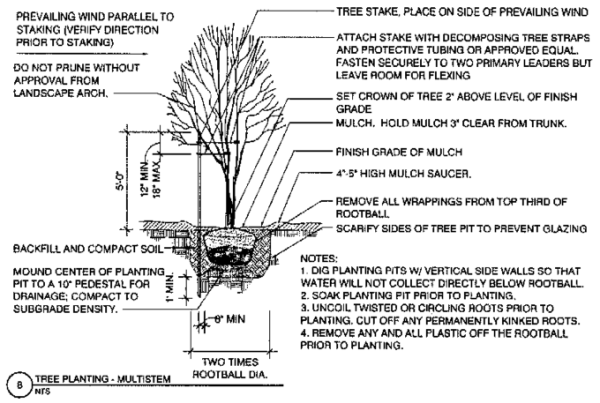
- Typical planting detail for a multi-stem tree or shrub. This particular detail does not include soil amendment, but soil amendment is recommended for the Choteau area.
- For each development where landscaping is required under this Zoning Code, a landscape plan shall be submitted as part of the application for a zoning permit. Landscaping that meets the standards of this section, as well as the applicable zoning district, is required for all new development and redevelopment. Landscape plans shall be drawn to scale and shall include:
- Nonconforming properties.
- Properties that do not meet the landscape standards set forth in this chapter, but which were legally developed prior to the effective date of this chapter, may continue as legally nonconforming properties. However, additional landscaping toward meeting the standards of this chapter shall be required in the event of:
- The use of the property changing from one permitted use to another;
- The use of the property changing from a permitted use to a special use;
- An additional structure is constructed on the subject property;
- The existing floor area of all structures on the property is increased by 25% or more; and
- The parking area is paved and/or reconstructed.
- The amount and extent of additional landscaping required on nonconforming properties shall be to the extent practicable as determined by the Zoning Administrator.
- Properties that do not meet the landscape standards set forth in this chapter, but which were legally developed prior to the effective date of this chapter, may continue as legally nonconforming properties. However, additional landscaping toward meeting the standards of this chapter shall be required in the event of:
- Selection of plant materials. All plant materials should be selected for their hardiness and survivability in the Choteau area, which is in USDA Zone 4. Specimen trees and ornamentals should be selected from the tree list provided in Appendix A of the City’s Master Forestry Plan.
- Minimum installed sizes. All landscape materials must meet at least the minimum installed sizes set forth below. Trees and plants recommended for USDA plant hardiness Zone 3b are preferred.
- Coniferous specimen trees (Austrian pine, blue spruce, Douglas fir, and the like): eight feet as measured from ground surface;
- Deciduous specimen trees (red oak, quaking aspen, Patmore ash, green ash, maple, and the like): two and one-half inch caliper as measured one foot above the ground surface;
- Ornamentals, multi-stem trees/shrubs (multi-stem aspen, amur maple, Russian olive, Walker weeping caragana, mountain ash, crabapple, and the like): five feet as measured from ground surface;
- Shrubs (potentilla, dwarf Arctic willow, snowberry, serviceberry, red twig dogwood, and the like): five-gallon containers;
- Ground covers (kinnikinik, sweetfern, cliff green, Tammy juniper, and the like): three-gallon containers. Rock, bark, and similar materials are suitable for planting beds, but not as a general ground cover; and
- Turf; seeding or sodding of turf grass areas are both permitted; grasses should be drought tolerant such as buffalo grass, blue grama, wheatgrass, and the like. Rock, bark, and similar materials may not be substituted for turf grass.
- Planting standards and guidelines. This division (G) contains standards and guidelines for the number and installed size of plant materials for each type of landscape area.
- General guidelines. For each 1,200 square feet of landscaped area, the following plant materials should be provided. Except for specimen trees, the quantities of plant materials are guidelines, and varying of these guidelines to accommodate the unique features of a development site is encouraged. However, specimen trees are required as set forth below:
- One specimen tree. No more than 75% of the required specimen trees shall be either conifer or deciduous;
- Two ornamental trees;
- Three large shrubs/multi-stems; and
- Ground cover and/or turf as appropriate.
- Planting strips. When landscape areas consist of strips no less than six feet and no more than 12 feet in width (such as in setbacks and adjacent to parking areas), the standards set forth in this subsection shall be applied. Because planting strips have their own set of unique standards, their area may be subtracted from the landscape area that is subject to the general guidelines and standards above.
- One specimen tree for each 40 linear feet of strip. Trees may be either deciduous or coniferous, as appropriate for the application. Trees need not be uniformly spaced, but may be grouped to present a more natural looking landscape.
- One ornamental tree for each 25 linear feet. Ornamentals may also be grouped or clustered for a more natural look.
- Adjacent to parking areas, car height screening is required. One shrub or multi-stem for each ten linear feet shall be provided, and may be clustered for a natural affect. Bark or mulch may be used for the shrub bed. For strips in side or rear setbacks that do not screen parking, shrubs are not required.
- Parking lot landscaping. This term refers to landscaping within the parking area itself.
- Landscape islands. Landscape islands shall be provided at least every ten parking spaces (20 spaces for a head to head arrangement). Islands shall be the approximate length of the adjacent parking space(s) and shall be at least eight feet in width. At least one deciduous specimen tree is required per island and the use of conifers is highly discouraged. The specimen tree should be selected so that it does not cause a visibility hazard to motorists as they maneuver in the parking area. Four shrubs not to exceed three and one-half feet in height as measured from the driving surface are also required in each island.
- Landscape strips (between parking rows). The use of landscape strips that separate two rows of parking spaces is discouraged.
- General guidelines. For each 1,200 square feet of landscaped area, the following plant materials should be provided. Except for specimen trees, the quantities of plant materials are guidelines, and varying of these guidelines to accommodate the unique features of a development site is encouraged. However, specimen trees are required as set forth below:
- Installation, phasing, and surety. Generally, landscaping shall be installed prior to issuance of a certificate of occupancy (CO). If no CO is required, installation must take place prior to occupancy (residential) or opening (nonresidential). Exceptions for landscape phasing and for building occupancy during seasons of the year not conducive to planting are set forth below.
- Should any project for which landscaping is required be completed and ready for occupancy between October 1 and April 15, landscape installation may be postponed until such time as weather and soil conditions allow for efficient installation and the best chance for survival of plant materials. Occupancy or opening of a project may be allowed by the city upon the posting of a surety (bond or letter of credit) equal to 110% of the estimated cost of the landscape installation.
- For development projects of two acres or more, landscaping may be phased over two planting seasons, provided that at least 50% of the required landscaping is installed during the first season prior to opening or occupancy as set forth in division (H)(1) above. In that event, a surety shall be provided equal to 110% of the estimated cost of the remaining landscaping.
- Maintenance and removal of dead and diseased plant materials. All required landscaping is required to be maintained in a park-like condition as it was originally approved. All diseased or dead plant materials must be replaced during the current or next planting season as applicable. Substitute plant species (a different species than was shown on the original approved landscape plan) may be approved by the Zoning Administrator upon request. Failure to maintain required landscaping is deemed a violation of this chapter.
(Prior Code, § 9-4-2) (Ord. 304, passed 4-10-2012) Penalty, see § 153.99
Property maintenance standards are intended to protect neighborhood quality, character, and property values by eliminating public health, safety, and nuisance issues associated with the accumulation of junk, debris, and the substandard maintenance of buildings and structures.
- Inoperable vehicles and parts. Inoperable vehicles or parts of vehicles, including, but not limited to, auto and truck bodies, boats, trailers, motorcycles, snowmobiles, RVs, engines, tires, rims, transmissions, and the like, may not be stored openly, except that when a vehicle is actively being restored or repaired, the vehicle itself may be stored outdoors for no more than 30 days.
- Trash and debris. No trash or debris shall be allowed to accumulate on properties, including, but not necessarily limited to, garbage, rubbish, ashes, yard and garden waste, tree trimmings, packaging, broken concrete or asphalt, furniture, appliances, scrap wood, demolition waste, building materials, and the like.
- Organic waste. Accumulation of organic waste is expressly prohibited and such wastes must be disposed of immediately. Organic waste includes, but is not necessarily limited to, septic tank pumpage, sludge, sewage of any kind, waste food items, dead animals and animal parts of any kind, manure, and the like. Compost bins are allowed provided that they are restricted to side and rear yard areas, odors are undetectable from adjacent properties, and that they do not attract wildlife.
- Building condition and maintenance. All buildings and structures shall be kept in a sound and livable condition and properly maintained, including siding, roofing, paint or stain, decks, porches, balconies, and windows, including screens and sashes. Structures are not permitted to remain in an obvious partially constructed state without continuous progress being made to complete the structure.
- Building construction. During construction, all building materials and construction waste must be contained on site. Outdoor burning of waste building materials is not permitted within the city limits.
(Prior Code, § 9-4-3) (Ord. 304, passed 4-10-2012) Penalty, see § 153.99
A home-based business is a nonresidential accessory and incidental use of residential property. Typically, it is a business operated from a home with part of the floor area of the residential unit and/or an accessory structure devoted to the business. This Zoning Code recognizes two types of home-based businesses: home occupations and cottage industries.
- Home occupations. The following standards and conditions apply to home occupations.
- Home occupations are conducted entirely within the primary dwelling unit and/or in an attached garage, provided that at least the minimum number of required parking spaces is maintained. Home occupations are not allowed to operate in a detached accessory structure of any kind. Home occupations may be operated from a single-family detached residence, duplex, townhome, or multi-family dwelling unit.
- No more than 25% of the floor area of the primary dwelling may be used for the home occupation. (Note: floor area of an attached garage may not be counted toward the allowable floor area for the home occupation.)
- There may be no outward appearance or visible evidence that a home occupation is being conducted on site, except for signage permitted by division (A)(5) below.
- No outdoor storage is permitted with the exception of one boat, trailer, RV, ATV, and the like, that is used in the operation of the home occupation. Such storage is not permitted in the front yard area of the primary residence, but may be located in a driveway, provided all required off-street parking spaces are maintained.
- One sign no greater than six square feet is allowed. Said sign must be wall-mounted to the primary structure and is subject to a sign permit.
- Home occupations are conducted solely by the resident or residents of the dwelling, including any ARUs. No one living off-site may be employed on the premises.
- No traffic shall be generated by any home occupation greater than what would normally be expected in a residential neighborhood. Any delivery and supply vehicles shall be no larger than those that normally make deliveries to residential neighborhoods. Retail sales conducted on premises are expressly prohibited as a home occupation. Retail sales may take place via telecommunications with merchandise sent out by common carrier.
- No home occupation may impact adjacent residential properties with noise, smoke, glare, fumes, dust, or odors in excess of that which is typical of a dwelling unit.
- No home occupation shall cause visual or audible interference in any radio or television receivers off premises, or cause fluctuations in line voltage off premises.
- Home occupations that meet the standards of this division (A) may operate as permitted uses in all residential districts. A business license from the city may be required.
- Cottage industries. The following standards and conditions apply to cottage industries.
- Cottage industries may be conducted by any member(s) of the household or residents of any ARU on the subject property. In addition, up to two persons who do not reside on the premises may be employed on premises in the cottage industry.
- One off-street parking space for each employee not residing on premises must be provided. Said parking shall be in a driveway or to the side or rear of the primary residence.
- The minimum lot area for a cottage industry shall be 10,000 square feet, and the associated residence must be a single-family detached dwelling unit.
- The maximum floor area devoted to the cottage industry shall not exceed 50% of the floor area of the primary residence on the subject property.
- The cottage industry may be conducted in the home, in an attached garage (provided that at least the minimum number of required parking spaces is maintained), or in an accessory structure that conforms to the standards of the applicable zoning district.
- No outdoor storage is permitted with the exception of two boats, trailers, RVs, ATVs, and the like, that are used in the operation of the cottage industry. Such storage is not permitted in the front yard area of the primary residence.
- Two signs are permitted for a cottage industry. One sign may be mounted on a wooden post(s) in the front yard of the primary residence. This sign may be no more than four feet in height and six square feet per side in area. The second sign shall be mounted flat to the wall of the structure in which the cottage industry is conducted and near the entryway. This sign shall not exceed two square feet in area.
- No cottage industry may impact adjacent residential properties with noise, smoke, glare, fumes, dust, or odors in excess of that which is typical of a dwelling unit.
- No cottage industry shall cause visual or audible interference in any radio or television receivers off premises, or cause fluctuations in line voltage off premises.
- Other than employees as allowed in this subsection, no traffic shall be generated by any cottage industry greater than what would normally be expected in a residential neighborhood. Any delivery and supply vehicles shall be no larger than those that normally make deliveries to residential neighborhoods. Retail sales are expressly prohibited as a cottage industry.
- Cottage industries are subject to a home business permit issued by the City Council. Anyone seeking to initiate a cottage industry shall submit an application on a form provided by the city, including an accurate site plan of the subject property drawn to a suitable scale (one inch = ten feet, one inch = 20 feet, and the like). The application shall include the signatures of all adjacent property owners that they have been notified of the proposed cottage industry. An application fee shall be set by resolution of the City Council. The City Council may act to approve, disapprove, or approve the application with conditions, at any regular meeting for which the agenda is published in the city’s newspaper of record. A business license from the city may also be required. Any cottage industry that is initiated without a home business permit and/or a business license if so required, is deemed in violation of these regulations.
(Prior Code, § 9-4-4) (Ord. 304, passed 4-10-2012) Penalty, see § 153.99
For residential structures in the A and B Residential Zoning Districts only, the applicant has the option of using the front setback prescribed for the applicable district, or, the prevailing setback provision may be used as set forth in this section.
- In lieu of the prescribed front setback, the applicant may reduce the required setback by using the mean setback of the four closest dwellings on the same side of the street.
- The applicant is responsible for obtaining accurate measurements of the four nearest residential structures and presenting them to the Zoning Administrator along with the application for a zoning permit.
- The applicant may use any dimension between the prescribed front setback and the mean of the four nearest dwelling units. (Example: Prescribed front setback is 16 feet. The mean front setback of the four nearest dwelling units is ten feet. The applicant may use any dimension between ten feet and 16 feet for the front setback.)
- Where a maximum front setback is specified, it may not be varied through this process.
(Prior Code, § 9-4-5) (Ord. 304, passed 4-10-2012)
The “height of a structure” is defined as the distance from the highest point of a roof to the nearest point of finished or natural grade, whichever one is applicable. Structural height is further determined as follows.
- Highest point of a structure. The highest point of a structure is the top of the highest roof pitch for a hip or gabled roof, or top of parapet for a flat roof not including any mechanical structures. Steeples, chimneys, antennas, receiving dishes, and the like, are not subject to limitations of structural height, except cell towers which are limited to 50 feet in height.
- Finished grade. Finished grade shall be construed as the grade at the base or foundation of a structure necessary to achieve positive drainage away from the structure only. Soil, fill, or other material may not be bermed against a structure to circumvent height limits.
- Natural grade. Natural grade shall be construed as meaning that the natural slope and topography of the land need little or no modification to site the structure. Where the nearest two points to natural grade are at different grades (such as, a house that takes up grade through the structure), the heights measured may be averaged.
(Prior Code, § 9-4-6) (Ord. 304, passed 4-10-2012)
- Front setbacks.
- A required front setback is measured at a right angle (90 degrees) from the front property line to the nearest of the following two points on the structure:
- The foundation wall of the principal structure; or
- The facing edge of a porch or deck over 16 square feet in area extending from the front of the principal structure.
- The following encroachments into the front setback are allowed:
- Steps are allowed to encroach into the required front setback up to eight feet;
- Ramps to provide accessibility to disabled persons may encroach up to 100%, but may not encroach onto the public right-of-way without special authorization from the holder of said right-of-way;
- Eaves may encroach up to two feet; and
- Porches and decks not exceeding 16 square feet in total area may encroach up to four feet.
- A required front setback is measured at a right angle (90 degrees) from the front property line to the nearest of the following two points on the structure:
- Side setbacks. A required side setback is measured at a right angle (90 degrees) from the side lot line to the nearest point of the foundation wall. Chimneys, eaves, bay windows no more than eight feet in total length, and garden windows may encroach no more than two feet into the required side setback.
- Rear setback. A required rear setback is measured at a right angle from the rear setback line to the nearest point on the foundation wall. Eaves may encroach no more than two feet and a deck or porch of no more than 16 square feet total area may encroach no more than four feet.
(Prior Code, § 9-4-7) (Ord. 304, passed 4-10-2012)
All outdoor lighting shall be downcast and shielded. No light trespass shall be allowed and no glare (direct sightline to an unshielded light source) shall be visible from off-site. This includes all light sources including freestanding luminaires, building mounted lighting, and canopy lighting.
(Prior Code, § 9-4-8) (Ord. 304, passed 4-10-2012) Penalty, see § 153.99
- Purpose. The purpose of these standards is to provide functional parking areas with safe and efficient circulation patterns that are adequate to meet the needs of users while avoiding the negative environmental and urban design impacts that can result from parking lots and other vehicular use areas. The provisions of this section aim to protect the public health, safety, and general welfare by avoiding spillover parking into adjacent neighborhoods, lessening and/or mitigating traffic congestion, enhancing pedestrian safety, reducing stormwater runoff; improving air quality through dust abatement encouraging infill development, and providing flexible methods to respond to the transportation and access demands of various land uses in different areas of the community.
- Applicability. Generally, the standards set forth herein apply only to new construction, new expansions of existing building or land uses, and changes of land use that result in greater parking requirements.
- Unless otherwise expressly stated, the parking standards of this section apply whenever an existing building or use is enlarged or expanded to include additional dwelling units, floor area, seating capacity, employees, or other units of measurement used for establishing off-street parking requirements.
- In the case of enlargements, expansions, or land use changes that require additional parking, additional spaces are required only to serve the enlarged or expanded area, or in the case of a land use change, only the difference in spaces required between the old and new use. There is no requirement to address lawfully existing parking deficits unless the site is completely redeveloped.
- Exemptions. As set forth in § 153.31(G) of this chapter, within the Central Business District (CB), all lodging, governmental facilities, and residential development must provide parking according to the standards set forth in this section. All other uses in the CB are exempt from off-street parking requirements.
- Calculation of space requirements.
- Floor area. When parking space requirements are based on floor area, the entire gross floor area in square feet must be calculated.
- Fractions. When calculations of the required number of spaces results in a fraction of a space, any fraction (represented as a decimal) of less than 0.5 is rounded down to the nearest whole space. Any fraction of 0.5 or greater is rounded up to the next whole space.
- Mixed uses. If more than one type of land use occupies a single structure or parcel of land where shared parking and access have been provided for, the total requirement for off-street parking shall be the sum of the requirements for all uses minus 10% of the total. If the peak parking demands of the various mixed uses occur on different days or at different times of the day, the land owner or developer may, upon producing relevant data and other evidence, request a reduction in the total parking requirement from the Zoning Administrator.
- General requirements.
- Location of parking spaces and access.
- All required parking spaces shall be on the same lot or an adjoining lot under the same ownership or lease with the principal building(s) that the parking serves.
- In the A and B Residential and BR Zoning Districts, parking is prohibited in front and street side setbacks, except that parking spaces may be located in front of a garage or carport that is located outside of required building setbacks. No more than 40% of the front yard area in a residential district may be paved or used for the parking or storage of vehicles. On corner parcels, not more than 20% of the street side yard area may be paved or devoted to parking or other vehicle use.
- In nonresidential districts, parking is permitted in all setbacks, provided it complies with standards for screening and landscaping. In no case shall a parking space be located such that it allows a vehicle to park across an external property line.
- Except for one- and two-family dwellings, no parking area shall be designed and constructed such that vehicles are permitted to back into a street.
- Surface material. All parking and drive areas within the city shall be surfaced with asphalt, concrete, or similar material, with an adequate subsurface base to produce a long lasting, durable, weatherproof surface. Exceptions to this standard are:
- One- and two-family residential development, provided that all surfaces are kept dust free;
- Any parking or drive area that is accessed from an unpaved alley or street;
- At the discretion of the Zoning Administrator, spillover parking or other parking that is not used on a regular and/or frequent basis may be treated with “turf block”, “grasscrete”, or similar products that allow grass or ground cover to grow in spaces between the structure of the product while still supporting the weight of vehicles; and
- Emergency access across open space or landscaped areas may be treated with products described in division (E)(2)(c) above, subject to approval of the Zoning Administrator and local Fire Department.
- Lighting. For parking areas of eight or more spaces, lighting of the parking area and walkways shall be provided to a 1.5 foot-candle level of illumination. Light sources shall be directed downward and shall be shielded to prevent spillover lighting onto adjacent properties.
- Curb stops. Where a vehicle overhang is adjacent to a walkway, landscaped area, or a wall, curb stops are required.
- Maintenance and use. The maintenance of all parking and drive areas is the responsibility of the property owner. The following maintenance and use standards apply to required off-street parking.
- Required off-street parking areas must be used solely for the temporary parking of licensed motor vehicles in operating condition.
- Required off-street parking spaces may not be used for the display of goods for sale or lease.
- Required off-street parking may not be used for open storage, storage of building materials, or storage of inoperable vehicles.
- Off-street parking spaces must be maintained to be free of potholes, trash, debris, dirt, and dust.
- No commercial motor vehicle repair work of any kind is permitted in a required parking space.
- Snow storage and drainage retention. The design of parking facilities with area for snow storage, drainage retention, or both functions within the same area, is encouraged by the city. Such areas may be provided within landscape areas and setbacks.
- Shared parking and shared access. In any development where there are two or more businesses both using the same parking area and common points of access, the property shall be encumbered by a “shared parking, shared access” easement. This easement may be placed on the face of the plat, or may be filed by separate instrument. The Zoning Administrator may require proof of such an easement prior to, or as a condition of, a zoning permit.
- Location of parking spaces and access.
- Parking requirements by use. The numbers of spaces required in this section are minimums and shall be maintained by ownership, easement, or lease, for as long as the land use which is served by the parking exists.
- Maximum number of spaces. Provision of more than 125% of the minimum number of spaces required is not permitted.
- On-street parking. No credit against the required off-street parking shall be allowed for on street spaces.
- Uses not specifically listed. For uses not listed in the space requirements set forth in this subsection, the Zoning Administrator shall determine the appropriate requirement based upon any similar uses that are listed and/or upon research.
- Required off-street parking spaces. The minimum number of parking spaces by land use is as follows:
Commercial Auto repair/quick lube 1 space per service bay Bed and breakfast or suite 2 spaces plus 1 space per rentable room Childcare (commercial) 1 space for every 10 children permitted based on total gross floor area and facilities; drop off area Hotel/motel 1 space per room or suite Restaurants (high turnover) 1 space per 3 seats Restaurants (sit down) 1 space per 4 seats Retail (general and specialty) 1 space per 250 gsf (gross square feet) Retail (home furnishings/home improvement) 1 space per 600 gsf Taverns 1 space per 4 seats table space, 1 space per 2 bar seats Theaters and other assembly 1 space per 4 seats Veterinary clinic 1 space per 400 gsf Industrial Manufacturing/assembly/fabrication 1 space per 800 gsf of active production area Warehousing/distribution 1 space per 2,000 gsf Office General/agency/professional office 3 spaces per 1,000 gsf Medical/dental 1 space per 250 gsf Public/Semi-Public Churches 1 space per 4 seats in main assembly area Government offices Determined by function Recreation center/facility Determined by function Residential 1 bedroom units, including “efficiency apartments” 1 space per unit Accessory dwelling unit (ADU) No additional spaces required All other multi-family units 1.5 spaces per unit Multi-family elderly 1 space per unit One- and two-family residential, including town homes, manufactured, and mobile units 1 space per unit
- Handicap accessible parking.
- Handicap accessible spaces required. Handicap accessible off-street parking shall be required according to the following schedule:
Total Spaces Provided Handicap Accessible Spaces (Minimum) 5 to 20 1 21 to 40 2 41 to 65 3 65+ 3% of total spaces required - Van accessible spaces. One out of each eight accessible spaces provided, but at least one space in each parking facility, shall be van accessible.
- Location. Accessible parking spaces shall be located so as to provide the shortest accessible route to a primary building entrance.
- Curb ramps and accessible routes. Curb ramps and accessible routes shall be provided which allow unobstructed travel from an accessible parking space to an accessible entrance. Parked vehicle overhangs shall not reduce the clear width of an accessible route. Parking spaces and access aisles shall not exceed 2% grade in all directions.
- Signage. Each accessible space shall be identified by a sign showing a universal symbol of accessibility (wheelchair). Van accessible spaces shall have an additional sign (“van accessible”) mounted below the accessibility symbol. Each sign shall be no smaller than one-foot by one-foot and shall be located at the end of the space at a height between four feet and seven feet. The sign(s) may be either wall mounted or freestanding. In addition, a painted accessibility symbol shall be painted directly onto the parking lot surface within the accessible space(s).
- Dimensional standards. All handicap accessible spaces shall be a minimum of 20 feet in length. Where two spaces share an accessible area, the minimum stall width shall be eight feet, and the width of the common accessible area shall also be eight feet.
Exhibit 36-5 Layout of Standard and Van Accessible Parking Spaces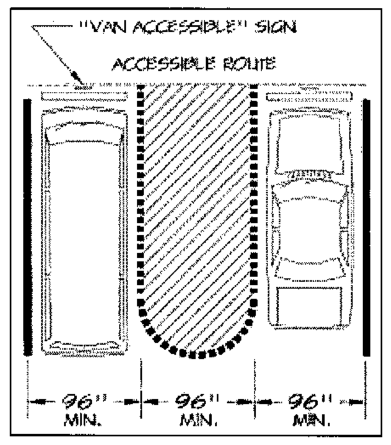
This illustration shows one van accessible space and one car/truck space utilizing a common accessible area. The width of each space is eight feet. At least one van accessible space is required in each parking facility.
- Handicap accessible spaces required. Handicap accessible off-street parking shall be required according to the following schedule:
- Dimensional standards. This division sets forth standards for the length and width of parking stalls and drive areas.
- Parallel spaces. Parking spaces designed parallel to a curb or wall shall be at least ten feet in width and 22.5 feet in length.
- Ninety degree spaces. All 90-degree parking spaces (perpendicular to the aisle) shall be at least ten feet in width and 20 feet in length. The two-way aisle shall be not less than 24 feet in width.
- Sixty and 45-degree spaces. All 60- and 45-degree parking spaces (angle from the aisle) shall be at least ten feet in width and 20 feet in length. A one-way aisle shall be 15 feet in width and a two-way aisle shall be not less than 22 feet wide.
(Prior Code, § 9-4-9) (Ord. 304, passed 4-10-2012) (Ord. 319, passed 10-8-2024) Penalty, see § 153.99
- Residential design standards.
- Orientation. Each primary single-family detached residence shall have a main entry facing the street from which the structure is addressed and draws its legal access.
- Eaves. All residential structures with pitched roofs shall have eaves not less than 12 inches.
- Facade materials. Residential structures shall not be sided with materials that are decidedly industrial in character. Materials such as uncoated metal, unpainted block masonry, split faced masonry, and synthetic stucco may be used for trim or architectural embellishment, but may not be used as primary facade materials. Wood, brick, or stone (including synthetic stone) are preferred materials.
- Covered entryways. The main entryway to a residential structure shall be shielded by a canopy, eave, or similar structure that extends from the exterior wall not less than four feet.
- CB design standards and guidelines.
- Purpose. The purpose of this division is to set forth basic design standards for certain specific elements of downtown built environment. These standards are intended to protect the downtown’s unique character and qualities while stimulating and protecting investment, and allowing the architect or designer the latitude to develop a creative response to any design issue. Where standards use terms such as “must”, “required”, or “shall be”, they are mandatory. Where terms such as “encouraged”, “preferred”, “may” or “optional” are used, the standard is considered a guideline and is voluntary. These standards and guidelines apply to the central business zoning district only.
- Front setbacks and exceptions. All primary structures are required to have a front setback from zero to five feet. The Zoning Administrator is empowered to grant an exception for a front setback of no more than 15 feet then the space between the principal structure and the front property line is designated on the zoning permit site plan as being used for outdoor dining, for public art, or for use as a plaza or other public gathering place. An increased front setback to allow parking in front of a structure is expressly prohibited.
- Exterior building materials. Acceptable exterior building materials for the fronts (street facing) of primary structures include wood and manufactured woodgrain hardboard, brick, split faced block, decorative (painted or coated) metal siding, and stone, including manufactured stone. Acceptable materials for the sides and rear of primary structures and for accessory structures include smooth painted concrete or cinder block, finished metal siding of all types, synthetic stucco, exterior insulated finish system, and vinyl exterior finishes of all types.
- Exterior colors. A wide variety of colors are acceptable in the CB District, including muted colors with a pastel or earth tone hue and all finished natural wood colors. Fluorescent or Day-Glo colors of any shade are prohibited. Bright and heavily saturated primary colors are encouraged for trim and architectural embellishments only.
- Entryways. A building’s primary door and entrance shall be located in the principal facade of the structure, and shall be oriented toward the street. The primary entrance must be readily apparent as a prominent architectural component. Entryways should be recessed from the front property line so that patrons have a queuing area out of the pedestrian flow. The recessed area must be at a minimum one and one-half times the width of the door to avoid a corridor like effect. Doors shall permit clear two-way visibility, and wood and glass are preferable materials.
- Windows. Street level windows are required of all structures, including the sides of structures occupying corner lots. Windows shall begin at least three feet above the sidewalk and may extend vertically to the top of the first level. Street level windows shall be designed to engage the pedestrian and invite visual inspection of the interior of the establishment, as well as to view displays of merchandise. Stenciled signage or other signage types that allow visual penetration through the lettering is encouraged. Reflective glazing is expressly prohibited. Windows may be recessed to allow patrons to view displays out of the pedestrian flow. Bay windows may not extend into the right-of-way (sidewalk area). Unframed windows are not permitted unless set into a brick or stone like facade.
- Modulation. Segments of plain or uniformly treated storefronts that are out of context with adjacent or nearby buildings are prohibited. Such treatments may be avoided or mitigated through modulation. In architectural terms, modulation is a technique for visually dividing the facade so that it takes on the appearance of distinctly different structures or portions of structures. This architectural technique is used to add visual interest to long storefronts or to other structures that occupy a significant segment of a downtown block. Visual interest can also be achieved through repeating architectural features, such as windows and the elements that frame them, and through recesses, off-sets, and other variations in plane sufficient to add shadow lines or depth to the facade.
- Lighting. Outside lighting should be minimal, and downtown businesses are encouraged to rely on ambient lighting provided by streetlights for the safe illumination of the sidewalk area. Low wattage lighting may be used to highlight an entryway provided no glare is cast out onto the sidewalk. Merchants are also encouraged to illuminate window displays and interior spaces provided that no glare is cast onto the sidewalk area. Flashing or strobe type lighting is prohibited.
- Fencing. Chainlink and other types of metal fencing shall not be visible from the street or sidewalk.
- BR design standards and guidelines.
- Purpose. The purpose of this division is to set forth basic design standards for certain specific elements of the business residential transition area that lies between the CB and the city’s traditional residential neighborhoods. Like the CB standards, these standards are intended to protect the character and qualities of the transition area, and stimulate investment while allowing the architect or designer the latitude to develop a creative response to any design issue. Where standards use terms such as “must”, “required”, or “shall be”, they are mandatory. Where terms such as “encouraged”, “preferred”, “may” or “optional” are used, the standard is considered a guideline and is voluntary. These standards and guidelines apply to the Business Residential Zoning District only.
- Exterior building materials. The BR transition area is more residential in character than the CB, and this should be reflected in the choice of exterior materials. Acceptable building materials for the fronts (street facing) and sides of buildings include wood and manufactured woodgrain hardboard, brick, painted or coated metal siding, and stone, including manufactured stone. Acceptable materials for the rear of primary structures and for accessory structures include smooth painted concrete (prestress or block), finished metal siding of all types, synthetic stucco, exterior insulated finish system, and vinyl exterior finishes of all types.
- Exterior colors. A wide variety of colors are acceptable in the BR transition area, including muted colors with a pastel or earth tone hue and all finished natural wood colors. Fluorescent or Day-Glo colors of any shade are prohibited. Bright and heavily saturated primary colors are encouraged for trim and architectural embellishments only.
- Entryways. A building’s primary door and entrance shall be located in the principal facade of the structure, and shall be oriented toward the street. The primary entrance must be readily apparent as a prominent architectural component, and may include a porch, deck, or other outdoor living space, and merchandise may be displayed in this area. Secondary entries and exits may be provided at the sides and rear of buildings.
- Windows. Lower level windows are required in all primary buildings, and shall be viewable by pedestrians on the public way in front of the property. Lower level windows shall be designed to engage the pedestrian and invite visual inspection of the interior of the establishment, as well as to view displays of merchandise. Stenciled signage or other signage types that allow visual penetration through the lettering is encouraged. Reflective glazing is prohibited, but awnings and window coverings to shade the morning or afternoon sun are allowed. Unframed windows are not permitted unless set into a brick or stone like facade.
- Lighting. Outside lighting should be residential like in intensity and direction, and should be used primarily to highlight entryways and outdoor spaces. Direct glare visible from the public way and trespass lighting onto adjacent properties are prohibited.
- Fencing. Chainlink and other types of metal fencing (except for wrought iron) shall not be visible from the adjacent street or sidewalk.
- HB design standards and guidelines.
- Purpose. The purpose of this division is to set forth basic design standards for certain specific elements of the highway business areas of the city that lie mostly on the fringes of town and generally encompass the “gateway” areas of the community. These gateway areas most often establish a first and lasting impression of the community. Therefore, a uniformly high standard of planning and design for the built environment of these areas benefits the entire community. Like other standards in this chapter, these standards are intended to set planning and design benchmarks and to stimulate and protect private investment, while allowing the architect or designer the latitude to develop a creative response to any design issue. Where standards use terms such as “must”, “required”, or “shall be”, they are mandatory. Where terms such as “encouraged”, “preferred”, “may” or “optional” are used, the standard is considered a guideline and is voluntary. These standards and guidelines apply to the Highway Business Zoning District only.
- Exterior building materials. A wide variety of exterior materials is acceptable for use in HB, including, but not necessarily limited to:
- Stone, including synthetic stone;
- Wood, both natural and woodgrain hardboard products;
- Concrete and cinder block, provided it is painted;
- Split face masonry;
- Stucco/Dryvit finishes; and
- Metal that is painted or otherwise coated. Unfinished metal or galvanized finishes are not acceptable, and Quonset style buildings are not acceptable in HB.
- Exterior colors. A wide variety of colors are acceptable in the HB District, including muted colors with a pastel or earth tone hue and all finished natural wood colors. Fluorescent or Day-Glo colors of any shade are prohibited. Bright and heavily saturated primary colors are encouraged for trim and architectural embellishments only.
- Entryways. A building’s primary door and entrance shall be located in the principal facade of the structure, and shall be oriented toward the street. The primary entrance must be readily apparent as a prominent architectural component, and may include a porch, deck, or other outdoor living space, and merchandise may be displayed in this area. Secondary entries and exits may be provided at the sides and rear of buildings.
- Windows. Lower level windows are encouraged, but not required, in all primary buildings. Lower level windows should be designed to engage the pedestrian and invite visual inspection of the interior of the establishment, as well as to view displays of merchandise. Stenciled signage or other signage types that allow visual penetration through the lettering is encouraged. Reflective glazing is prohibited, but awnings and window coverings to shade the morning or afternoon sun are allowed. Unframed windows are not permitted unless set into a brick or stone like facade.
- Lighting. Outside lighting should be of sufficient intensity and suitable for an environment in which both vehicles and pedestrians will be present. Parking lot lighting is encouraged, but industrial and highway type fixtures are not permitted. Maximum height of light standards should be no more than 20 feet, and cutoff luminaires are required. Lighting elsewhere should be used primarily to highlight entryways and outdoor spaces. Direct glare visible from the public way and trespass lighting onto adjacent properties are prohibited.
- Fencing. Chainlink and other types of metal fencing shall not be visible from the adjacent street or sidewalk.
(Prior Code, § 9-4-10) (Ord. 304, passed 4-10-2012) Penalty, see § 153.99
Fences and retaining walls are allowed as accessory structures in all zoning districts, subject to zoning permits. The following standards must be met:
- Fencing.
- Height; materials. In all residential districts, in residential PUDs, and in the BR District, no fence, hedge, or freestanding wall (not part of a building) located within or bounding a required front setback, may exceed 42 inches in height. Fencing other than in the front setback shall not exceed six feet in height. Allowable fencing materials and designs include:
- Wood or vinyl (including PVC) picket or rail fencing;
- Within required front setbacks, wood or vinyl board fencing must maintain a minimum space of one inch between boards. Wood and vinyl board fencing elsewhere may be 100% sight obscuring;
- Wood or vinyl board on board fencing provided that boards on opposite sides of stringers do not overlap;
- Chainlink and woven metal fencing; and
- Other similar materials and designs as approved by the Zoning Administrator.
- Institutional security fencing. Open security fencing up to six feet in height may be allowed by the Zoning Administrator for schools, correctional facilities, and other public and quasi-public institutions when necessary for the safety or restraint of the occupants thereof, without regard to the setbacks specified in division (A)(1) above.
- Obstruction at intersection. No portion of any fence shall pose a visual obstruction at any street intersection. (See § 153.63 of this chapter for standards.)
- Ornamental pedestrian entries. Ornamental pedestrian entries, such as arches or arbors, shall not exceed ten feet in height.
- Vehicular entries. Vehicular entries for subdivisions, parks, and development projects shall not exceed 20 feet in height and 36 feet in width.
- Wire products. In all residential districts, residential PUDs, and in the BR and CB Districts, barbed wire, razor wire, concertina wire, and similar wire products are not allowable fencing materials.
- Open security fencing. In the CB, HB and GI Districts, for commercial and industrial storage areas located in side or rear yards, open security fencing may be constructed up to eight feet in height and may be topped with barbed wire. The barbed wire course is calculated as part of the allowable fence height.
- Wildlife exclusion fencing. Wildlife exclusion fencing up to eight feet in height is allowed for gardens, haystack yards, and similar areas, provided that the guidelines set forth in “A Landowners Guide to Wildlife Friendly Fences: How to Build Fence with Wildlife in Mind” are followed.
- Fences in excess of six feet. Any fence, or any portion of a fence, such as entryways and arbors, that exceeds six feet in height, is subject to a building permit.
- Height; materials. In all residential districts, in residential PUDs, and in the BR District, no fence, hedge, or freestanding wall (not part of a building) located within or bounding a required front setback, may exceed 42 inches in height. Fencing other than in the front setback shall not exceed six feet in height. Allowable fencing materials and designs include:
- Retaining walls. Retaining walls over four feet in height require a building permit.
(Prior Code, § 9-4-11) (Ord. 304, passed 4-10-2012) Penalty, see § 153.99
No use of land shall be permitted or allowed within the city that is in violation of federal, state or local law.
(Prior Code, § 9-4-12) (Ord. 314, passed 8-22-2017) Penalty, see § 153.99
- Status of nonconformities. The adoption of the Zoning Code will mean that some lots, land uses, and structures that may have conformed to the prior code will not conform to the provisions and standards set forth in this code. This section provides the standards and requirements by which legal nonconforming lots, uses, and structures may be continued and even transferred. It is the city’s intent that the adoption of these regulations will render no legal lot of record “unbuildable”, and that any use which was legal and proper under prior regulations will continue to be legal and proper under these regulations.
- Lots, uses, and structures that were legally nonconforming under prior regulations, and which do not conform to these regulations, remain legally nonconforming;
- Lots, uses, and structures that were legal and conformed to prior regulations, but do not conform to these regulations, become legally nonconforming under these regulations;
- Lots, uses, and structures which were not legal under prior regulations, and do not conform to these regulations, remain illegal under these regulations; and
- Legally nonconforming lots and/or nonconforming lots with nonconforming structures, as well as nonconforming uses of land, may be transferred to heirs and assigns in a manner similar to any conforming lot, structure, or use.
- Nonconforming lots.
- Legal lots of record that previously existed on the effective date of these regulations that do not conform to these regulations due to lot area, width, or other dimensional standard, may continue to exist as legally nonconforming lots under these regulations.
- Nonconforming lots may be developed for any of the principal permitted, accessory, and conditional uses allowed by the applicable zoning district.
- Nonconforming lots are subject to all standards of the applicable zoning district, including setbacks, floor area ratios, landscape ratios, and structural height limits.
- Nonconforming land uses.
- Any land use that previously existed on the effective date of these regulations, conformed to the prior regulations, but does not conform to these regulations, may continue to exist as a legally nonconforming land use.
- No such nonconforming use shall be enlarged nor extended to occupy a greater area of land or structure than was occupied on the effective date of these regulations.
- No such nonconforming use shall be moved in whole or in part to any portion of the lot or parcel other than that occupied on the effective date of these regulations.
- If any such nonconforming use is discontinued for any reason for a period of one year (calendar date to calendar date), or three years in the case of nonresidential uses in the B Residential District, any subsequent use of the subject property and/or structure shall conform to these regulations.
- No additional structure not conforming to these regulations shall be erected in connection with such nonconforming use of land or structures.
- Nonconforming structures.
- Any structure that previously existed on the effective date of these regulations, which conformed to the prior regulations, but does not conform to these regulations in terms of height, setbacks, floor area ratio, landscape ratio, or other such standards, may continue to exist as a legally nonconforming structure under these regulations.
- No such nonconforming structure may be enlarged, expanded, or altered in a way that increases its nonconformity, but may be altered to decrease its nonconformity.
- Should such nonconforming structure be moved for any reason and for any distance, it shall thereafter conform to these regulations.
- Should any nonconforming structure or nonconforming portion of a structure be destroyed by any means to an extent greater than 50% of its floor area, it shall not be reconstructed except in conformity with these regulations.
- Nothing in these regulations shall be deemed to prevent the strengthening or restoring to a safe condition of any structure or portion of a structure declared to be unsafe by an official charged with protecting the public safety, upon order of such official.
- Nonconforming manufactured homes.
- Consistent with § 153.28 of this chapter, legally existing Class B and Class C manufactured homes in the A Residential Zoning District may only be replaced by a Class A manufactured home or a site built dwelling unit. In addition to this requirement, all Class B and C manufactured homes in the A Residential Zoning District are subject to applicable provisions from divisions (C) and (D) above.
- Consistent with § 153.29 of this chapter, legally existing Class B and Class C manufactured homes in the B Residential Zoning District may only be replaced by a Class A or B manufactured home or a site built dwelling unit.
(Prior Code, § 9-4-13) (Ord. 304, passed 4-10-2012) Penalty, see § 153.99
- Corner visibility triangle. Every street intersection shall have associated with it a corner visibility triangle. This area shall be created by extending the curb lines (or edge of pavement where there are no curbs) to an imaginary point in the street where the lines intersect. From that point, 30 feet is measured back along each line, then a line across both ends is drawn to close the triangle. In most cases, this triangular area will include both public right-of-way and private property adjacent to the right-of-way.
- Visibility standards. Within the corner visibility triangle, there shall be no continuous obstructions between the heights of 30 inches and ten feet, as measured from the adjacent road surface. This includes landscaping, fencing, and structures of all kinds.
- Applicability. This standard applies to streets of all functional classifications, but does not apply to intersections of a street and an alley.
(Prior Code, § 9-4-14) (Ord. 304, passed 4-10-2012)
- Parking and storage. Major recreational equipment shall not be parked or stored in any required front or side yard other than a driveway that provides direct access from the street to a garage or carport. However, major recreational equipment may be parked anywhere on residential property for the purpose of loading or unloading for a period not to exceed 24 hours. Major recreational equipment may be parked or stored in bona fide commercial storage facilities that meet the standards of these regulations.
- Use as living or sleeping quarters. Major recreational equipment shall not be used for sleeping, living, housekeeping, or any commercial purpose (including home-based business) when parked or stored on property within a residential zoning district. Use of major recreational equipment as an ARU or as guest quarters is expressly prohibited.
(Prior Code, § 9-4-15) (Ord. 304, passed 4-10-2012) Penalty, see § 153.99
153.76 Zoning Permit Fee Required
153.77 Application For Zoning Permit
153.78 Site Inspections
153.79 Limitations Of Zoning Permit
153.80 Expiration Of Zoning Permits; Extension
153.81 Revocation Of Zoning Permits
153.82 Certificate Of Compliance Required
153.83 Administrative Appeals
153.84 Variances
153.85 Zoning Administrator
153.86 Board Of Adjustment
153.87 Zoning Commission
153.88 Amendments To The Zoning Code
153.89 Amendments To The Official Zoning Map
153.90 Amendments To The Growth Policy
153.91 Zoning Administrator Responsible For Enforcement
153.92 Enforcement Protocol To Be Established
153.93 Application For Variance Stays All Abatement Proceedings
153.94 Appeal Stays All Abatement Proceedings
153.95 Imminent Threat To Life Or Property
153.99 Penalty
A zoning permit shall be required for any construction, reconstruction, addition, relocation of a structure, or change of land use, and for permanent signs of all kinds. Subdivisions are not subject to zoning permits, but shall be designed, reviewed, and approved pursuant to the State Subdivision and Platting Act, being MCA §§ 76-3-101 et seq., and local subdivision regulations in effect for the city. Interior modifications of structures, and any other renovations that do not increase the floor area of a structure or cause expansion of the structure in any way, are not subject to zoning permits. Agricultural buildings associated with bona fide agricultural operations are not subject to zoning permits, but such structures must meet any applicable requirements of this chapter. Zoning permits shall be applied for on a form provided by the city, and are reviewed according to procedures established by the city.
(Prior Code, § 9-2-1) (Ord. 304, passed 4-10-2012)
Each application for a zoning permit shall include the applicable fee. Fees are established by resolution of the City Council. No application for a zoning permit is complete without the required fee.
(Prior Code, § 9-2-2) (Ord. 304, passed 4-10-2012)
The purpose of the zoning permit is to assure that all building construction and development activity complies with these regulations, as well as regulations promulgated by other agencies as applicable. An application for a zoning permit may be filed either concurrently with a building permit application or prior to applying for a building permit. A zoning permit application may also be filed concurrently or prior to any application for a city business license.
- The applicant shall file a properly completed application form, including a site plan, project description, and any other required supporting materials, with the Zoning Administrator. Once all required materials are submitted, the Zoning Administrator shall deem the application complete.
- The Zoning Administrator or his or her designee shall review the application to determine compliance with these regulations. Should the Zoning Administrator find that the application complies with these regulations, the application shall be approved. However, the Zoning Administrator may impose reasonable conditions on the zoning permit to ensure compliance with these regulations, as well as the regulations promulgated by other agencies as they may apply.
- The application shall be approved or denied within 20 business days and the applicant shall be notified in writing within five business days of the decision.
(Prior Code, § 9-2-3) (Ord. 304, passed 4-10-2012)
The filing of an application for a zoning permit constitutes consent of the property owner and applicant for authorized city personnel to conduct inspections of the subject property during the review process. Refusal of the owner or applicant to allow authorized personnel on site for necessary inspections may delay review of the permit application, and/or result in denial of the application.
(Prior Code, § 9-2-4) (Ord. 304, passed 4-10-2012)
Zoning permits issued pursuant to this chapter are limited in their authorization to the work and/or development expressly described therein. Issuance of a zoning permit does not convey any broad powers or authority to the applicant beyond the purpose described in the zoning permit application and for which the permit was issued. Zoning permits shall run with the land, are site specific, and are not transferable to another property or site.
(Prior Code, § 9-2-5) (Ord. 304, passed 4-10-2012)
If the work described in the zoning permit has not begun within one year from the date of issuance, the permit expires and is void. The Zoning Administrator shall provide written notice to the permittee once a permit expires. Should the permittee request in writing an extension of the zoning permit, the Zoning Administrator may grant such extension for not more than one year. Any such request for an extension must be made prior to the actual expiration of the zoning permit. The Zoning Administrator is not empowered to reinstate an expired zoning permit.
(Prior Code, § 9-2-6) (Ord. 304, passed 4-10-2012)
- Zoning permits may be revoked for good cause shown. Procedures to revoke zoning permits may only be initiated by the city and only the City Council is authorized to revoke a zoning permit.
- Prior to initiating any permit revocation procedure, the city shall have:
- Conducted an inspection of the subject property;
- Thoroughly investigated any complaints;
- Contacted the permittee in writing notifying him or her of the nature of complaints, issues, and/or potential violations; and
- Provided the permittee every reasonable opportunity to address and correct conditions, violations, or deficiencies.
- A zoning permit may be revoked based on one or more of the following findings:
- That the initial application and/or representations made by the applicant in connection with the application were fraudulent or otherwise inaccurate or misleading to the extent that the decision to grant the zoning permit was based upon or influenced by said application or representations; and
- That operation of the authorized use or development has become a public nuisance and/or an imminent threat to the public health, safety, and general welfare.
- The City Council may revoke a zoning permit upon approval of a motion by simple majority where findings and cause for the revocation are set forth in the motion to revoke.
- The applicant shall be notified of the revocation action through a cease and desist order issued by the Zoning Administrator.
(Prior Code, § 9-2-7) (Ord. 304, passed 4-10-2012)
- Once a development project has been completed, a certificate of compliance (CC) must be requested from the city on a form provided by the Zoning Administrator. The purpose of the CC is to ensure that all work described on the approved zoning permit has been completed, or as applicable, a surety for performance has been provided.
- Should a certificate of compliance be applied for in the months of October through March, a surety may be provided in lieu of landscaping, paving, or other improvements that do not affect the immediate and safe use of the site, and that cannot be installed during cold weather periods. Sureties may include letters of credit, bonds, or certified checks left on file with the city until such time as the improvements are satisfactorily completed. Personal or company checks cannot be accepted as sureties.
- Failure to obtain a certificate of compliance prior to occupying the project or improvement for which the zoning permit was issued is deemed a violation of this code of ordinances.
(Prior Code, § 9-2-8) (Ord. 304, passed 4-10-2012) Penalty, see § 153.99
- Any interpretation of these regulations or any decision made by the Zoning Administrator pursuant to these regulations may be appealed to the Board of Adjustment (BOA) following the procedures set forth below. Such appeal shall be taken within a reasonable time as provided by the rules of the Board.
- The appellant shall file a written appeal on a form provided by the city and shall provide all relevant supporting information. A filing fee shall be paid by the appellant.
- Upon receipt of the appeal, the Zoning Administrator shall publish a notice in the official city newspaper at least ten days prior to the next scheduled meeting of the Board of Adjustment, and shall place the appeal on the Board’s agenda for that meeting. The Board must meet within 25 business days of an appeal filed with the Zoning Administrator.
- The BOA shall conduct a hearing on the appeal following procedures set forth in the Board’s adopted rules of procedure. No appeal shall be heard if the appellant or a representative is not present. If the appeal involves an action taken or permit granted to a third party, such as a property owner or development, no hearing shall be conducted unless the third party is present.
- Based upon relevant findings and conclusions, the BOA may uphold, overturn, or modify the action or interpretation made by the Administrator. The BOA shall take final action within 20 business days of the initial opening of the public hearing.
- The Zoning Administrator shall notify the appellant and other interested parties in writing of the BOA’s decision within five business days.
- Any decision of the BOA may be appealed to district court as provided in MCA § 76-2-327. Notice of intent to file an appeal shall halt all proceedings by the Zoning Administrator to carry out the BOA decision, unless in the judgment of the Zoning Administrator, such action is imperative due to imminent public health or life safety concerns.
- When in the judgment of the Zoning Administrator, his or her decision or interpretation of the regulations will affect a specific property or class of properties, and/or have a potentially significant impact on a neighborhood or landscape of the city, the Zoning Administrator shall notify adjacent property owners via first class mail of his or her intent to render a decision or interpretation. The letter shall explain the pending decision and shall invite comment for a period of not less than 15 days following the date of the letter. At the end of this comment period, the Zoning Administrator may officially render the decision or interpretation, and communicate it in writing to all parties involved. Once the decision or interpretation is finalized, the decision or interpretation may be appealed to the Board of Adjustment through the procedure set forth in division (A) above.
(Prior Code, § 9-2-9) (Ord. 304, passed 4-10-2012)
The Board of Adjustment (BOA) may, in specific cases, grant relief from the standards and requirements of these regulations as set forth in MCA § 76-2-323.
- The applicant shall apply for a variance on a form supplied by the city. The applicable filing fee shall be paid and all relevant supporting materials shall be submitted.
- Upon receipt of the application, the Zoning Administrator shall publish a notice in the official city newspaper at least 15 calendar days prior to the next regular meeting of the Board of Adjustment and shall place the variance on the Board’s agenda for that meeting.
- The Zoning Administrator shall notify all property owners within 150 feet of the subject property by regular first class mail at least 15 calendar days prior to the date of the hearing by the BOA.
- The BOA shall conduct a hearing on the proposed variance following procedures set forth in the Board’s adopted rules of procedure. No hearing shall be conducted if the applicant or a representative is not present.
- In applying the provisions of MCA § 76-2-323(1)(c), the BOA may only grant relief upon a finding that the following criteria are met in substance as they may apply to the application:
- The variance is necessitated due to exceptional and/or extraordinary circumstances or conditions that are unique to the subject property, and are not generally characteristic of similarly situated properties;
- Approval of the variance(s) will preserve a property right or use that is generally enjoyed by owners of similarly situated properties, and conversely, approval of a variance will not bestow a special privilege on the applicant that is not generally enjoyed by the owners of similarly situated properties;
- The alleged hardship has not been created by the applicant;
- Specific relief from the code shall be the minimum necessary; and
- Adverse impacts associated with granting relief from the code are avoided or effectively mitigated.
- Conditions may be imposed by the BOA that will cause the above criteria to be met.
- Final action is required on a variance request within 20 business days of the initial opening of the public hearing.
- The Zoning Administrator shall notify the applicant and interested parties of the BOA decision in writing within five business days.
- Decisions of the BOA may be appealed to District Court as set forth in MCA § 76-2-327.
- Granting of a variance allows the applicant specific relief from the provisions of this code. Granting of a variance does not convey broad powers to deviate from other standards and requirements set forth herein. A variance runs with the land and is not transferable to another site or property.
(Prior Code, § 9-2-10) (Ord. 304, passed 4-10-2012)
- Duties; general. The Zoning Administrator is charged with the administration, interpretation, and enforcement of the Zoning Code.
- Powers and duties. The Zoning Administrator or his or her designees shall:
- Enforce any and all provisions of these regulations;
- Keep complete, accurate, and secure records;
- Accept applications and appeals, and ensure their appropriateness and completeness;
- Update these regulations and the official zoning map as directed by the City Council;
- Report to the Planning Board and City Council any recommendations for amendments and improvements to these regulations, and the procedures contained herein;
- Interpret these regulations as they apply to specific properties and developments, with the proviso that the Zoning Administrator does not have the authority to alter these regulations as they may apply to a specific property or to grant relief from the provisions of these regulations;
- Determine the location of any zoning district boundary;
- Render lawful similar use rulings for uses not specifically listed in the use table for the applicable zoning district;
- Receive and investigate allegations of noncompliance or violation of these regulations and take appropriate abatement action;
- Review and issue zoning permits;
- Make recommendations to the Board of Adjustment on variance applications; and
- Make recommendations to the Zoning Commission and City Council with regard to amendments to these regulations, the official zoning map, and to annexations.
(Prior Code, § 9-2-11) (Ord. 304, passed 4-10-2012)
- The Board of Adjustment is established as authorized in MCA § 76-2-321.
- The duties and powers of the Board of Adjustment are as follows:
- The Board of Adjustment shall consist of five members appointed by the City Council.
- The Board of Adjustment is established by Ordinance 226, as may be amended from time to time.
- The Board of Adjustment shall serve without compensation, except for expenses authorized in the performance of their duties.
- The Board of Adjustment shall have the authority to:
- Hear and decide appeals in which it has been alleged that there is an error in order, requirement, decision, or interpretation made by the Zoning Administrator in the enforcement of these regulations; and
- Hear and grant or deny any proper application for a variance to the terms, conditions, or standards of these regulations.
- The Board of Adjustment shall conduct hearings according to its own adopted rules of procedure.
(Prior Code, § 9-2-12) (Ord. 304, passed 4-10-2012)
- The Zoning Commission is established as authorized in MCA § 76-2-307.
- The duties and powers of the Zoning Commission are as follows:
- To conduct hearings and advise the City Council on matters of annexation, including the appropriate zoning district to which annexed property may be applied;
- To conduct studies and investigations on growth and/or growth management issues arising within and/or affecting the city, and to advise the City Council on such matters; and
- To hold public hearings on any request to amend these regulations and/or the official zoning map of the city, and to make recommendations to the City Council on such amendment requests.
(Prior Code, § 9-2-13) (Ord. 304, passed 4-10-2012)
- Amendments to the Zoning Code of the city may be initiated by the City Council, Zoning Commission, Board of Adjustment, or any individual, group of individuals, business, corporation, or other organization whether or not located in the city.
- Applications for Zoning Code amendments shall be made on a form provided by the city, and the applicable filing fee shall be paid. No application can be considered complete without the applicable fee.
- In the application, the complete rationale for the amendment must be provided, and the following criteria addressed to the extent they are applicable:
- How the proposed amendment implements the growth policy more effectively than existing language in the Zoning Code;
- How the proposed amendment will promote the public health, safety, and general welfare;
- How the proposed amendment facilitates the adequate provision of transportation, water, wastewater, schools, parks, and other public services;
- Impact of the proposed amendment on motorized and nonmotorized transportation systems;
- How the proposed amendment promotes compatible urban growth and enhances the character and qualities of the city;
- How the proposed amendment will contribute to conserving the value of buildings and encouraging the most appropriate use of land throughout the city; and
- Additional community benefits, if any, that will be provided or promoted by the proposed amendment.
- Once the Zoning Administrator has deemed the application complete, it shall be forwarded to the Zoning Commission for review and a public hearing. The public hearing shall be held no later than 60 calendar days after the application has been received by the Zoning Commission. The Zoning Administrator shall provide notice of the public hearing in a newspaper of general circulation at least 15 calendar days prior to the date of the hearing, and all other procedures set forth in section MCA § 76-2-303 shall be followed.
- The Zoning Commission shall forward its recommendation to the City Council within seven business days of the meeting at which the recommendation is adopted.
- The City Council shall take action on the proposed amendment and Zoning Commission recommendation within 30 business days following the receipt of the recommendation.
- Final action to adopt a Zoning Code amendment shall be by ordinance.
(Prior Code, § 9-2-14) (Ord. 304, passed 4-10-2012)
- Amendments to the official zoning map of the city may be initiated by the Zoning Commission, City Council, any individual, group of individuals, business, corporation, or any other organization with a property interest in at least one property within the amendment area. A property interest shall mean fee simple ownership or a contractual interest in purchasing a property.
- Applications for zoning map amendments shall be made on a form provided by the city. Included in the application shall be a scaled map of the proposed amendment area depicting existing and proposed zoning districts. The application must be signed by all owners of record of at least one property in the area of the proposed amendment, or, a separate letter of authorization, also signed by all owners of record of at least one of the affected properties, may be issued to the applicant.
- In the application, the complete rationale for the zoning map amendment must be provided, and the following criteria shall be addressed to the extent they are applicable:
- How the proposed map amendment implements the growth policy more effectively than the existing zoning district(s);
- How the proposed amendment will promote the health, safety, and general welfare;
- How the proposed amendment facilitates the adequate provision of transportation, water, wastewater, schools, parks, and other public services;
- Impact of the proposed amendment on motorized and non-motorized transportation systems;
- How the proposed amendment promotes compatible urban growth and enhances the character and qualities of the city;
- How the proposed map amendment will contribute to conserving the value of buildings and encouraging the most appropriate use of land throughout the city; and
- Additional community benefits, if any, that will be provided or promoted by the proposed map amendment.
- Once the Zoning Administrator has deemed the application complete, it shall be forwarded to the Zoning Commission for review and a public hearing. The public hearing shall be held no later than 60 calendar days after the application has been received by the Zoning Commission. The Zoning Administrator shall provide notice of the public hearing in a newspaper of general circulation at least 15 calendar days prior to the date of the hearing, and all other procedures set forth in MCA § 76-2-303 shall be followed.
- The Zoning Commission shall forward its recommendation to the City Council within seven business days of the meeting at which the recommendation is adopted.
- The City Council shall take action on the proposed amendment and Zoning Commission recommendation within 30 business days following the receipt of the recommendation.
- Final action to adopt a zoning map amendment shall be by ordinance.
(Prior Code, § 9-2-15) (Ord. 304, passed 4-10-2012)
- Pursuant to MCA § 76-1-601, the city growth policy shall be reviewed at least every five years. This review shall be conducted by the Choteau-Teton County City-County Planning Board in cooperation with the city. Results of the review shall be summarized in a written report to the City Council and citizens of the city. Should the City Council opt to revise the growth policy, procedures set forth in MCA §§ 76-1-602 to 76-1-604 shall be followed.
- An amendment to or review of the growth policy may be requested at any time by any individual, group of individuals, business, corporation, or other organization, whether or not it is located within the city. Such request shall be in writing, shall clearly describe the need for review or amendment, including relevant data, and shall be submitted to the Zoning Administrator, who shall forward the request to the City-County Planning Board.
- At its option, and for good cause shown, the City-County Planning Board may:
- Proceed with a review or amendment process based upon the written request; or
- Hold the request until the next scheduled growth policy review. The Board shall notify the originator of the request and the City Council in writing as to their decision.
- At any time, and for good cause shown, the City Council may direct a review or initiate an amendment to the growth policy.
(Prior Code, § 9-2-16) (Ord. 304, passed 4-10-2012)
The Zoning Code Administrator shall be responsible for the enforcement of all requirements and standards set forth in these regulations.
(Prior Code, § 9-2-17) (Ord. 304, passed 4-10-2012)
In order to ensure consistency and fairness in the enforcement process, the Zoning Administrator shall establish and follow an enforcement protocol. At a minimum, this protocol shall include the following.
- Anyone may file a complaint with the Zoning Administrator regarding a possible violation of these regulations. The complaint may be delivered by any means, including writing, via electronic mail, or by telephone, including text messaging.
- The Zoning Administrator shall investigate the complaint within a reasonable period of time as established in the protocol.
- Should the Administrator find that a violation exists, he or she shall notify the responsible party (homeowner, business owner, contractor, and the like) in writing, describing the violation, citing the applicable language in these regulations, and providing a reasonable time for the party to abate the violation as set forth in the enforcement protocol.
- Should the violation not be abated or otherwise resolved by the end of the time period set forth in the enforcement protocol, the Zoning Administrator shall mail a second notice of violation by certified return receipt requested mail. This notice shall include a second time period in which the violation must be abated and shall give notice that if the violation is not abated in that time period, the matter will be turned over to the City Attorney for prosecution without further notice.
(Prior Code, § 9-2-18) (Ord. 304, passed 4-10-2012)
If the violation is of such a nature that it can be negated through relief from the strict provisions of these regulations, a completed application for a variance, properly filed with the Zoning Administrator, shall stay all abatement proceedings until the Board of Adjustment, following the procedures set forth in § 153.84 of this subchapter, renders a decision on the variance application. A subsequent appeal by any party to District Court shall also stay abatement proceedings.
(Prior Code, § 9-2-19) (Ord. 304, passed 4-10-2012)
Should the responsible party choose to appeal any interpretation or determination by the Zoning Administrator relative to an alleged violation, filing such an appeal with the Zoning Administrator shall stay all abatement proceedings until the Board of Adjustment, following the procedures set forth in § 153.92 of this subchapter, renders a decision on the appeal. A subsequent appeal by any party to District Court shall also stay abatement proceedings.
(Prior Code, § 9-2-20) (Ord. 304, passed 4-10-2012)
The provisions of §§ 153.93 and 153.94 of this subchapter notwithstanding, if in the judgment of the Zoning Administrator, a violation of these regulations constitutes an imminent threat to life or property, or, could result in a hazard to public health, the Zoning Administrator has the authority under this chapter to issue an immediate cease and desist order. Once the threat to life, property, or public health is removed, the abatement protocol shall be carried out.
(Prior Code, § 9-2-21) (Ord. 304, passed 4-10-2012)
- Pursuant to MCA § 76-2-315, a violation of the standards and requirements set forth in this chapter is a misdemeanor. Anyone convicted of violating the provisions or conditions of this chapter may be fined not more than $500 or imprisoned for not more than 30 days, or both, and in addition, shall pay all costs and expenses incurred in the case. Each day such violation continues is a separate offense.
- The owner or tenant of any buildings, structures, premises or part thereof, and any architect, builder, contractor, agent, or other person who commits, participates in, assists in, or maintains such violation may each be found guilty of a separate offense and penalties herein provided.
- Nothing contained herein prevents the city from taking such other lawful action as is necessary to prevent or remedy any violation.
(Prior Code, § 9-2-22) (Ord. 304, passed 4-10-2012)
REFERENCES TO REVISED CODE OF MONTANA
REFERENCES TO PRIOR CODE
REFERENCES TO ORDINANCES
| MCA Section | Code Section |
| 2-66-1001 et eq. | 10.21 |
| 7-4102 | 30.01 |
| 7-1-4123 | 152.02 |
| 7-2-4736 | 51.02 |
| 7-4-4501 | 30.02 |
| 7-5-4104(1) | 94.04 |
| 7-5-4201 | 10.21 |
| 7-5-4207 | 10.99 |
| 7-5-4401(1) | 11.03 |
| 7-12-4221 | 33.02 |
| 7-12-4222 | 33.02 |
| 7-12-4223 | 33.02 |
| 7-12-4224 | 33.02 |
| 7-12-4225 | 33.02 |
| 7-12-4227 | 33.02 |
| 7-12-4228 | 33.02 |
| 7-12-4401 et seq. | 96.02 |
| 7-12-4422 | 96.02 |
| 7-13-4106 | 96.01 |
| 7-13-4311 | 52.63 |
| 7-13-4312 | 52.63 |
| 7-13-4313 | 52.63 |
| 7-13-4314 | 52.63 |
| 7-13-4402 | 52.63 |
| 7-14-4102 | 96.42 |
| 7-14-4105 | 96.42 |
| 7-14-4106 | 96.42 |
| 7-14-4122 | 96.42 |
| 7-14-4123 | 96.42 |
| 7-14-4201 | 96.59 |
| 7-15-4125 | 96.42 |
| 7-15-4126 | 96.03 |
| 7-21-4206 | 150.36 |
| 7-32-4202 | 10.99 |
| 7-32-4203 | 10.99 |
| 15-1-101 | 153.04 |
| 23-5-112(16) | 153.04 |
| 23-5-301 et seq. | 112.89 |
| 23-5-312 | 112.89 |
| 32-2142 | 70.02 |
| 32-2143 | 70.02 |
| 32-2143.3 | 70.02 |
| 50-5-227 | 153.04 |
| Title 50, Chapter 60 | 150.04 |
| 50-60-203 | 150.20 |
| 52-2-602 | 153.04 |
| 52-2-703 | 153.04 |
| Title 61 | 72.15 |
| 61-8-711 | 72.15 |
| 61-10-147 | Ch. 74, Sch. IV |
| 69-7-101 et seq. | 52.45 |
| 75-10-501 | 153.04 |
| 76-1-601 | 153.90 |
| 76-1-602 to 76-1-604 | 153.90 |
| Title 76, Chapter 2, Part 3 | 153.03 |
| 76-2-303 | 153.88, 153.89 |
| 76-2-307 | 153.87 |
| 76-2-315 | 153.99 |
| 76-2-321 | 153.86 |
| 76-2-323 | 153.84 |
| 76-2-323(1)(c) | 153.84 |
| 76-2-327 | 153.83, 153.84 |
| 76-2-411 | 153.04, 153.28, 153.29 |
| 76-3-101 et seq. | 153.06, 153.75 |
| 76-3-103 | 153.04 |
| Chapter 76-5 | 152.01 |
| 76-5-101 through 76-5-406 | 152.02 |
| RCM Section | Code Section |
| 11-927 | 130.01, 130.04 |
| 11-936 | 130.08 |
| 11-943 | 130.07 |
| 11-971 | 33.03 |
| 11-2258 | 33.03 |
| 94-35-181 | 130.01 |
| 94-35-248 | 130.08 |
| Prior Code | 2021 Code |
| Ch. 1-4 | 10.99 |
| 1-5-1 | 11.01 |
| 1-5-2 | 11.02 |
| 1-5-3 | 11.03 |
| 1-6-1 | 30.01 |
| 1-6-2 | 30.02 |
| 1-6-5 | 30.03 |
| 1-6-7 | 30.04 |
| 1-8-1 | 32.01 |
| 1-8-2 | 32.02 |
| 1-8-3 | 32.03 |
| 1-8-4 | 32.04 |
| 1-8-5 | 32.05 |
| 1-8-6 | 32.06 |
| 1-8-7 | 32.07 |
| 1-8-8 | 32.08 |
| 1-10-1 | 10.17 |
| 1-10-2 | 10.18 |
| 1-10-3 | 10.19 |
| 1-10-4 | 10.20 |
| 1-10-5 | 10.21 |
| 1-11-1 | 33.01 |
| 1-12-1 | 33.02 |
| 2-1-1 | 52.01 |
| 2-1-2 | 52.02 |
| 2-1-3 | 52.03 |
| 2-1-4 | 52.04 |
| 2-1-5 | 52.15 |
| 2-1-6 | 52.16 |
| 2-1-7 | 52.17, 52.99 |
| 2-1-8 | 52.18 |
| 2-1-9 | 52.19 |
| 2-1-10 | 52.20 |
| 2-1-11 | 52.21 |
| 2-1-12 | 52.22 |
| 2-1-13 | 52.23 |
| 2-1-14 | 52.24 |
| 2-1-15 | 52.25 |
| 2-1-16 | 52.26 |
| 2-1-17 | 52.27 |
| 2-1-18 | 52.28 |
| 2-1-19 | 52.29 |
| 2-1-20 | 52.30 |
| 2-1-21 | 52.31 |
| 2-1-22 | 52.45 |
| 2-1-23 | 52.46 |
| 2-1-24 | 52.47 |
| 2-1-25 | 52.48 |
| 2-1-26 | 52.05 |
| 3-1-1 | 150.01 |
| 3-1-2 | 150.02 |
| 3-1-3 | 150.03 |
| 3-1-4 | 150.04 |
| 3-1-5 | 150.05 |
| 3-1-6 | 150.06 |
| 3-1-7 | 150.07 |
| 3-1-8 | 150.08 |
| 3-1-9 | 150.09, 150.99 |
| 3-2-1 | 150.20 |
| 3-2-2 | 150.21 |
| 3-3-1 | 150.35 |
| 3-3-2 | 150.36 |
| 3-4-1 | 152.01 |
| 3-4-2 | 152.02 |
| 3-4-3 | 152.03 |
| 4-1-1 | 130.01 |
| 4-1-2 | 130.02 |
| 4-1-3 | 130.03 |
| 4-1-4 | 130.04 |
| 4-1-5 | 130.05 |
| 4-1-6 | 130.06 |
| 4-1-7 | 130.07 |
| 4-1-8 | 130.08 |
| 4-1-9 | 130.09 |
| 4-1-10 | 130.10, 130.99 |
| 4-2-1 | 90.01 |
| 4-2-2 | 90.02 |
| 4-2-3 | 90.03 |
| 4-2-4 | 90.04 |
| 4-2-5 | 90.05 |
| 4-2-6 | 90.06, 90.99 |
| 4-4-1 | 131.01 |
| 4-4-2 | 131.02 |
| 4-4-3 | 131.03 |
| 4-5-1 | 130.25 |
| 4-5-2 | 130.26 |
| 4-5-3 | 130.99 |
| 4-6-1 | 91.01 |
| 4-6-2 | 91.02 |
| 4-6-3 | 91.03 |
| 4-6-4 | 91.04 |
| 4-6-5 | 91.05 |
| 4-6-6 | 91.06 |
| 4-6-7 | 91.07 |
| 4-6-8 | 91.08 |
| 4-6-9 | 91.09 |
| Ch. 4-7 | 130.11 |
| 4-8-1 | 112.01 |
| 4-8-2 | 112.02 |
| 4-8-3 | 112.15 |
| 4-8-4 | 112.16 |
| 4-8-5 | 112.17 |
| 4-8-6 | 112.18 |
| 4-8-7 | 112.19 |
| 4-8-8 | 112.20 |
| 4-8-9 | 112.21 |
| 4-8-10 | 112.22 |
| 4-8-11 | 112.23 |
| 4-8-12 | 112.24 |
| 4-8-13 | 112.25 |
| 4-8-14 | 112.26 |
| 4-8-15 | 112.27 |
| 4-8-16 | 112.28 |
| 4-8-17 | 112.29 |
| 4-8-18 | 112.30 |
| 4-8-19 | 112.31 |
| 4-8-20 | 112.32 |
| 4-8-21 | 112.33 |
| 4-8-22 | 112.34 |
| 4-8-23 | 112.35 |
| 4-8-24 | 112.85 |
| 4-8-25 | 112.86 |
| 4-8-26 | 112.87 |
| 4-8-27 | 112.36 |
| 4-8-28 | 112.37 |
| 4-8-29 | 112.38 |
| 4-8-30 | 112.39 |
| 4-8-31 | 112.40 |
| 4-8-32 | 112.55 |
| 4-8-33 | 112.56 |
| 4-8-34 | 112.57 |
| 4-8-35 | 112.58 |
| 4-8-36 | 112.41 |
| 4-8-37 | 112.42 |
| 4-8-38 | 112.70 |
| 4-8-39 | 112.71 |
| 4-8-40 | 112.43 |
| 4-8-41 | 112.72 |
| 4-8-42 | 112.99 |
| 4-8-43 | 112.88 |
| 4-8-44 | 112.89 |
| 4-10-1 | 93.01 |
| 4-10-2 | 93.02 |
| 4-10-3 | 93.03 |
| 4-10-4 | 93.04 |
| 4-10-5 | 93.05 |
| 4-10-6 | 93.06 |
| 4-10-7 | 93.07 |
| 4-10-8 | 93.08 |
| 4-10-9 | 93.99 |
| 4-10-10 | 93.09 |
| 5-1-1 | 151.01 |
| 5-1-2 | 151.02 |
| 5-1-3 | 151.03 |
| 5-1-4 | 151.04 |
| 5-1-5 | 151.05 |
| 5-1-6 | 151.06 |
| 5-1-7 | 151.07 |
| 5-1-8 | 151.08 |
| 5-1-9 | 151.09 |
| 5-1-10 | 151.10 |
| 5-1-11 | 151.11 |
| 5-1-12 | 151.12 |
| 5-1-13 | 151.13 |
| 5-1-14 | 151.14 |
| 5-1-15 | 151.15 |
| 5-1-16 | 151.16 |
| 5-2-1 | 111.01 |
| 5-2-2 | 111.02 |
| 5-2-3 | 111.03 |
| 5-2-4 | 111.04 |
| 5-2-5 | 111.05 |
| 5-2-6 | 111.06 |
| 5-2-7 | 111.07 |
| 5-2-8 | 111.08 |
| 5-2-9 | 111.09 |
| 5-2-10 | 111.10 |
| 5-2-11 | 111.11 |
| 5-2-12 | 111.12 |
| 5-2-13 | 111.13 |
| 5-2-14 | 111.14 |
| 5-2-15 | 111.15 |
| 5-2-16 | 111.16 |
| 5-2-17 | 111.99 |
| 5-2-20 | 111.17 |
| 5-3-1 | 110.01 |
| 5-3-2 | 110.02 |
| 5-3-3 | 110.03 |
| 5-3-4 | 110.04 |
| 5-3-5 | 110.99 |
| 6-2-13 | 92.01 |
| 6-2-14 | 92.02 |
| 6-3-1 | 92.20 |
| 6-3-2 | 92.21 |
| 6-3-3 | 92.22 |
| 6-3-4 | 92.23 |
| 6-4-1 | 92.35 |
| 6-4-2 | 92.36, 92.99 |
| 6-4-3 | 92.37 |
| 7-1-1 | 51.01 |
| 7-1-2 | 51.02 |
| 7-1-3 | 51.03 |
| 7-1-4 | 51.04 |
| 7-1-5 | 51.05 |
| 7-1-6 | 51.06 |
| 7-1-7 | 51.07 |
| 7-1-8 | 51.99 |
| 7-2-1 | 53.01 |
| 7-2-2 | 53.02 |
| 7-2-3 | 53.03 |
| 7-2-4 | 53.04 |
| 7-2-5 | 53.05 |
| 7-2-6 | 53.06 |
| 7-2-7 | 53.07 |
| 7-2-8 | 53.08 |
| 7-2-9 | 53.99 |
| 7-3-1 | 94.01 |
| 7-3-2 | 94.02 |
| 7-3-3 | 94.03 |
| 7-3-4 | 94.04 |
| 7-3-5 | 94.05 |
| 7-3-6 | 94.05 |
| 7-3-7 | 94.06 |
| 7-3-8 | 94.06 |
| 7-3-9 | 94.05 |
| 7-4-1 | 53.20 |
| 7-4-2 | 53.21 |
| 7-4-3 | 53.22 |
| 7-4-4 | 53.23 |
| 7-4-5 | 53.24 |
| 7-4-7 | 53.25 |
| 7-4-8 | 53.26 |
| 7-4-9 | 53.27 |
| 7-4-10 | 53.28 |
| 7-4-11 | 53.29 |
| 7-4-12 | 53.30 |
| 7-5-1 | 50.01 |
| 8-1-1 | 96.20 |
| 8-1-2 | 96.21 |
| 8-1-3 | 96.22 |
| 8-1-4 | 96.23 |
| 8-1-5 | 96.24 |
| 8-1-6 | 96.25 |
| 8-1-7 | 96.26 |
| 8-1-8 | 96.27 |
| 8-1-9 | 96.28 |
| 8-1-10 | 96.29 |
| 8-1-11 | 96.30 |
| 8-1-12 | 96.31 |
| 8-1-13 | 96.32 |
| 8-1-14 | 96.33 |
| 8-1-15 | 96.34 |
| 8-1-16 | 96.35 |
| 8-1-17 | 96.36 |
| 8-1-18 | 96.37 |
| 8-1-19 | 96.38 |
| 8-1-20 | 96.39 |
| 8-1-21 | 96.40 |
| 8-1-22 | 96.41 |
| 8-1-23 | 96.42 |
| 8-3-1 | 96.55 |
| 8-3-2 | 96.56 |
| 8-3-3 | 96.57 |
| 8-3-4 | 96.58 |
| 8-3-5 | 96.59 |
| 8-4-1 | 96.01 |
| 8-4-2 | 96.99 |
| 8-5-1 | 96.02 |
| 8-5-3 | 33.03 |
| 8-7-1 | 97.01 |
| 8-7-2 | 97.02 |
| 8-7-3 | 31.01 |
| 8-7-4 | 97.03 |
| 8-7-5 | 97.04 |
| 8-7-6 | 97.05 |
| 8-7-7 | 97.06 |
| 8-7-8 | 97.07 |
| 8-7-9 | 97.08 |
| 8-7-10 | 97.09 |
| 8-7-11 | 97.10 |
| 8-7-12 | 97.11 |
| 8-7-13 | 97.12 |
| 8-7-14 | 97.13 |
| 8-7-15 | 97.14 |
| 8-7-16 | 97.15 |
| 8-7-17 | 97.16 |
| 8-7-18 | 97.17 |
| 8-7-19 | 97.99 |
| Ch. 8-8 | 96.03 |
| 8-9-1 | 96.70 |
| 8-9-2 | 96.71 |
| 8-9-3 | 96.72 |
| 8-9-4 | 96.73 |
| 8-10-1 | 96.04, 96.99 |
| 8-11-1 | 96.05 |
| 8-12-1 | 52.60 |
| 8-12-2 | 52.61 |
| 8-12-3 | 52.62 |
| 8-12-4 | 52.63 |
| 8-13-1 | 94.20 |
| 8-13-2 | 94.21 |
| 8-13-3 | 94.22 |
| 8-13-4 | 94.23 |
| 8-13-5 | 94.24 |
| 8-13-6 | 94.25 |
| 8-13-7 | 94.26 |
| 8-13-8 | 94.27 |
| 8-13-9 | 94.28 |
| 8-13-10 | 94.29 |
| 8-13-11 | 94.30 |
| 8-13-12 | 94.31 |
| 8-13-13 | 94.32 |
| 8-13-14 | 94.33 |
| 8-13-15 | 94.34 |
| 8-13-16 | 94.35 |
| 8-13-17 | 94.36 |
| 8-13-18 | 94.37 |
| 8-13-19 | 94.38 |
| 8-13-20 | 94.39 |
| 8-13-21 | 94.40 |
| 8-14-1 | 95.01 |
| 8-14-2 | 95.99 |
| 9-1-1 | 153.01 |
| 9-1-2 | 153.02 |
| 9-1-3 | 153.03 |
| 9-1-4 | 153.05 |
| 9-1-5 | 153.06 |
| 9-1-6 | 153.07 |
| 9-1-7 | 153.08 |
| 9-1-8 | 153.09 |
| 9-1-10 | 153.10 |
| 9-2-1 | 153.75 |
| 9-2-2 | 153.76 |
| 9-2-3 | 153.77 |
| 9-2-4 | 153.78 |
| 9-2-5 | 153.79 |
| 9-2-6 | 153.80 |
| 9-2-7 | 153.81 |
| 9-2-8 | 153.82 |
| 9-2-9 | 153.83 |
| 9-2-10 | 153.84 |
| 9-2-11 | 153.85 |
| 9-2-12 | 153.86 |
| 9-2-13 | 153.87 |
| 9-2-14 | 153.88 |
| 9-2-15 | 153.89 |
| 9-2-16 | 153.90 |
| 9-2-17 | 153.91 |
| 9-2-18 | 153.92 |
| 9-2-19 | 153.93 |
| 9-2-20 | 153.94 |
| 9-2-21 | 153.95 |
| 9-2-22 | 153.99 |
| 9-3-1 | 153.25 |
| 9-3-2 | 153.26 |
| 9-3-3 | 153.27 |
| 9-3-4 | 153.28 |
| 9-3-5 | 153.29 |
| 9-3-6 | 153.30 |
| 9-3-7 | 153.31 |
| 9-3-8 | 153.32 |
| 9-3-9 | 153.33 |
| 9-3-10 | 153.34 |
| 9-3-11 | 153.35 |
| 9-3-12 | 153.36 |
| 9-3-13 | 153.37 |
| 9-4-1 | 153.50 |
| 9-4-2 | 153.51 |
| 9-4-3 | 153.52 |
| 9-4-4 | 153.53 |
| 9-4-5 | 153.54 |
| 9-4-6 | 153.55 |
| 9-4-7 | 153.56 |
| 9-4-8 | 153.57 |
| 9-4-9 | 153.58 |
| 9-4-10 | 153.59 |
| 9-4-11 | 153.60 |
| 9-4-12 | 153.61 |
| 9-4-13 | 153.62 |
| 9-4-14 | 153.63 |
| 9-4-15 | 153.64 |
| Ch. 9-5 | 153.04 |
| Ch. 10-1 | 70.01 |
| 10-2-1 | 70.15 |
| 10-2-2 | 70.16 |
| 10-2-3 | 70.17 |
| 10-2-4 | 70.18 |
| 10-2-5 | 70.19 |
| 10-2-6 | 70.20 |
| 10-3-1 | 70.35 |
| 10-3-2 | 70.36 |
| 10-3-3 | 70.37 |
| 10-3-4 | 70.38 |
| 10-3-5 | 70.39 |
| 10-3-6 | 70.40 |
| 10-3-7 | 70.41 |
| 10-3-8 | 70.42 |
| 10-3-9 | 70.43 |
| 10-3-10 | 70.44 |
| 10-3-11 | 70.45 |
| 10-3-12 | 70.46 |
| 10-4-1 | 71.15 |
| 10-4-2 | 71.16 |
| 10-4-3 | 71.17 |
| 10-4-4 | 71.18 |
| 10-4-5 | 71.19 |
| 10-4-6 | 71.20 |
| 10-4-7 | 71.21 |
| 10-4-8 | 71.22 |
| 10-4-9 | 71.23 |
| 10-4-10 | 71.24 |
| 10-4-11 | 71.25 |
| 10-4-12 | 71.26 |
| 10-5-1 | 71.40 |
| 10-5-2 | 71.41 |
| 10-6-1 | 71.55, Ch. 74, Sch. I |
| 10-6-2 | 71.56 |
| 10-7-1 | 71.70 |
| 10-7-2 | 71.71 |
| 10-7-3 | 71.72 |
| 10-7-4 | 71.73 |
| 10-7-5 | 71.74 |
| 10-7-6 | 71.75 |
| 10-8-1 | 71.01 |
| 10-9-1 | Ch. 74, Sch. II |
| 10-9-2 | 71.85 |
| 10-9-3 | 71.86 |
| 10-9-4 | 71.87 |
| 10-9-5 | 71.88 |
| 10-9-6 | 71.89 |
| 10-9-7 | 71.90 |
| 10-9-8 | 71.91 |
| 10-9-9 | 71.92 |
| 10-10-1 | 71.105 |
| 10-10-2 | 71.106 |
| 10-10-3 | 71.107 |
| 10-10-4 | 71.108 |
| 10-10-5 | 71.109 |
| 10-10-6 | 71.110 |
| 10-10-7 | 71.111 |
| 10-10-8 | 71.112 |
| 10-10-9 | 71.113 |
| 10-10-10 | 71.114 |
| 10-10-11 | 71.115 |
| 10-10-12 | 71.116 |
| 10-10-13 | 71.117 |
| 10-10-14 | 71.118 |
| 10-10-15 | 71.119 |
| 10-10-16 | 71.120 |
| 10-10-17 | Ch. 74, Sch. III |
| 10-10-18 | Ch. 74, Sch. IV |
| 10-11-1 | 70.002 |
| 10-12-1 | 71.130 |
| 10-12-2 | 71.131 |
| 10-12-3 | 71.132 |
| 10-12-4 | 71.133 |
| 10-12-5 | 71.134 |
| 10-12-6 | 71.135 |
| 10-12-7 | 71.136 |
| 10-12-8 | 71.137 |
| 10-13-1 | 72.30 |
| 10-13-2 | 72.31 |
| 10-13-3 | 72.32 |
| 10-14-1 | 72.01 |
| 10-14-2 | 72.02 |
| 10-14-3 | 72.03 |
| 10-14-4 | 72.04 |
| 10-14-5 | 72.05 |
| 10-14-6 | 72.06 |
| 10-14-7 | 72.07 |
| 10-14-8 | 72.08 |
| 10-14-9 | 72.09 |
| 10-14-10 | 72.10 |
| 10-14-11 | 72.11 |
| 10-14-12 | 72.12 |
| 10-14-13 | 72.13 |
| 10-14-14 | 72.14 |
| 10-14-15 | 72.15 |
| 10-15-1 | 70.03 |
| 10-16-1 | 71.150 |
| 10-16-2 | 71.151 |
| 10-16-3 | 71.152 |
| 10-16-4 | 71.153 |
| 10-16-5 | 71.154 |
| 10-16-6 | 71.155 |
| 10-16-7 | 71.156 |
| 10-16-8 | 71.157 |
| 10-16-9 | 71.158 |
| 10-16-10 | 71.159 |
| 10-16-11 | 71.160 |
| 10-17-1 | 71.170 |
| 10-17-2 | 71.171 |
| 10-17-3 | 71.172 |
| 10-17-4 | 71.173 |
| 10-17-5 | 71.174 |
| 10-17-6 | 71.175 |
| 10-17-7 | 71.176 |
| 10-17-8 | 71.177 |
| 10-17-9 | 71.178 |
| 10-17-10 | 71.179 |
| 10-17-11 | 71.180 |
| 10-17-12 | 71.181 |
| 10-17-13 | 71.182 |
| 10-18-1 | 73.01 |
| 10-18-2 | 73.02 |
| 10-18-3 | 73.03 |
| 10-18-4 | 73.04 |
| 10-18-5 | 73.05 |
| 10-18-6 | 73.06 |
| 10-18-7 | 73.07 |
| 10-18-8 | 73.08 |
| 10-18-9 | 73.09 |
| 10-18-10 | 73.10 |
| 10-18-11 | 73.11 |
| 10-18-12 | 73.12 |
| 10-18-13 | 73.13 |
| 10-18-14 | 73.14 |
| 10-18-15 | 73.15 |
| 10-18-16 | 73.16 |
| 10-18-17 | 73.17 |
| 10-18-18 | 73.18 |
| 10-19-1 | 70.99 |
| 10-19-2 | 70.60 |
| 10-19-3 | 70.61 |
| 10-19-4 | 70.62 |
| 10-19-5 | 70.63 |
| 10-19-6 | 70.64 |
| 10-19-7 | 70.65 |
| 10-19-8 | 70.66 |
| 10-19-9 | 70.67 |
| 10-19-10 | 70.68 |
| 10-19-11 | 70.69 |
| 10-19-12 | 70.70 |
| 10-19-13 | 70.71 |
| 10-19-14 | 70.72 |
| 10-19-15 | 70.73 |
| 10-20-1 | 73.30 |
| 10-20-2 | 73.31 |
| 10-20-3 | 73.32 |
| 10-20-4 | 73.33 |
| 10-20-5 | 73.34 |
| 10-20-6 | 73.99 |
| Ord. No. | Date Passed | Description |
| 1 | 5-5-1913 | 10.17, 10.18, 10.20, 10.21 |
| 4 | 5-15-1913 | 30.03 |
| 10 | 5-19-1913 | 94.01 - 94.04, 130.01, 130.02, 130.07 |
| 10A | 9-15-1913 | 130.08 |
| 17 | 1-5-1914 | 96.03 |
| 22 | 2-16-1914 | 11.01 - 11.03 |
| 24 | 4-21-1914 | 96.20 - 96.27, 96.29 - 96.41 |
| 28 | 7-20-1914 | 150.35 |
| 29 | 3-1-1915 | 130.06 |
| 42 | 8-23-1915 | 96.01, 96.99 |
| 45 | 4-2-1917 | 130.04 |
| 46 | 4-2-1917 | 130.05 |
| 48 | 8-8-1917 | 92.35 |
| 71 | 4-4-1932 | 52.60 - 52.63 |
| 72 | 4-4-1932 | 97.18, 97.99 |
| 90 | 6-1-1942 | 91.01 - 91.09 |
| 25 | 6-29-1944 | 30.01 - 30.04 |
| 102 | 9-10-1949 | 96.05 |
| 106 | 6-5-1950 | 130.03 |
| 123 | 3-1-1954 | 33.03, 96.02 |
| 125 | 4-4-1955 | 96.55 - 96.59 |
| 128 | 6-4-1956 | 96.28 |
| 131 | 5-18-1959 | 130.25, 130.26, 130.99 |
| 137 | 8-15-1960 | 151.01 - 151.16 |
| 138 | 10-17-1960 | 72.13 |
| 139 | 11-21-1960 | 96.71 - 96.73 |
| 141 | 4-3-1961 | 96.70 |
| 143 | 6-19-1961 | 96.28 |
| 144 | 12-18-1961 | 94.20 - 94.40 |
| 156 | 10-4-1965 | 130.11 |
| 161 | 10-2-1967 | 130.09 |
| 165 | 12-18-1967 | 96.28 |
| 169 | 3-18-1968 | 150.36 |
| 171 | 5-20-1968 | 10.99 |
| 172 | 5-20-1968 | 70.99 |
| 173 | 6-17-1968 | 96.42 |
| 176 | 6-2-1969 | 96.28 |
| 179 | 12-7-1970 | 71.120 |
| 184 | 10-2-1972 | 96.28 |
| 186 | 1-3-1973 | 96.28 |
| 188 | 4-16-1973 | 131.01 - 131.03 |
| 192 | 10-21-1974 | 112.01, 112.02, 112.15 - 112.43, 112.55 - 112.58, 112.70 - 112.72, 112.85, 112.87, 112.88, 112.99 |
| 195 | 2-3-1975 | 112.02 |
| 196 | 5-19-1975 | 10.99 |
| 199 | 12-1-1975 | 73.30 - 73.34, 73.99 |
| 202 | 7-19-1976 | 33.02 |
| 207 | 3-7-1978 | 111.01 - 111.17, 111.99 |
| 208 | 3-8-1978 | 150.21 |
| 209 | 6-6-1978 | 70.02 |
| 210 | 6-6-1978 | 72.12 |
| 217 | 12-18-1979 | 96.04, 96.99 |
| 218 | 2-19-1980 | 32.01 - 32.08 |
| 225 | 2-17-1981 | 90.01, 90.03 - 90.06 |
| 227 | 5-18-1982 | 53.01 - 53.08, 53.99 |
| 228 | 5-18-1982 | 53.20 - 53.30 |
| 229 | 5-3-1983 | 112.02, 112.89 |
| 230 | 9-6-1983 | 112.86 |
| 233 | 11-5-1984 | 72.14, 72.15 |
| 234 | 11-20-1984 | 10-19 |
| 235 | 1-15-1985 | 130.10, 130.99 |
| 240 | 10-7-1986 | 50.01 |
| 243 | 3-17-1987 | 90.01 |
| 246 | 7-21-1987 | 112.70 |
| 247 | 10-20-1987 | 92.20 - 92.23 |
| 254 | 3-20-1990 | 71.56 |
| 255 | 11-6-1990 | 94.05, 94.06 |
| 256 | 11-6-1990 | 90.01 |
| 258 | 5-21-1991 | 152.01 - 152.03 |
| 262 | 12-15-1992 | 90.99 |
| 263 | 3-16-1993 | 90.03, 90.04, 90.99 |
| 264 | 5-3-1994 | 110.01, 110.03, 110.04, 110.99 |
| 267 | 2-21-1995 | 33.01 |
| 270 | 2-4-1997 | 92.01, 92.02 |
| 272 | 2-4-1997 | 92.37 |
| 271 | 2-24-1997 | 130.25, 130.26 |
| 275 | 6-2-1998 | 90.04 |
| 279 | 4-6-1999 | 110.02, 110.03 |
| 280 | 5-4-1999 | Ch. 74, Sch. II |
| 284 | 10-5-1999 | 95.01, 95.99 |
| 287 | 7-11-2000 | 95.01 |
| 289 | 8-15-2000 | 93.01 - 93.09, 93.99 |
| 290 | 6-19-2001 | 93.04 |
| 293 | 8-7-2001 | Ch. 74, Sch. IV |
| 294 | 4-16-2002 | 52.01 - 52.05, 52.15 - 52.31, 52.45 - 52.48, 52.99 |
| 296 | 1-7-2003 | 90.01, 90.02, 90.05 |
| 298 | 3-16-2004 | 31.01, 97.01 - 97.17, 97.99 |
| 299 | 5-18-2004 | 51.01 - 51.07, 51.99 |
| 304 | 4-10-2012 | 97.08 |
| 304 | 4-10-2012 | 153.01 - 153.10, 153.25 - 153.37, 153.50 - 153.59, 153.63 - 153.64, 153.75 - 153.95, 153.99 |
| 305 | 4-17-2012 | 150.21 |
| 307 | 2-5-2013 | 90.99 |
| 308 | 2-5-2014 | Ch. 74, Sch. II |
| 309 | 6-4-2014 | 71.55, Ch. 74, Sch. I |
| 310 | 2-3-2015 | 150.01 - 150.09, 150.20, 150.99 |
| 312 | 3-21-2017 | 92.36, 92.99 |
| 314 | 8-22-2017 | 153.61 |
| 315 | 5-19-2020 | 150.20 |